


Even though it began in 1999 with the release of Disciples: The Sacred Lands, I’ve somehow never even heard of the Disciples series, let alone managed to play any of the numerous entries over the many years of the franchise’s existence. So, as my mindfulness teacher likes to tell me, it’s with a beginner’s mind – or in video game lexicon, as a total noob – that I approach Disciples: Domination, the strategy RPG follow-up to 2021’s Disciples: Liberation.
Taking place in a fantasy world known as the Sacred Lands – it’s your classic fantasy medieval world, packed with demons, dwarves, and boring religion-obsessed humans – you take on the role of the Queen of the realm, Avyanna. Despite having defeated some big bad god to free the realm some twenty years ago, Avyanna has inexplicably just sat on her throne for two decades and let the kingdom rot. I’m not really sure why, to be honest, and I don’t think Avyanna knows either, as no attempt is made to explain her ambivalent ineptitude. Anyway, now it’s up to Avyanna to rescue her people from her own regal incompetence by fighting a whole lot of turn-based battles. She’ll do this by riding across a world map – where the frame rate gets inexplicably dodgy – meeting NPCs, undertaking quests, and getting stuck into some battles.
Each battle takes place on a hex grid map in which your forces start on one side and the enemy the other. These aren’t vast armies that you’re leading into battle, but rather smaller groups of around ten warriors. Avyanna and key storyline characters must be included in your squad, but otherwise you’re free to recruit a selection of warriors, healers and wizards from your city and base of operations.
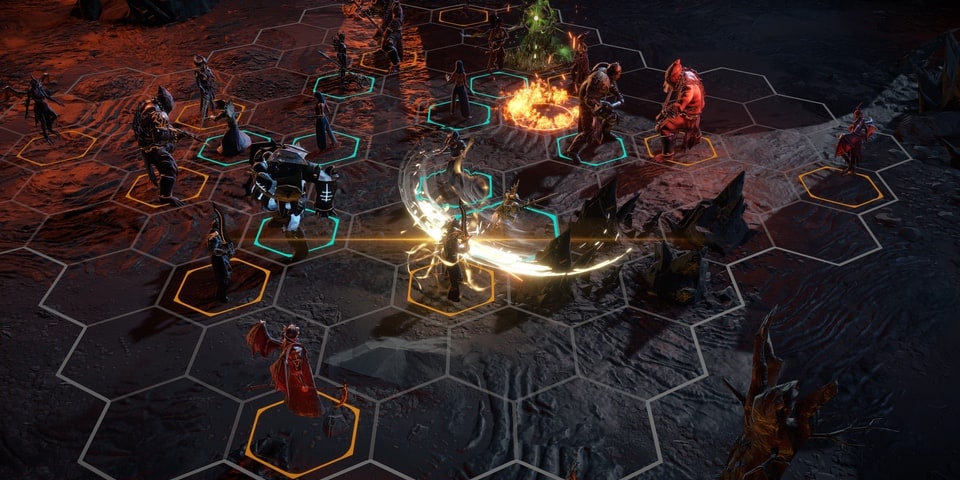
In combat, this is your standard turn based strategising. Each character has a number of action points and corresponding abilities to spend them on, but not using them grants you a health boost, which can be very handy. Enemies aren’t the brightest, it must be said, all too eager to run headlong into the fray and set themselves up for your flanking manoeuvres, but they make up for their lack of brains with brawn. It can take a whole lot of attacks from several of your units to bring down a foe. This issue applies to friend and foe alike; everyone seems to have far too many hit points and takes an absolute age to die, rendering battles slow-paced and rather lethargic, lacking any sense of risk that a beloved character could cark it at any moment with just one wrong choice, such as in the Fire Emblem series.
Still, it’s competent enough battling, with some interesting combos possible, as one character knocks an enemy into another, setting up domino-like damage. Avyanna also has some very cool sounding magical powers at her disposal, such as her necromancer form in which she can summon the dead or suck the life force out of some hapless creature. The problem is that, thanks to the muted visuals, all of these abilities don’t look very interesting, effects are flat and, no matter the unparalleled power of your levelled-up attack, the game fails to embody that in an aesthetically interesting way. Competent then but hardly engaging. We might have begun something of a theme here.

There are a lot of battles to be had over the roughly 35-hour campaign, but they crucially fail to develop beyond what you experience in the first few hours of gameplay. As such, the battles soon become repetitive, and given everyone’s spongey healthbars, are something of a chore to get through. Things only get more interesting when a boss pops up, and whilst these guys provide some nasty difficulty spikes, they do at least break out of staring at the screen, eyes glazed over and with a sense of lethargy creeping over you, just like Avyanna had during her decades long reign.
Speaking of Avyanna, her characterization is inexplicably weak. Despite being a veritable goddess, she is instead portrayed as a whiny teenager, the terrible voice acting imbuing her with all the presence and power of a Kellogg’s Pop Tart – sweet but with no substance. Voice acting across the board is poor, with many characters sounding like they’re on a first read through of the script.
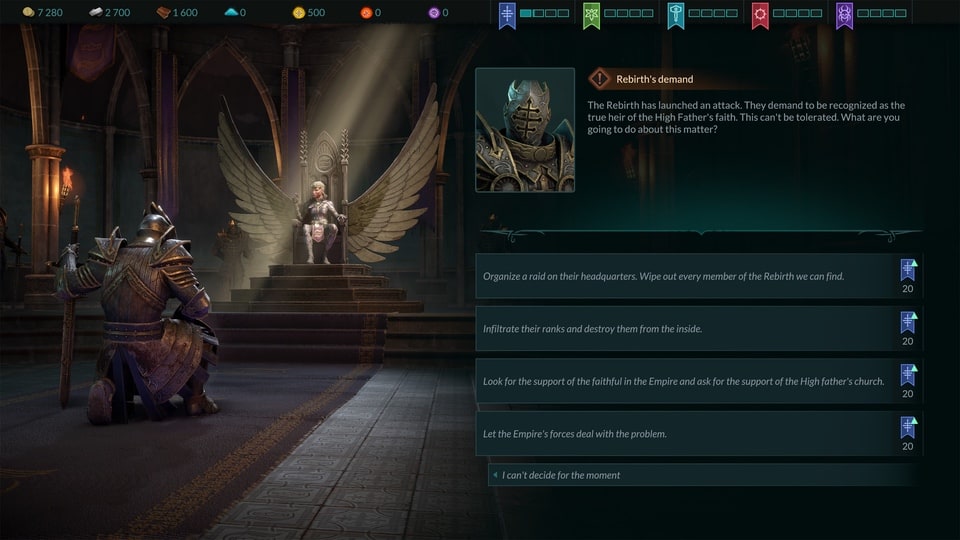
Overall then, we’re looking at a fairly bland strategy RPG with drab characters and uninspired visuals. Things pick up with the throne room, though. Situated in her castle, Avyanna can return here after main quests to receive her people and attempt to solve their dilemmas. These are many, varied, ethically ambiguous, and genuinely intriguing conundrums, asking you to deal with plagues, famines and legal disputes. You’re given a selection of choices to respond with, though no matter what you decide, more often than not, you’ll be naffing off one of the factions of your kingdom. The best choices can be discovered by analysing the issue and then gathering resources in the field to solve the problem. This was by far the most compelling element of the game, and I would put up with countless battles just to capture a mine, gather some gold, and be able to best resolve a problem involving a wild beast rampaging through a village. If only the rest of the game was so compelling, then that would be an RPG worth strategising about.

It’s great to see a review of such a long-standing series! The evolution of games like Disciples is always fascinating, and it’s interesting to hear your perspective on the latest installment. Thanks for sharing your thoughts!