
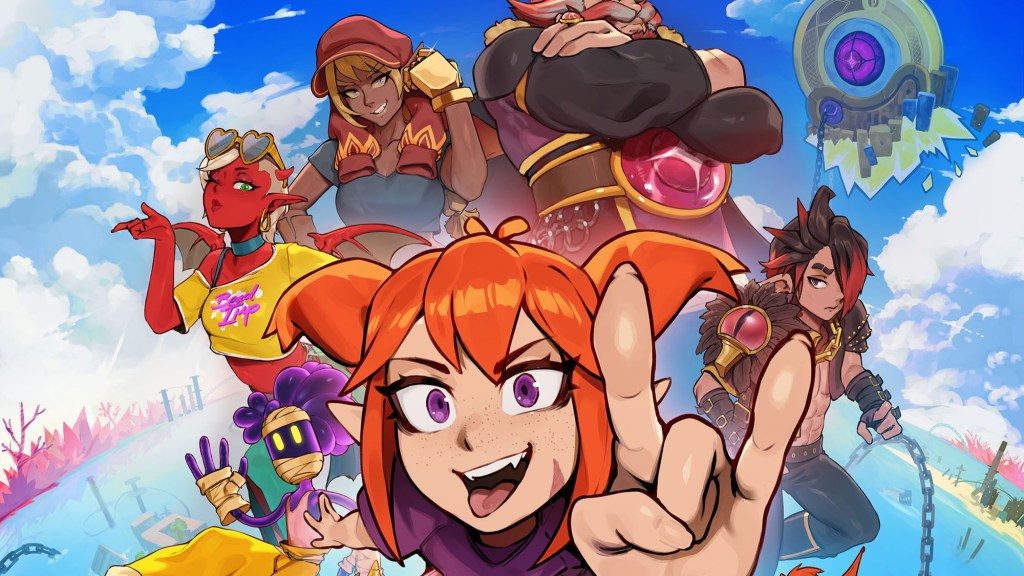

Surfin’ Turf

HIGH Unbelievably good movement mechanics
LOW Lots of little rough edges
WTF The number of penises gamers made with the in-game graffiti mechanic is… sobering
It’s a pleasure to see a sequel to a game that was very good, but flawed – and to then be able to say that sequel is phenomenal. Demon Tides by Fabraz is a joyous explosion of 3D platforming magic and, while the bought-and-sold, synapse-less, concave-witted corporate journalists seem to’ve mostly ignored it, it’ll probably be the easiest recommendation I’ll make all year. Anyone who likes platformers should check this out, like yesterday.
Fabraz is a dev fixated on two things – jumpin’, and collectin’ – and they have been studiously honing their platform skills for years across several titles. The aforementioned very-good-but-flawed title was 2021’s Demon Turf. It took me a few years to get around to it because 3D platforming is a genre which I love but ignore completely until the mood comes over me like a fever – at which point they’re all I play, until I’ve sated my jump-lust and then retreat back into my lair like some sort of Gamer Dracula.
Anyway, I liked Demon Turf a lot — almost loved it — but a not-inconsiderable accretion of frustrations stopped it short of greatness. Fabraz’s been tweaking, expanding, and updating Turf since its release, and has made it clear that it was a special project for them, so a sequel was not a surprising development — but the scale and success of Demon Tides did surprise me.

Demon Tides takes the tight, movement-focused, collectathon gameplay of its predecessor and liberates it from almost all linearity, both in terms of level design and character ability. What we’ve got here is a classic case of MORE. More movement options, more openness, more color, more variety — but it’s also that much rarer thing — a situation where that surfeit is accompanied by quality, and the MORE is also BETTER.
This is an open world platformer, with levels of all sizes designed as islands and spread across the watery reaches of Ragnar’s Rock, an archipelago kingdom. There is a little progression-gating, with each of two later map zones cordoned off until a certain number of Golden Gears – the standard issue Star/Moon/Jiggy/Remote/Hourglass/Gobbo/whatever-the-hell-Glover-gets equivalent – are collected. But other than that, players can go where they want, when they want.
Even more importantly, main character Beebz’s entire moveset is open from minute one. This includes all her abilities from Turf and its mini-sequel Neon Splash (albeit refined) as well as some additional moves like a forward tackle and a downward pound.
I’ve thought long and hard about this, but I think it’s true — Beebz feels better to control than any 3D platformer character, ever. Yes, even that one.
There’s a learning curve to her moveset because she has two branches of possible jump sequences, but once that’s been internalized, it feels like there’s nothing Beebz can’t do – and, no matter what she’s doing, it feels great to do — it’s all so fluid and dynamic and beautiful. Rare is the game that I 100% complete, but I did everything there was to do in Demon Tides simply because I did not want to stop jumping, spinning, gliding, floating, and grappling. If Fabraz released DLC tomorrow, I would grab and play it immediately.

Applying the most exquisite, tasteful layer of complexity to character control is the talisman system. Probably derived from Hollow Knight’s badge mechanic, this was present in Demon Turf but has been completely overhauled and, yes, expanded here.
Beebz can equip a number of talismans (found throughout the world or purchased from her kappa friend Midgi) to tweak her moveset, or even outright expand it. I wasn’t taken by the talismans at first, but by the end of the adventure I was a total convert. For the most part, these are not piddly upgrades. Huge props to Fabraz for not being afraid to give players the ability to make Beebz stupidly overpowered. There’s even an option to maintain different loadouts which can be swapped out on the fly.
Level design doesn’t reach the alpine heights of the movement and controls, but across the board it’s rock-solid, and well above average. Demon Tides is easier than Turf and its challenge tends to hover in the ‘entirely doable’ zone, with an occasional minor spike northward. However, knowing Fabraz’s penchant for making speed-runnable games, I’d guess the real difficulty will come in optimizing routes through the various levels – not something I’m interested in personally, but I’m glad it’s here. The only complaint I have in this department is that there are a handful of islands with very little to do on them: either a just a handful of eyetems (a collectible) or a (sigh…) lore object to touch, triggering a Breath of the Wild-style story memory.

The story, I could take or leave. Demon Turf had a DIY punk-ish aesthetic, like something that would be on Cartoon Network during the heyday of its weirdness in the ’90s. Playing Demon Tides after that is like meeting up with a formerly Goth friend after years apart and discovering they have somehow become profoundly, terminally anime — and not cool anime, but like C-tier Shonen stuff. The vibe is totally different. If we imagine hooking Tides up to a cringe-o-meter, the needle would be oscillating madly right on the line between “neat bad” and “bad bad,” with a slight tendency, maybe, towards the latter.
But nobody comes to platformers for the story, they come to them for joy of play – and Demon Tides is nearly pure mechanical joy. It’s a geyser of creativity and passion that ennobles the genre. There are flaws, but they’re very hard to see from the heights this game reaches the vast majority of the time. Anybody with any interest in jumping and/or collecting should leap, not walk, to the digital storefront.
Score: 9 out of 10
Disclosures: This game is developed and published by Fabraz. It is currently available on PC. This copy of the game was obtained via publisher. Approximately 30 hours of play were devoted to the game, and it was 100% completed (WOW!) There are no multiplayer modes, but there is an indirect, Dark Souls-style message system where players can leave graffiti hints and jokes for other players to see and rate.
Parents: At the time of review this game was not yet rated by the ESRB. By and large this is a kid-friendly game – there is very little combat, and what little there is is no more troubling than in Mario. There are a handful of more mature elements — some of the characters are definitely meant to be sexy and there is some swearing in the (text-based) story scenes. The aforementioned indirect multiplayer message system limits players to certain images, but people have of course figured out how to layer and alter these images to make genitalia, bodily fluids, and words like “cuck.” Funny? Absolutely, but if it bothers you this system can be disabled in the menu.
Colorblind Modes: There are no colorblind modes present.
Deaf & Hard of Hearing Gamers: Dialogue is conveyed mostly in text – characters will sometimes voice the first line or so, but that’s it. The font cannot be resized. There are some timing-based platforming elements, but they are always visually as well as audibly telegraphed. The UI cannot be resized but it is very large and there isn’t a ton to keep track of anyway. As far as I can tell, Demon Tides is fully accessible.
Remappable Controls: The game supports keyboard + mouse and controller – and both are fully remappable.


The post Demon Tides Review appeared first on Gamecritics.com.

Great review! It’s always interesting to see how movement mechanics can really elevate a game. Hopefully, the rough edges will get smoothed out in future updates. Looking forward to more discussions about it!