

Don’t Play TH-15 Game On Switch, Please!

HIGH A wonderfully imaginative narrative undergirding the whole experience.
LOW The narrative (and its key concepts) might be a bit too mysterious at times.
WTF The entire central conceit, I suppose.
I think it speaks to how much I enjoyed playing TR-49 that I’m still feeling positive about it, despite the fact that I couldn’t even beat my review copy because it kept crashing!!!
I had to watch a playthrough on YouTube in order to see the ending cutscene, because every time I tried to input my solution to the final puzzle, TR-49 would freeze, the ambient audio continuing to run until I gave up and closed the program. This cheesed me off, but honestly I was used to dealing with TR-49’s performance hiccups by that point.
Throughout my entire playthrough, TR-49 would freeze about every minute or so (returning to the Switch’s homescreen and then immediately resuming would solve this, fortunately). For many this would be an intolerable inconvenience. But again, it speaks to the degree to which I was enchanted by the process of uncovering TR-49’s secrets that my brain almost edited these moments out of my playing experience. I treated them like the tiniest little gnats drifting around my head — something to be unconsciously swatted away as I continued, in a trance, to solve puzzle after puzzle.

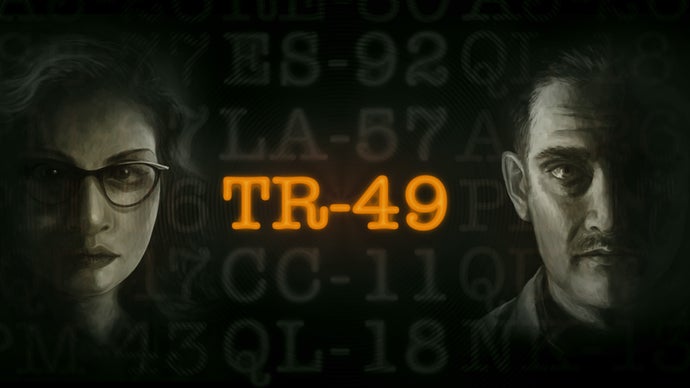
TR-49 encourages this kind of dedicated, captivated play, I think, by cultivating a sense of true mystery and ambiguity from minute one. The story begins immediately upon booting up for the first time (a favorite trick of mine) and dropping the player into a mysterious subterranean laboratory filled with 1940s technology. The player quickly realizes they are a woman named Abbi, who has seemingly awoken with no memory of who they are or what they’re supposed to be doing.
Abbi is quickly contacted through a radio by an equally mysterious figure named Liam, who convinces them that they must use the big machine in the center of the lab. Abbi then approaches the TR-49 console and begins interacting with it. After this point, the entirety of TR-49 takes place within this single, fixed perspective.
The console, the player discovers, is a piece of souped-up WWII technology, once a codebreaking machine. Nowadays, as Liam helpfully explains, it is used to… devour (?) texts of all kinds, from in-universe pamphlets to real-world texts like the Bible or Pride and Prejudice, storing them within the system under codes in a [Letter][Letter]-[Number[Number] format.

At the point where the story begins, the few texts the player has access to seem to be garbled and corrupted, with the majority of entries missing their titles. The player is then prompted to use the information in these files to obtain codes for other files, allowing them to navigate to those pages in the database. They also need to find the names for the documents, which they must assign to the correct document in order to restore them to full legibility.
This sounds a bit dry, doesn’t it? I promise though, TR-49 manages to coax a humongous amount of intrigue and momentum out of its simple loop!
For one thing, it’s helped along greatly by its aesthetic and approach to player feedback. Take the music for instance — a series of beautiful, low-key arrangements. The music offers a sonic palette that feels familiar, but it’s remarkable how it sustains, throughout TR-49’s entire runtime, an incredibly mournful, mysterious atmosphere, yet always feels on the verge of bursting into a massive crescendo. The player is left with the sense, as they browse through the computer and uncover TR-49’s backstory, that they are exploring a world of tragedy on a grand scale, despite the fact that they are glued to a single screen for the entire runtime!

Speaking of backstory, the story (and overall tone) further increased the hold TR-49’s simple gameplay had over me. I wouldn’t dare offend the good people at Inkle by attempting to fully summarize the plot, but I can say confidently that the story takes place in a world where, somehow, the written word has the power to reshape reality itself. This is largely framed as a scientific phenomenon, but it’s given a certain magical quality as well. Specifically, the TR-49 machine hosts a good number of occult treatises and journals, illustrating a long lineage of eccentric, often tragic truth-seekers.
The tension between science and the supernatural, sustained over a long period of time, creates the truly wondrous feeling that anything could happen. Truly, every element of TR-49 combines beautifully to coax the player (or me, at least) to keep deliriously filling out their code sheet, desperate to see what happens next. Even the tiniest aesthetic choices, such as how the machine hesitates slightly after the player inputs a correct code before zooming out and scrolling across dozens of files to access the new document, create a sense of anticipation and release.
In the end, does TR-49 live up to its promise? I mean… mostly!

The majority of the plot’s movement is related to the protagonist coming to realizations about past events, making a critical decision towards the end using the information they’ve learned, and an inattentive player might completely miss some of these revelations. There is some active, external plot movement, but it mainly takes place off-screen, overheard on the radio. TR-49 does a decent job of painting the picture of a world gone mad, flourishing just out of frame, but I couldn’t blame anyone for feeling that external events of the story just don’t feel fleshed out enough. That said, it’s about the journey, not the destination!
Regardless of its eventual end state, TR-49 is a wonderful toy to poke and prod at, and it evokes the feeling of strolling through a computerized graveyard, the voices of the dead drifting across the static.
Score: 7.5 out of 10
Disclosures: this game is developed and published by Inkle. It is currently available on PC, iOS, and Switch. This copy of the game was obtained via publisher and reviewed on the Switch. Approximately 5 hours of play were devoted to the single-player mode, and the game was completed. There are no multiplayer modes.
Parents: According to the ESRB, this game is rated T and contains Language, Mild Violence. The mild violence mentioned in this description is contained to descriptions of violence inflicted on characters, which entirely occurs off-screen.
Colorblind Modes: There are no colorblind modes available.
Deaf & Hard of Hearing Gamers: This game offers subtitles. The subtitles cannot be altered or resized. Subtitles are provided for all dialogue, and all the puzzles are text-related, with no sound cues required for progression. As such, TR-49 is fully accessible.


Remappable Controls: No, this game’s controls are not remappable. Interacting with the machine on Switch is accomplished mainly through holding down ZR, pointing to the letter/number you want to input with the left analog stick, and inputting the value with the A button. L brings up all relevant logs, with R specifically bringing up the list of document titles and possible codes.
The post TR-49 Review appeared first on Gamecritics.com.