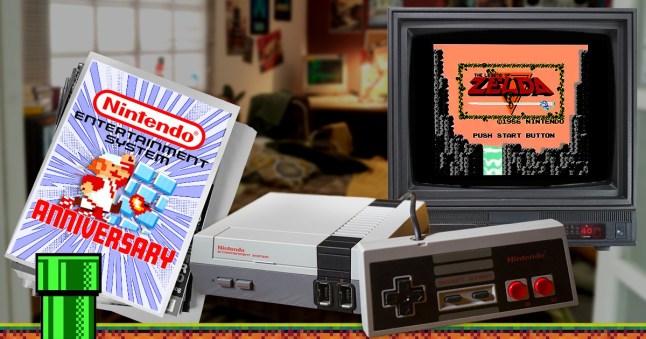


To mark the NES’ 45th anniversary, GameCentral breaks down how, despite the reverence many have for it, it had such little impact on UK gamers.
There’s no denying that the Nintendo Entertainment System, better known as the NES, is very important to the games industry, beyond just being Nintendo’s first traditional home console.
However, if you’re reading this and live in the UK, you very likely have little to no nostalgia for the thing and may not have even played one, if you grew up in the 80s when the NES was new.
So, with the NES turning 45 this year, we want to look back at why the NES left so little cultural impact in the UK, why it’s still so beloved regardless, and how its most iconic franchises have stood the test of time.
When was the NES first released?
The NES originally launched on July 15, 1983, but only in Nintendo’s home country of Japan, where it was called the Family Computer or Famicom for short.
Expert, exclusive gaming analysis
Sign up to the GameCentral newsletter for a unique take on the week in gaming, alongside the latest reviews and more. Delivered to your inbox every Saturday morning.
Nintendo already had experience in the video game space by that point, having released arcade games, including breakthrough hit Donkey Kong, and a Japanese only line-up of consoles with built-in games called the Colour TV-Game.
The NES was extremely successful in Japan and launched in the US two years later, in 1985. That was shortly after the infamous video game crash of 1983, when the North American market had become oversaturated with consoles and extremely low-quality games.
Although the crash was largely irrelevant to the rest of the world, in America it began to look like video games and home consoles would be nothing but a short-lived fad.
The situation was so bad that Nintendo created the R.O.B. robot accessory, so that the whole system and its games would be treated as a toy, and not a video game console, by retailers.
Ultimately, the video game crash was lucky timing for Nintendo, as the NES was able to rejuvenate the American market, with the reputation they earned during that time still serving them well today.
It’s one of the reasons why the NES and its library of games are held up with such reverence to this day. For anyone who grew up gaming in America, in the 80s, the name Nintendo became synonymous with video games themselves and many of its first and third party games became household names.
Many long running franchises got their start on the NES so without it, you not only wouldn’t have Super Mario Bros. or The Legend Of Zelda, but the likes of Final Fantasy and Castlevania as well.
So, how come there’s not as much love for it in the UK? Well, there are number of reasons for that.

Why was the NES not popular in the UK?
For starters, the NES launched in the UK far too late. By the time it arrived in 1987, the NES was five years old (which is the entire lifetime of most consoles, especially back then) and since the UK wasn’t as impacted by the video game crash as the US, there wasn’t a gaming industry in need of saving over here.
Even Continental Europe got the NES a year before the UK, as back then there was no Nintendo of Europe and instead the console was distributed by a hotchpotch of different companies – a situation that didn’t change properly until after the launch of the N64 in 1997.
In 1987, the dominant formats in the UK were the 8-bit ZX Spectrum and Commodore 64 home computers. That same year, the 16-bit Amiga 500, also from Commodore, launched and that seemed far more appealing to most British gamers, with its more advanced graphics and lower-priced games.
The fact that the best NES games were far superior to any home computer title is something most UK gamers never really got to find out for themselves, as beyond playing them in-store or at a rich friend’s house, the fact that the games cost upwards of £50 (almost £150 when adjusted for inflation) made the whole console prohibitively expensive.
At the time, most home computer games cost no more than £15 (£45 adjusted for inflation), with budget titles often as little as £2 (£6 adjusted). And that’s not even taking into account how easy it was to pirate the games – which is a factor games companies prefer to forget when considering the reasons for the success of the original PlayStation and other pre-digital formats.
In the UK, the NES was overshadowed by not just home computers but also the Sega Master System, which launched in the UK the same year and was far more reasonably priced, at around £99 (£295 adjusted), with games that typically cost no more than £30 (£89 adjusted)
The Master System was still only a minor hit in the UK, though, and it wasn’t until the advent of the Sega Mega Drive and SNES that home consoles began to take root, as more powerful IBM-compatible PCs helped squeeze out home computers.
However, the lack of nostalgia for Nintendo, and marketing aimed solely at young children, meant the Mega Drive was far more successful in the UK than the SNES. Sega and Sonic the Hedgehog were for cool kids and Nintendo was for babies – was the argument made in thousands of playgrounds around the UK.
Things didn’t really change until the Wii era, when it and the Nintendo DS began to prove as popular in the UK as anywhere else in the world. But that deep foundation of nostalgia, that is so prominent in North America and Japan, does not exist in Britain, and all because of poor decision making and high prices back in the 80s.
The most iconic NES games
Super Mario Bros.
The original Super Mario Bros. is easily the most influential game from the NES. Mario may have debuted beforehand, in the Donkey Kong arcade game, but Super Mario Bros. made him the superstar he is today and led to what is the biggest gaming franchise in the world.
It also inspired many other 2D platformers, who would crib, if not outright copy, its ideas, including Sonic The Hedgehog. Unlike most NES games it’s also still perfectly playable today, with new 2D Mario games still abiding by its founding principles.
The Legend Of Zelda
Much like Super Mario Bros. was for 2D platformers, The Legend Of Zelda was extremely influential for action adventures, and what would become the action role-playing genre – even though Zelda has always lacked traditional role-playing elements.
Many top-down fantasy action games would come forth from it, and traces of its impact can be felt in modern role-playing games, 2D or otherwise, such as Square Enix’s The Adventures Of Elliot: The Millenium Tales.
Unlike Super Mario Bros., the original Zelda isn’t much fun to play today but it went on to spawn at least three subsequent entries that, at the time, were considered the best video game of all time, with A Link To The Past on the SNES, Ocarina Of Time on the N64 (soon to receive a remake), and Breath Of The Wild on the Switch.
Metroid
Alongside another NES game we’ll get to later, Metroid pioneered the Metroidvania genre, which has belatedly become a mainstay of the indie games market, with blockbusters like Hollow Knight and its sequel, Silksong.
Metroid itself, though, hasn’t aged especially gracefully and is extremely antiquated, with its sequels easily surpassing it. It’s especially not worth revisiting when a full remake exists in the excellent Metroid: Zero Mission.
Plus, while the series itself remains a fan favourite among Nintendo’s audience, Metroid games aren’t the biggest money makers. Metroid Dread is the best-selling entry in the series at 3.07 million copies, which isn’t a lot when compared to other Nintendo properties.
It’s why new Metroid games are so few and far between, although Nintendo may be looking to beef its profile in the Switch 2 era. Not only was Metroid Prime 4: Beyond one of its first releases (although that also sold poorly), but it’s rumoured that there’s at least two more Metroid games in development at the moment.
Castlevania
The other half of the Metroidvania portmanteau, Castlevania had more of a presence on the NES than Metroid, with three games as opposed to one, but all of them have long been outclassed by the later sequels.
Metroid is doing a lot of the heavy lifting in terms of early influences, when it comes to the Metroidvania concept, but Castlevania 2: Simon’s Quest on the NES was an unusually non-linear experience for the time – although the series only became permanently so following the release of 1997’s Symphony Of The Night on the original PlayStation.
Although the wider franchise is viewed as one of Konami’s biggest properties, it has only maintained relevancy through a strange sort of second hand fame, via the Metroidvania name, the Netflix anime shows, and indie homages such as Vampire Survivors and Dead Cells.
Konami itself hasn’t produced a proper new game in over a decade, although for the franchise’s 40th anniversary this year there’s finally going to be a new title called Castlevania: Belmont’s Curse, by Dead Cells co-developer Evil Empire.
Metal Gear
Metal Gear is revered as pioneering stealth mechanics, influencing later stealth games such as Tenchu and Splinter Cell, and incorporating military themes and action elements that were confirmed to be a source of inspiration on the original Gears Of War.
Unlike other games we’ve mentioned so far, though, Metal Gear never launched as a NES exclusive. In fact, by the time it came to the NES in the UK, it had been available on the MSX2 8-bit home computer for two years. The MSX2 was only really popular in Japan though and while it was also ported to the Commodore 64, that didn’t happen until 1990.
It was only with Metal Gear Solid on the original PlayStation that the series went mainstream, and helped make creator Hideo Kojima a household name (depending on what kind of a household you live in), although the NES sequel Snake’s Revenge had nothing to do with Kojima and the sequel he did make was only released on the MSX2.
Nevertheless, except for Snake’s Revenge, all the games are still part of the same continuity as the modern titles, which still reference their characters and events. Although it’s still unclear what future the franchise has without Kojima, as the most recent title was merely a remake of Metal Gear Solid 3.
Kojima now runs his own development studio, working on games like Death Stranding and the upcoming OD, although the game after that is billed as a spiritual successor to Metal Gear, codenamed Physint.
Mega Man
The Mega Man series of 2D action platformers saw no less than six games on the NES, which helped cement it as one of the console’s key third party staples. Although they’re all near enough identical in terms of gameplay and structure, the common consensus is that Mega Man 2 is the best one.
While Mega Man was successful enough to become something of a mascot for Capcom, with numerous sequels and sub-series (like the Mega Man X games on the SNES), its importance within the company has dwindled as the likes of Resident Evil, Monster Hunter, and Street Fighter proved more profitable.
Capcom has pumped out multiple retro compilations of the various sub-series, but actual new games are a rarity, with the last wholly original one being Mega Man 11 in 2018, which rigidly stuck to the usual series formula. There is Mega Man: Dual Override next year but it doesn’t look to be making any big changes either.
Mega Man is perhaps the best example of a NES game which is revered in the US and Japan but has always been very hard to appreciate by those that didn’t grow up with it, especially as it’s never really evolved beyond its original template. Frankly, we’d much prefer to see a new Battle Network game.
Final Fantasy and Dragon Quest
Final Fantasy and Dragon Quest both saw multiple titles during the NES’ lifetime and are the two foundational stones of the Japanese role-playing genre; even though Dragon Quest, which arrived first, was heavily influenced by Western titles such as Ultima and Wizardry.
Once again, there’s far less nostalgia for them in the UK, since the original NES games were never released here. The first mainline Final Fantasy game didn’t arrive in Europe until Final Fantasy 7 in 1997, while the first Dragon Quest game wasn’t until 2006, with PlayStation 2 entry Dragon Quest 8 – although to be fair a lot of Dragon Quest games didn’t make it to North America either, where they were initially called Dragon Warrior.
Japanese role-playing games in general were often not released in Europe during the 80s and 90s, no matter the franchise or publisher. Final Fantasy 7 on the original PlayStation did break down a lot of barriers but the genre has still always been less successful in the UK than almost anywhere else.
The modern popularity of anime has had surprisingly little influence on the genre outside of Japan, with Final Fantasy 14 director Naoki Yoshida recently suggesting that Final Fantasy is struggling to reach new audiences because new games come out far less frequently now than they did during the NES and SNES era.
The longer development cycles of modern games is an intractable problem but, as he points out, it makes it harder for younger players to grow attached to franchises and characters.
This applies to most of the franchises that got their start on the NES, with only Mario and Zelda increasing their reach and popularity over the decades, with other series seeming to prioritise appealing to adults’ nostalgia, rather than attracting new and younger players.
Despite that increasingly narrow focus, the fact remains that many of the biggest franchises today got their first start over 40 years ago, on Nintendo’s little grey box.
Without the NES, the video games industry as we know it literally wouldn’t exist. And yet unless you grew up with it, most of its games are hard to enjoy today. That doesn’t mean it shouldn’t still be celebrated but it’s also important for long-running franchises to accept the need for change, or risk appealing only to an increasingly aged fanbase.

Email gamecentral@metro.co.uk, leave a comment below, follow us on Twitter.
To submit Inbox letters and Reader’s Features more easily, without the need to send an email, just use our Submit Stuff page here.
For more stories like this, check our Gaming page.