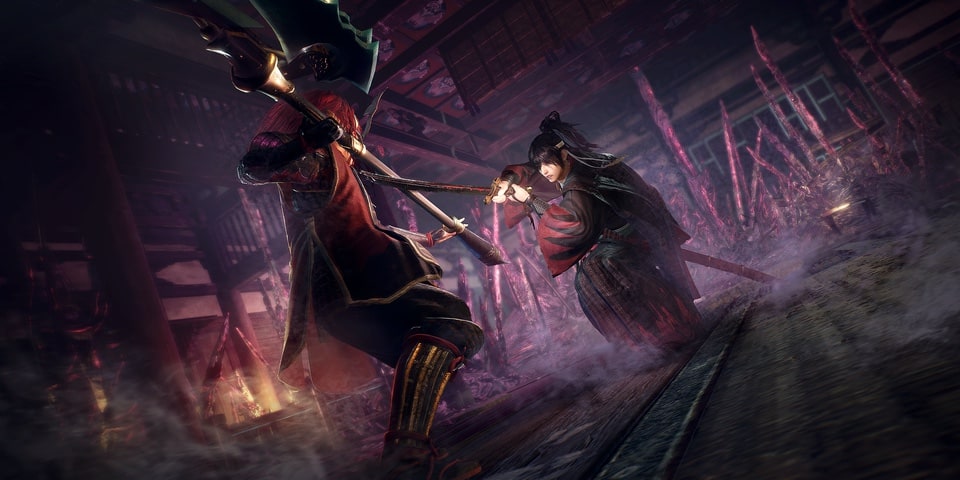

Nioh has been one of my favourite takes on the Soulslike genre ever since the original launched in 2017. Not only does this series have a stellar aesthetic, but you get to enjoy being surrounded by some of the coolest monster designs going (thanks to the Japanese folklore that they’re based on), and the more fluid approach to combat and Diablo-style loot progression means you’re always moving forward and you can dive in deep or just enjoy hitting things. Nioh 2 was substantially better than the first one, and I’m very happy to report that Nioh 3 is substantially better than the second one.
Casting you as Tokugawa Takechiyo, the grandchild of Tokugawa Ieyasu, your goal in Nioh 3 is to save the world from his nefarious brother Tokugawa Kunimatsu, who has upended the natural order of the world. Spanning multiple periods of Japanese history, each has been corrupted by a massive Yokai known as the Crucible, which is drawn to a mineral known as Crucinite and turns people into monster. The actual characters and story are a little derivative, but the writing and spectacle of it all really help cement it as being something very enjoyable. That’s just why you’re fighting though, and frankly it’s how you’re fighting and exploring the world that makes this game so very special.
Where you could always build your character to suit different playstyles in the first two games, Nioh 3 gives you two forms to switch between, with one being Samurai and one being Ninja. These dictate which weapons you can use, along with which special abilities as well. Samurai can still switch stances, as with the previous games, and restore stamina in combat with a well-timed Ki Pulse, while Ninja get access to ninjutsu that recharge as you deal damage to enemies and has an evasive Mist move as a Ki Pulse alternative.

You can build these two styles separately, having Samurai being a tank with low movement speed and the Ninja being a lot faster, but that’s just the most obvious direction to take and there’s more flexibility to choose your own playstyles. There are benefits to both, and the game looks to encourage you to swap back and forth, most notably by letting you can deflect otherwise unblockable attacks by switching between the two with good timing. Oh, and you can just do auto-equip for both as well, where it’ll keep your weapon preferences in mind and then just optimise your armour at different agility levels.
Along with that, you get access to Onmyo magic, which gets stronger if you invest in it. This lets you summon the souls of defeated Yokai to help you, but can also turn them into consumable items that recharge when you pray at a shrine. You can then further go down all of these as you level up by allocating stats, picking skills to take for each form, and more. All of this is an awful lot to deal with, and can feel daunting for the sheer wealth of possibilities, but don’t worry, you can re-spec whenever you want. It makes for a wonderfully flexible system.

When it comes to exploration, instead of going on missions or having a more wide-linear path through the world, you’re now just let loose in an open sandbox set in a particular time period. There are a few of these periods to explore, and each one is split into multiple individual regions which let you pick up buffs the more you explore them. There are multiple areas that feel like individual Nioh missions just put into an open world, and that’s incredibly. There’s something wonderful about just wondering into a cave and finding out it’s a whole adventure all on its own. You even gain new exploration abilities as you go through the game, acting almost like a Metroidvania-style secret system.
The result of all of this is an incredibly expansive game that never feels empty, encourages multiple playstyles and the ability to flit between them at will, and a gorgeous world to explore with some of the coolest boss designs I’ve had the pleasure to fight. It can be a bit silly sometimes, with enemy AI not noticing you assassinating a friend of theirs just a few feat away with lots of loud and squishy noises, but it’s just too much fun for that to be a deal breaker.

On top of all of that, you have the returning ability to play through the whole game in co-op, though I’ve not had a chance to do so prior to release. You can still summon people to help you just for a particular boss battle – either other players or NPC characters – but the idea of running around these massive regions with a friend is one that’s just deeply appealing to me. I’ve been wanting to play another open-world game for a while, and I’d sort of forgotten that’s what Nioh 3 was promising. This game is hitting the spot in every possible way.