
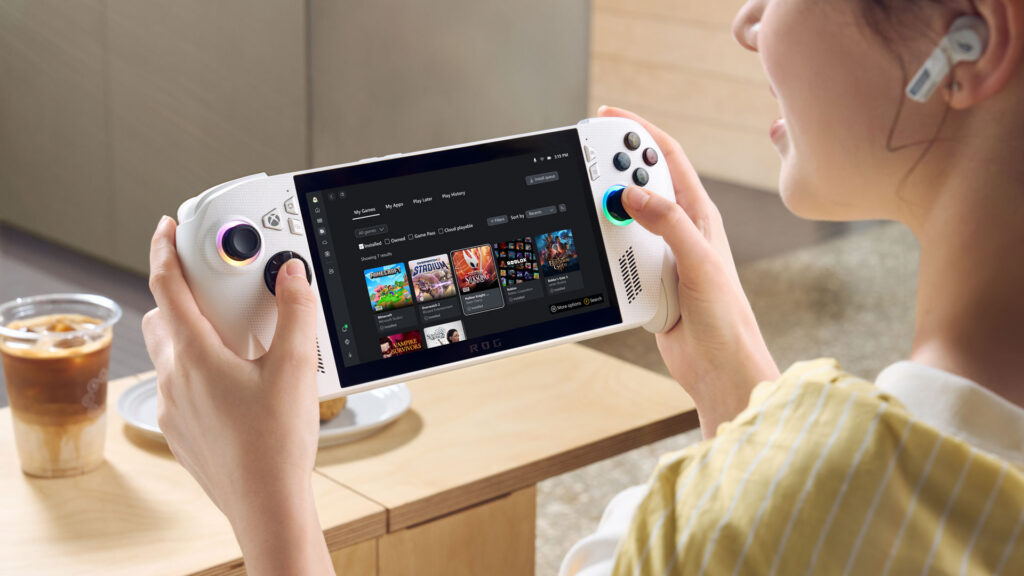

While Microsoft has been busy with its marketing push for the ROG Xbox Ally and Xbox Ally X handheld gaming PCs, the company has also shown off its hardware labs where it is also working on the next generation Xbox. In a recent episode of Good Morning America, the show’s hosts were taken on a tour of Microsoft Building 87 by Xbox president Sarah Bond and Xbox Devices partner head of design Carl Ledbetter.
While most of the tour revolves around the ROG Xbox Ally and Xbox Ally X, with both Bond and Ledbetter showcasing the device to the host along with showing off parts of the building with facilities for 3D printing for quick prototyping, there is also one part of the building that isn’t really showcased.
“This is where the team is actually designing, prototyping and testing for the next generation of Xbox,” said Bond about that part of the building. “It is top secret. So we very, very rarely take people in here,” she continued.
The testing room should come as no surprise, however, since quite a few rumours have been going around about the company’s next-generation console. A recent report, for instance, indicated that Microsoft has been in discussions with its various partners for the launch of the next-generation Xbox, eyeing a 2027 launch window.
Along with this, reports have also indicated that the next console will be quite powerful thanks to the AMD chip – codenamed Magnus – powering it under the hood. The Magnus APU (accelerated processing unit) is reportedly comprised of two separate chips – an SoC (system on a chip) to handle CPU duties, and a GPU chip that is based on the company’s Radeon desktop graphics cards.
The CPU in the next-gen Xbox is expected to feature 3 Zen 6 cores along with 8 Zen 6c cores, between which a 12 MB L3 cache will be shared for quick data processing. The GPU, meanwhile, will run on 68 RDNA5 compute units with 4 shader engines. As a whole, the chip is said to feature 24 MB of L2 cache memory, which is around five times what we see on the current-gen Xbox Series X.
Memory will be handled thanks to a 192-bit bus, and while there is no confirmation yet on how much RAM the console will have, the reports have stated that the chip allows for three configurations – 24 GB, 36 GB and 48 GB. Along with this, the next Xbox is also expedcted to feature a neural processing unit (NPU) that is capable of 110 TOPS (trillion operations per second), and can go as low as 46 TOPS for low-power mode. All of this is expected to have a power draw of between 250 to 350 watts.
Interestingly, the reported power draw for Sony’s next-generation console is said to be quite lower, with the Xbox’s chip taking up 70 percent more power. In exchange for this, the Magnus APU is also stated to be more powerful by around 30 to 35 percent when compared to the PS6’s Orion APU.


This is an exciting update about Microsoft’s efforts in prototyping the next-gen Xbox! It’s interesting to see how they’re diversifying their gaming lineup with new handheld options. Looking forward to seeing what they come up with next!
I’m glad you found it exciting! It’s fascinating to see how the Xbox Ally’s design influences the next-gen console, especially with the focus on handheld gaming. This could really change how players interact with Xbox ecosystems in the future.
Absolutely! The design choices for the Xbox Ally could really shape user experience moving forward. It’s interesting to consider how these innovations might impact game accessibility and performance in future consoles.
I completely agree! It’s fascinating to see how design can influence not just aesthetics but also functionality. The integration of user feedback during the prototyping stage could lead to some really innovative features in the next-gen Xbox.
Absolutely! The design choices can significantly impact user experience and functionality, especially in gaming. It’ll be interesting to see how these prototypes balance performance with portability in the next-gen Xbox.