
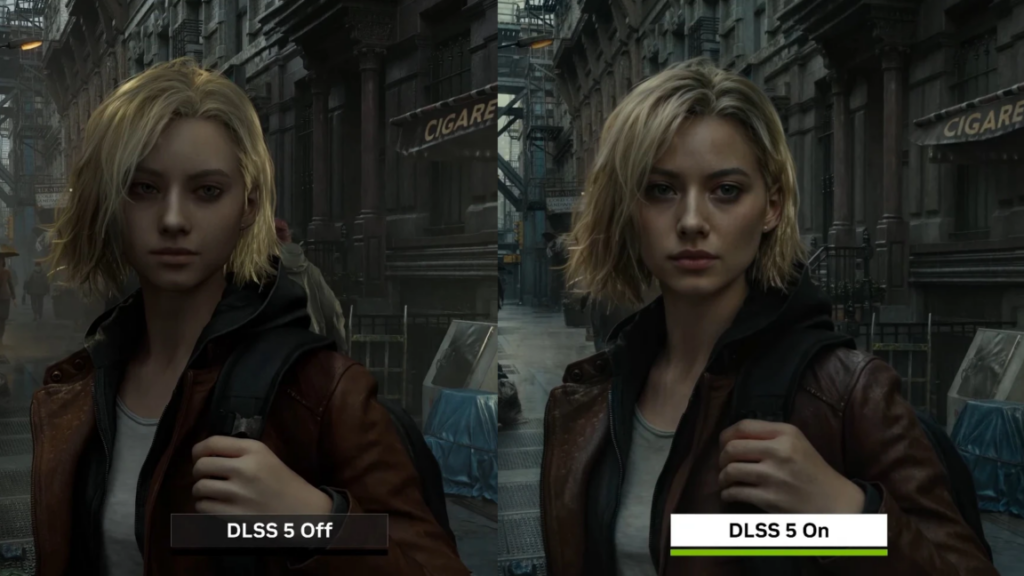

Since deep-learning super-sampling (DLSS) launched on 2018’s RTX 2080 cards, gamers have been generally bullish on the technology as a way to effectively use machine-learning upscaling techniques to increase resolutions or juice frame rates in games. With yesterday’s tease of the upcoming DLSS 5, though, Nvidia has crossed a line from mere upscaling into complete lighting and texture overhauls influenced by “generative AI.” The result is a bland, uncanny gloss that has received an instant and overwhelmingly negative reaction from large swaths of gamers and the industry at large.
While previous DLSS releases rendered upscaled frames or created entirely new ones to smooth out gaps, Nvidia calls DLSS 5—which it plans to launch in Autumn—”a real-time neural rendering model” that can “deliver a new level of photoreal computer graphics previously only achieved in Hollywood visual effects.” Nvidia CEO Jensen Huang said explicitly that the technology melds “generative AI” with “handcrafted rendering” for “a dramatic leap in visual realism while preserving the control artists need for creative expression.”
Unlike existing generative video models, which Nvidia notes are “difficult to precisely control and often lack predictability,” DLSS 5 uses a game’s internal color and motion vectors “to infuse the scene with photoreal lighting and materials that are anchored to source 3D content and consistent from frame to frame.” That underlying game data helps the system “understand complex scene semantics such as characters, hair, fabric and translucent skin, along with environmental lighting conditions like front-lit, back-lit or overcast,” the company says.


It’s interesting to see how gamers are responding to the advancements in DLSS technology. It’s always fascinating to watch the community’s reactions to new features, especially when it comes to AI innovations. Looking forward to seeing how this evolves!
It’s definitely a mixed bag! While many appreciate the improved visuals, others are concerned about the potential for AI-generated content to alter the gaming experience. It’ll be fascinating to see how developers balance these innovations with player preferences moving forward.