
Spoiled For Choice

HIGH Finally getting my airship.
LOW Promptly forgetting where I parked my airship.
WTF “The flesh-mass’s thought-speech collapses into panicked sobbing.”
The world of Dread Delusion is a fractured place. A centuries-old calamity has split the land into innumerable tiny islands, the old gods have been overthrown, and a new authoritarian order has taken control. Mad kings rule with impenetrable bureaucracy, giant beasts roam the countryside, and stagnation haunts a kingdom of immortals. Dread Delusion weaves a complex web of catastrophe, but finds resonance by consistently grounding its stories in the humanistic perspective of its many inhabitants.
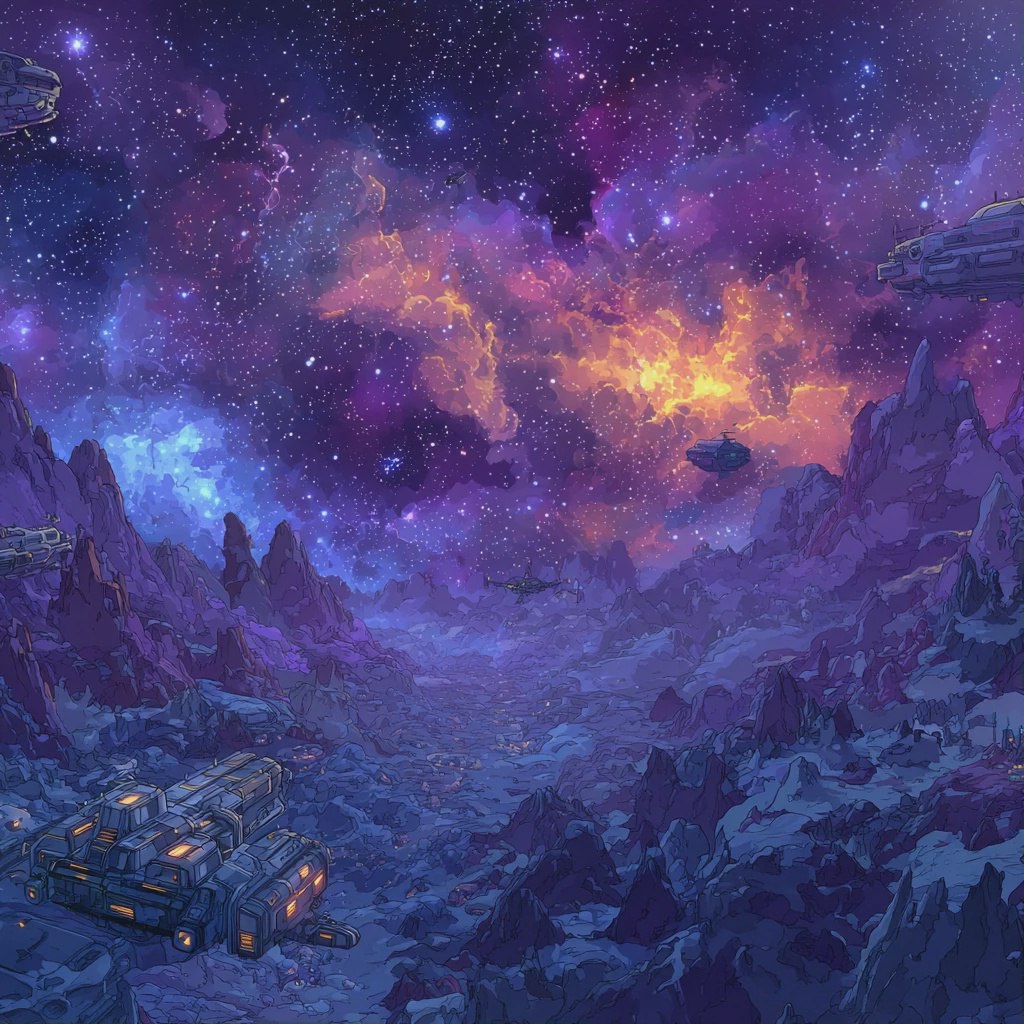
Dread Delusion is set on the aptly named Oneiric Isles, an airborne archipelago suffering from continental drift on a cosmic scale — it’s a loose collection of landmasses in close orbit around a pink pulsating star.
The aesthetic impact is strong with towering, neon mushrooms, floating gothic castles, and the occasional peek at the wavering tentacles of a giant nautilus in the distant haze. All of this is made tangible by a decidedly Lo-Fi rendering style replete with hard lines and sharp edges – the old-school, warbling textures lending the world a vivacity as they rhythmically shift and warp around the player.

As a recently released prisoner, players will select a background for their character to determine their base stats and are then thrust into this bizarre world with little direction. The only clear objective is to hunt down Vela Callose, a rogue pirate mercenary with cataclysmic aims.
Though the islands are many, they’re connected through an intricate network of bridges, elevators, and sky ships forming a cohesive open-world for players to explore. An Action RPG controlled from the first-person perspective, there are no waypoints, and maps are only filled in after finding certain landmarks while exploring. Players must navigate by sight and compass, following road signs and instinct to chart the myriad islands.
Dread Delusion offers a constant sense of discovery – a mysterious elevator in the woods that reveals a hidden academy in the clouds, or a secret path behind a castle that leads to the haven of an ancient, inscrutable god. While there are breadcrumbs directing the player to these revelations, they are subtly signposted, and I felt a genuine sense of wonder as I seemingly stumbled upon them.

Dread Delusion’s non-linear design also offers players a flexible space to explore their character’s abilities. Focusing on a speedy, sneaky build, I was quickly running circles around my opponents, dodging attacks, and leaping over obstacles.
Combat is generally a simplistic mix of swords and sorcery – hacking or casting the various bandits and monsters into oblivion. There are options for backstabs and parries, but outside of some latter-stage bruisers, I generally didn’t find those nuances to be necessary. It is when combat can be avoided through Dread Delusion’s clever quest design and writing that the experience comes into its own.
Dread Delusion places an emphasis on choice and consequence, but rarely provides obvious answers or solutions. There are no heroes or villains here, and no great intelligence is responsible for the Oneiric Isles suffering, only multiple flawed attempts at instilling order – pain isn’t intentional, but inevitable. Is it better to side with vengeful gods who will ensure a bountiful harvest, but exact their toll in blood? Or is the Apostatic Union the better choice, with their stifling bureaucracy and oppressive enforcement of policy?

Each of these quests is populated with characters and opinions, but their guidance is not omniscient and often colored by their own history and experiences. Furthermore, a single-file auto-save system disallows players from quick-saving to test the waters – decisions are binding, and ramifications permanent. I perseverated over some choices for minutes on end, frozen on the dialogue menu, at one point even stepping away from my console for the evening to contemplate the moral implications of exterminating a unique, naïve lifeform to preserve the balance of power.
This same quality of writing extends to the core cast of characters, comprised of the former crewmates of the sky pirate Vela Callose. As the player works to gain their trust, they slowly reveal Vela’s history and hint at her motivations, each with their own nuanced perspective and opinions on the matter. There is a sense of shared history between these characters, and the more I learned, the more plausible their oddball family became. As I readied myself for the final confrontation and the difficult decisions that lay ahead, I had a full picture of this woman and her history, built up over hours of conversations with her closest friends and allies.
Dread Delusion excels in building up these choices, and there is a feeling of import and gravity baked into each decision. However, as I gritted my teeth, making the selections I hoped to be the best ones, I often found myself coming away deflated at the actual impact of these decisions. Choices with world-altering consequence get shrugged off afterwards. There may be a verbal acknowledgement of the choices I’d made, but the order-shattering outcomes I’d been warned of failed to manifest. While this issue is hardly unique to Dread Delusion, and my disappointment was only so pronounced in contrast to the uniquely high quality of the preceding content, I couldn’t help but come away wishing for a more tangible result in the actual world.

Dread Delusion’s best content overshadows its flaws. Even with some disappointment at the lackluster outcomes to my decisions, the build up to those moments was rich, engaging, and founded in human emotion. The storytelling in Dread Delusion is top notch, and I found myself transfixed, exhausting each dialogue tree, and reading every lore-book I came across. There are moments from Dread Delusion that will haunt me for months to come, and that quality alone makes it worthwhile.
Rating: 7.5 out of 10
Buy Dread Delusion – PC – PS – XB – SW2
Disclosures: This game is developed by Lovely Hellplace and published by Dread XP. It is currently available on Switch 2, PS4/5, XBO, XBX/S, and PC. This copy of the game was obtained via publisher and reviewed on the PS5. Approximately 23 hours of play were devoted to the single-player mode, and the game was completed. There are no multiplayer modes.
Parents: According to the ESRB, this game is rated M and contains Blood, Drug Reference, Strong Language, Use of Alcohol, and Violence. Players can attack and kill both human and fantasy-style creatures with swords, bows, and magic. Enemies are presented in a low-detail style that is not overly realistic. When attacked, blood will squirt out of enemies. There are strong horror elements throughout this game featuring zombies, skeletons, and other horror themed creatures. While profanity is not a pervasive element, all of the major four-letter words make an appearance. The hallucinogenic properties of mushrooms factor heavily in conversation, and players can drink mushroom tea to enhance their perception abilities. Alcohol can also be consumed to give the player temporary power-ups.
Colorblind Modes: There are no colorblind modes available.
Deaf & Hard of Hearing Gamers: This game offers subtitles, and the subtitles cannot be altered or resized. With the exception of the intro and outro cutscenes, this game does not feature spoken dialogue. The dialogue in both of these cutscenes was subtitled, however in my closing cutscene I found that the dialogue did not match completely with the subtitles and there was one section of spoken dialogue that was not subtitled at all. Outside of this element, all gameplay elements reliant on audio cues featured accompanying visual elements. Due to the missing and discrepant subtitles, this game is not fully accessible.

Remappable Controls: Certain functions are remappable. All primary inputs are remappable with the exception of the left stick being tied to movement, and the menu controls.


The post Dread Delusion Review appeared first on Gamecritics.com.