

The Way Of The Dragon

HIGH Solid loot and progression.
LOW Bizarre design choices.
WTF Being a “Dragonborn” without being called one.
There’s no shortage of action-role-playing games (ARPGs) like Diablo these days. It seems there’s always a new isometric hack-and-slash title with mountains of loot and a million different build-crafting options. Games like Path of Exile, The Last Epoch and even Warhammer 40,000: Inquisitor – Martyr all feature similar loops, and I find myself dipping in occasionally.
However, the genre’s recent turn to live-service and MMO elements is a turn-off. Seasonal updates, online connection requirements and constant world-changing events have become the norm. While there’s nothing inherently wrong with these things as concepts, relying on them can sometimes mean that a game feels incomplete if the online hamster wheel is taken away.
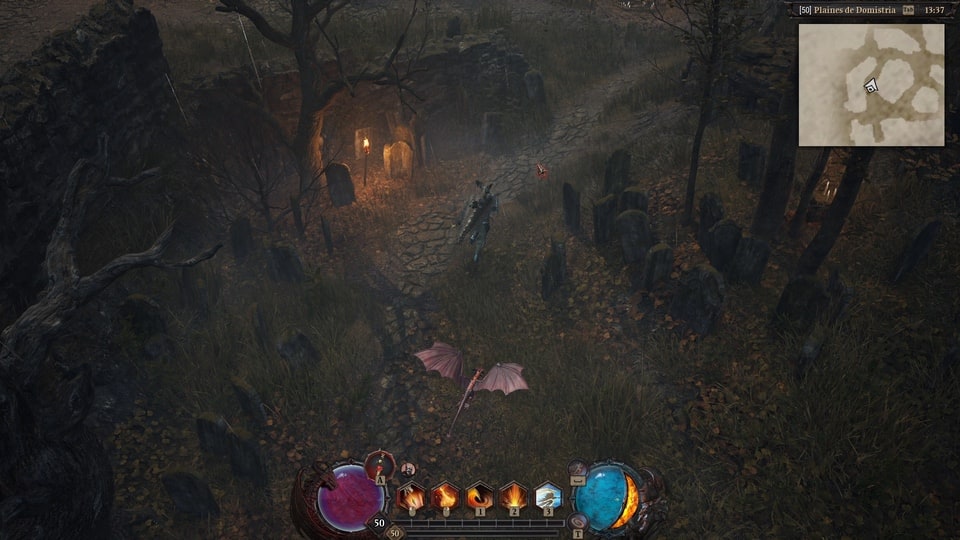
Dragonkin: The Banished feels like the perfect remedy for that fatigue. Developed by EKO Software (developers of ARPG Warhammer: Chaosbane), this isometric actioner sees players control one of four classes — Barbarian, Oracle, Knight, and Tracker. Each has different proficiencies, strengths and weaknesses and serve a variety of playstyles. I stuck with the Tracker, as she was mostly range-based, with a healthy mix of knife attacks and traps along the way.

Combat is a fast-paced, real-time affair as players mow through waves of enemies. Players use different abilities, some on a cooldown, to fight multiple foes at once as they travel through different areas across a segmented map. While not truly open world, each area is fairly large, allowing for plenty of exploration and opportunities to grind for XP.
Combat is deceptively simple, but the way character building works is unique. Rather than dumping points into predetermined tracks, players pick skills up like loot or earn them after completing quests. Skills are then slotted into a hexagonal grid. Each skill slot is pre-attached to a slight enhancement, taking allowing for different combinations.
For example, I had picked up an ability that allowed my Tracker to shoot a barrage of arrows, and I attached it to a slight speed buff. As I kept building up the grid, I found other cool combinations and would constantly juggle between what was worth keeping and what I should toss. There’s also regular loot, like armor and different weapons, but dropping skills the same way that loot is dropped is a fascinating and engaging way to help build out a character, allowing for plenty of experimentation. I eventually crafted my character around poison-based attacks and rapid knife slashes, allowing me to clear crowds fast thanks to a lingering poison effect.

Another cool addition not typically seen in the ARPG genre are settlement/building mechanics. Here, players can build additions to the hub world, adding things like shops or training grounds to refine their skills. As they progress through the campaign, they unlock even more additions to their home base.
While the game has online co-op, I do appreciate how well it works offline. There’s no need for a persistent internet connection and I’m not pressured to consistently check in for any seasonal resets that may occur. It feels like a complete package that allows me to play at my own pace in a way that harkens back to action games from past generations. It’s refreshing, and while I do sometimes find myself stuck in the online hamster wheel with things like Destiny 2, I enjoyed Dragonkin‘s quasi-unplugged approach.
Unfortunately, the story and voice acting range from boring to downright awful, and they’re so bad that they legitimately hold Dragonkin back from being one of the genre’s best. The player characters are tasked with fighting invading dragons, but the narrative feels like a mishmash of dark fantasy elements delivered in an inconsistent tone. The voice work is laughable, and almost requires the game to be played on mute — which I did. Those who want to enjoy the grind while listening to an audiobook or podcast will find this a great choice.

Also, there’s a bizarre design choice involving the difficulty options. I normally play loot-based games on harder difficulties, as it generally means players get the best possible loot. The only way to change the difficulty here, however, involves visiting an NPC at the home base. Why this wasn’t a menu option is beyond me, but it makes the experience more convoluted than it needed to be.
Those looking for a simple-yet-effective grind and not bothered by bad voice acting will enjoy Dragonkin: The Banished. It doesn’t attempt to rewrite the ARPG, but it provides a solid loop with a novel approach to skill-building that serves as an antidote to the terminally-online titans of the genre.
RATING: 7 out of 10
Buy Dragonkin: The Banished– PC – PS – XB
Disclosures: This game is published by NACON SA and developed by EKO Software. It is available on PC, XBX/S, and PS5. This copy was obtained via publisher and was reviewed on PS5. Approximately 10 hours were spent across the single-player. There is multiplayer but it was not played for this review. The game was not completed.
Parents: According to the ESRB, this game is rated T for Blood and Violence. According to the site: This is an action role-playing game in which players assume the roles of heroes attempting to find and defeat the Dragon Lords. From a ¾-overhead perspective, players explore environments, interact with characters, complete quests, and battle human and fantastical enemies (e.g., dragons, bandits, beasts). Players use spears, hammers, axes, bows, and magic to kill enemies in fast-paced combat. Battles are accompanied by impact sounds and blood-splatter effects. Some environments depict bloodstains and corpses on the ground. Cutscenes depict further instances of violence and/or blood: a character stabbed; an arrow striking a dragon’s head.
Colorblind Modes: Colorblind modes are present in the options menu.
Deaf and Hard of Hearing Gamers: There are plenty of visual cues during gameplay, in the form of markers and map icons, as well as camera positioning. All of these can be adjusted in the menu. Subtitles are present and can be resized. As no audio cues are needed for gameplay, I’d say this is fully accessible.


Remappable Controls: The controls cannot be remapped but there are two presets.

The post Dragonkin: The Banished Review appeared first on Gamecritics.com.