
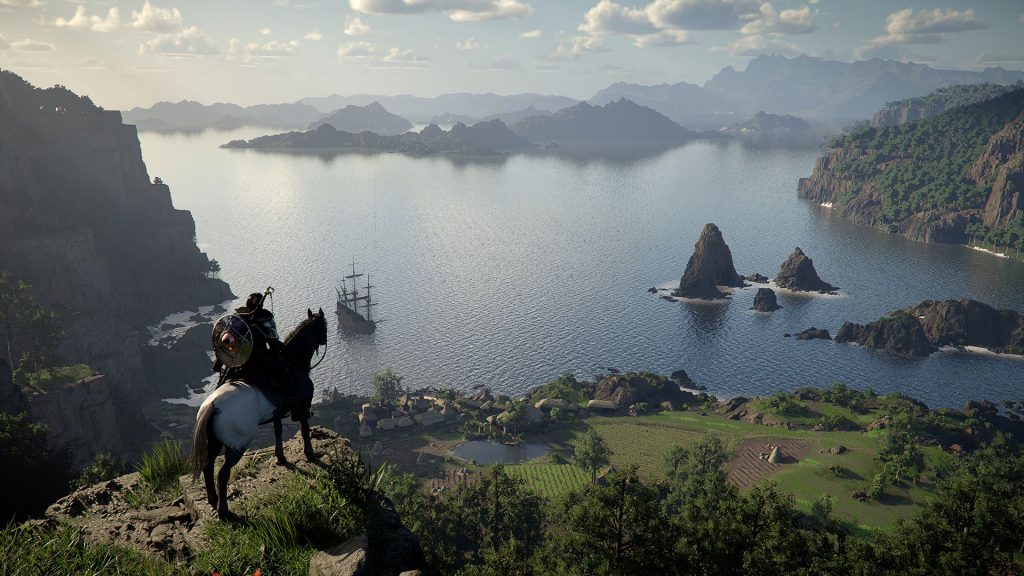

While the days of AAA games costing a set, one-and-done price are becoming rarer, not every modern blockbuster comes with a battle pass attached. Big-budget, single player experiences still exist, arriving whole, self-contained, and fully-functional. Recent games like Ghost of Yōtei prove that premium offerings are still very much alive. Yet, Crimson Desert, with its colossal open world, smorgasbord of mechanics, and striking fidelity, feels a little too good to be true. If it’s a simple $70 transaction for all this stuff, then what’s the catch?
Rightly or wrongly, it’s often too easy to feel jaded. The developers of this new, medieval timesink, has explicitly positioned Crimson Desert as a bountiful single-transaction game, with no microtransactions or monetised progression loops to be seen. But, as we’ve just alluded to, this doesn’t make it unique. No, the difference is in who makes this promise. Stepping in, the developer’s Marketing and PR Lead Will Powers has been explicit: Crimson Desert is not a platform for extra spending, but an immersive world for you to enjoy your time in.
But look – the more this developer underlines their single-purchase pledge, the more scrutiny they invite. They’re working for our trust, but they won’t earn it just by selling an open world replete with features. Instead, it’ll come through clear and transparent communication.
To assure you that Crimson Desert will arrive optimised, the game is launching March 19th to PS5, Xbox Series X|S, PC, and Mac simultaneously, with review embargos being lifted twenty-four hours earlier. Also, throughout development, the developer has emphasised a human-first philosophy in their craft; key vocal performances aren’t AI generated, for instance. Admittedly, this intimation is subtle, but at a time when AI-generated assets are becoming more common throughout the industry, and a growing flashpoint among communities too, it feels crucial for the developer to point it out. It’s not about flaming developers who are adopting AI into their workflow, but using the topic’s presence to help us best understand their working culture.
But here’s the other thing – a one-and-done purchase isn’t just a strategy to satisfy players who are burned out by microtransactions. No, premium price tags come with greater expectations too. If there’s no long-tail monetisation, this open world must feel complete on day one. Side content can’t exist to drive your daily log-in, nor mission rewards to funnel you toward buying cosmetics. Every part of Crimson Desert has to justify itself within a cohesive whole.
From previews, Crimson Desert’s continent of Pywel is shown to be built around systemic interplay, where every mechanic from traversal and combat, to its weather cycles and narrative consequences collide to create emergent moments. Other open worlds eschew rigid checklists for self-curation too, of course, as the genre moves away from the bland Assassin’s Creed tower formula, but Crimson Desert’s inferred interconnectedness still stands as relatively unique in the space. For example, while it’s drawn heavy comparisons to Dragon’s Dogma 2 this is mostly aesthetic. Really, the developer is bringing something more in line with Breath of the Wild.
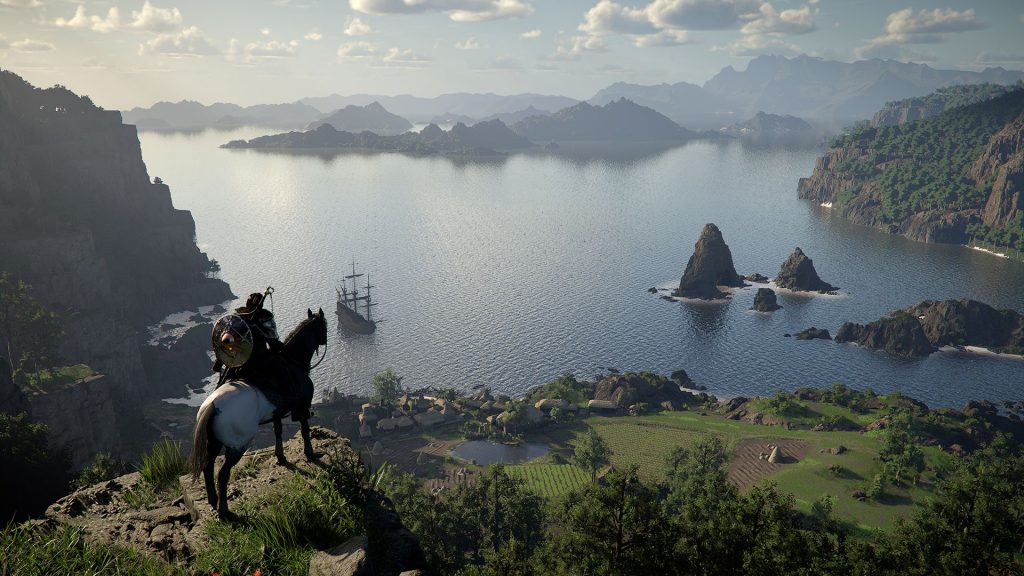
Even from a technical standpoint, the developer’s pledge for trust aligns. When Digital Foundry couldn’t attend a preview event, the developer provided bespoke PC footage – with slow moving panoramas at a locked 60fps – and detailed hardware specs. DF doesn’t typically produce preview coverage, so their interest alone reflects the developer’s confidence in their game’s performance, particularly on PC. As evidenced in DF’s report, the game engine is capable of producing some striking photorealism. The tech allows for some solid art direction too; night-time’s sparse lighting leans boldly into middle-ages blackness, for instance, where flames mark a solitary glow, creating a gloomy and mysterious atmosphere.
Digital Foundry’s writeup might reinforce trust, but it works both ways too. Post-release fixes can’t be ruled out for every player, especially if you’re on console. While PC performance looks stellar, console footage has been more curated (although Will Powers confirms in an interview with XboxEra that Sony’s State of Play footage was captured on a PS5 Pro).
Still, until we see more uncut console footage, there’s the perception the developer still has trust to build. However, there is a counter argument here. The fact Sony offered platform exclusivity – which the developer rejected – at least suggests they were internally impressed, and that, maybe, the Japanese giant has had some involvement during development. Will Powers is on record again confirming PS5 Pro enhancements are coming day one, with the final couple of months development time focused squarely on optimisation across all platforms.
Reports that it has gone gold, alongside consistent and transparent communication surrounding delays has helped stabilise any concerns. Backtracking to PlayStation, the community sentiment at PS-focused outlet Push Square seems to be of cautious optimism. Even without raw PS5 footage, there’s faith in the game that likely stems from its open and honest marketing. Indeed, research suggests that the developer framing postponements as opportunities for polish has strengthened consumer confidence precisely because they’ve communicated cleanly.
Diverting from emotional contracts and consumer psychology now, none of this matters if the game’s systemic open world doesn’t deliver. Set across a vast and seamless continent comprising five distinct, culturally diverse countries, Crimson Desert is a single player, action-adventure where you play as Kliff. As a warrior embarking on a mission to reunite the scattered allies of the recently ransacked Greymanes – the defending clan of the region of Pelun – you’ll soon become embroiled in a broader political crisis that ensues amidst a power vacuum.
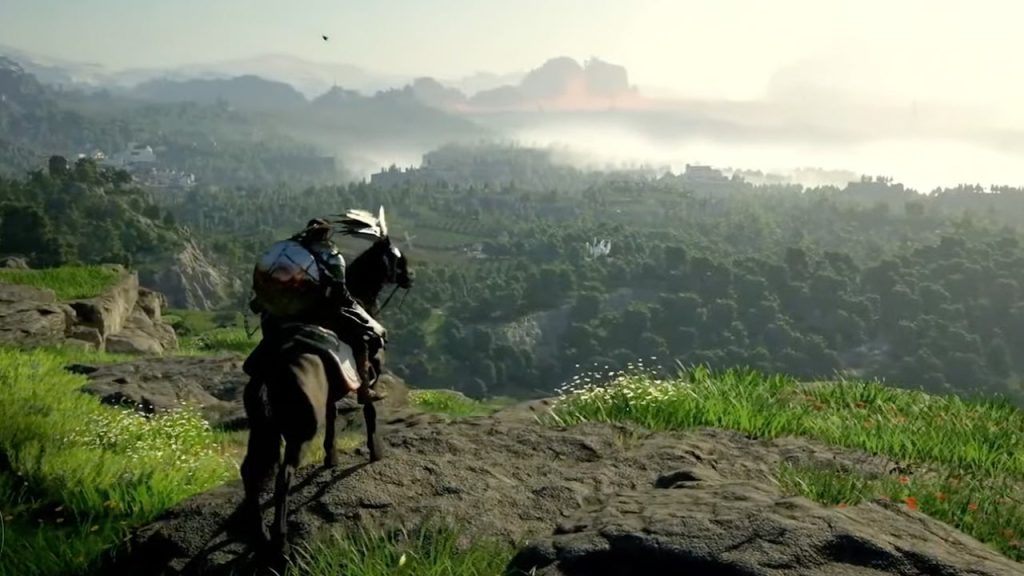
That’s the narrative throughline, but the developer has been vocal in confirming that there isn’t an apocalyptic pull that compels you to be urgent. Instead, distraction is encouraged. Sure, you can push the story forward, but anything from explorative detours, mundane chores, resource harvesting, or pocket skirmishes, to simply appreciating the view are all equally viable ways to stretch time. We mentioned it in our “15 Things I Can’t Wait To Do” feature, but the wonderfully tactile pickaxe mining animations indicate that the developer has placed meaning into whatever activity takes your fancy. The result? Crimson Desert is all the better because its world doesn’t shy away from stillness. After all, that’s where true believability lies.
It’s tempting to accuse developer of masking their monetization intentions, but that’s not accurate. Internally, the developer has an exclusive team working entirely on Crimson Desert. It started life as an MMO, but evolved throughout development into a standalone single-player. This pivot suggests a recognition that there is still an enormous appetite for self-contained experiences, and the developer pushing for a prestige single player title shouldn’t be viewed with scepticism.
The developer has been assuring us for some time that one payment will unlock the full experience. Our trepidation isn’t because every AAA game is predatory – indeed, many aren’t – but because brand history shapes perception (although too many broken games shipping with backtracked promises unstandably feeds this cynicism). If Crimson Desert lands, it might be remembered for more than just awestriking visuals or interlinked gameplay mechanics. It’ll prove that completeness can still be a headline feature.
Note: The views expressed in this article are those of the author and do not necessarily represent the views of, and should not be attributed to, GamingBolt as an organization.


This post offers an interesting perspective on the evolving landscape of AAA games. It’s refreshing to see a focus on building trust with players rather than just showcasing features. Looking forward to seeing how this approach unfolds in future titles!
I agree, it’s definitely a refreshing take! The emphasis on trust over just flashy features highlights a shift towards building long-term relationships with players, which could really reshape how we engage with these games. It’ll be interesting to see if more developers follow suit.