
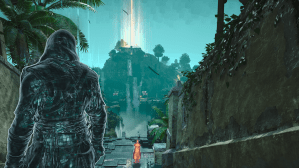

Assassin’s Creed Black Flag Resynced isn’t just a remake of the sixth mainline game in Ubisoft’s historical fantasy action-adventure series: It’s a sequel. And, surprisingly, it’s not a sequel to Assassin’s Creed III like the original Black Flag was back in 2013. Instead, Resynced is a sequel to 2025’s Assassin’s Creed Shadows. Bizarrely, however, Resynced hides this fun little tidbit away. And that’s a shame, because I really like how Resynced continues Shadows’ story.
I shouldn’t be surprised that Resynced is a sequel to Shadows. Chronologically, their historical stories take place back-to-back. Shadows takes place after the events of the Ezio trilogy–Yasuke even speaks with a priest about the events of Assassin’s Creed II and Brotherhood, and Ezio’s effects on Italy and Europe at large. In Assassin’s Creed’s timeline, the events of the Kenway Saga follow that of the Ezio trilogy, and even though Assassin’s Creed III is the first of the Kenway Saga games to come out, Black Flag is the first chronologically–it follows the events of Edward Kenway, grandfather of Assassin’s Creed III’s Connor Kenway.
Also, as we noted two weeks ago, Assassin’s Creed Shadows’ final DLC is a direct lead-in to the events of Black Flag, implying that Shadows’ Naoe and Yasuke had a big part in giving the Assassins an early advantage in the West Indies, especially in terms of knowing to start looking for the Observatory. With hindsight, it makes perfect sense that Shadows should lead into Resynced.
Which makes it all the weirder that Resynced basically hides that it’s a sequel.
For one, when you first boot up Resynced, it plays the exact same intro that plays when you first start Shadows. It welcomes you to the Animus, while hinting that you’re being lied to and should seek out the truth within the simulation you’re experiencing. When it played at the start of Resynced, I figured that meant that time in the Assassin’s Creed universe had not progressed forward. That, narratively, the Animus users in Resynced’s present day were opening their simulations in-line with the users who had booted into Shadows.

However, if you take the time to find four rifts scattered around the Caribbean, it’s clear that this game takes place after the events of Shadows. In Shadows, your avatar is occasionally pulled into a space between the simulated memories of Naoe and Yasuke, where you interact with mysterious figures known as the Guide and Ego. The former believes that humanity should have a right to choose, while the latter has a darker outlook and wants to use artificially generated content to brainwash society into following Ego’s leadership.
There’s more to discover if you want–namely that the Guide and Ego are two warring sides of the same artificial intelligence that was created by the Templars in the modern day, and it’s using the simulated memories of Naoe and Yasuke and your reaction to it to determine which line of thought to pursue. However, the main plot points involving the Guide and Ego, as well as a helpful individual known as Eagle, are mandatory parts of Shadows’ story. You don’t exit the Animus entirely to play through these modern-day elements like you did in previous Assassin’s Creed games, but you are forced to exit the simulation of Naoe and Yasuke to get enough context for what’s going on.

Resynced continues this narrative thread, as Ego uses four rifts to test your conviction when it comes to wanting free will and presenting you with simulated realities that are designed to make you feel like giving away all your rights to an artificial intelligence is the best path forward. But unlike Shadows, none of these moments are mandatory to progress the story. You can easily skip them, and if you don’t know to look for them, you might not even know that they’re there.
Presumably, the philosophy here is that those who want more of this storyline will instinctively know to search it out, while those who don’t care about the present-day narrative elements can easily pass this by.

This feels like a lost opportunity, though. The rifts in Shadows provided the narrative framing for its story, and by extension the rifts in Resynced do the same for it. It’s a stronger story with them there, and making it possible for players to miss all of them and not know that Resynced is actually building on the storylines of another game feels like a misstep–especially considering how well the two work back-to-back.
The modern-day storyline of Shadows dealt with ignorance, and how choosing to ignore the problems around you does not protect you and those you care about. It was a fascinating framing for Shadows, as Naoe and Yasuke’s stories took place during a time when Japan was largely cut off from the rest of the world, which within Assassin’s Creed’s historical fantasy made the country especially susceptible to the machinations of the Templars. Naoe and Yasuke learn that concerning yourself only with your own immediate spot in the world is dangerous, and that rebelling against the status quo and ignorance is a duty.

That leads perfectly into Resynced, which follows Edward Kenway’s rebellious life. He fights against the desires of his wife, he fights against England’s crown as a pirate, he fights against his role in life by chasing wealth, and he fights against the philosophy of the Assassins–his existence is rebellion. And the modern-day storyline in Resynced frames Edward’s actions (as well as those of the pirates around him) to spell out a warning that rebelling against the status quo and ignorance can be dangerous and that you shouldn’t do it. Now, obviously, Ego is wrong. But with this framing, it makes Resynced feel almost like a rebuttal to the Guide’s philosophy in Shadows.
I assume the next Assassin’s Creed, Project Hexe, will act as the tiebreaker so to speak between Shadows and Resynced, creating a trilogy of games that deal with two artificial minds battling to convince Animus users whether the Assassin or Templar doctrine is the better path forward. If that’s the case, the problem now is that a lot of fans will only have half of the argument (and that’s assuming they played Shadows from start to finish). Because so much of Ego’s side is optional thanks to how Resynced seems to keep the modern-day plotline a secret, it’s difficult to see how Ubisoft plans to try to continue this story in some way that ensures the fanbase is completely caught up.
If the plan was for Resynced to always have been a sequel to Shadows, I would have liked for the remake to commit to that. Since Resynced is a full on remake and not a mere visual remaster, you can have Edward learn about Naoe and Yasuke’s contributions from the Assassins (and better yet–those of Kassandra as well!), and ensure the modern day framing is more prominent and connected to more recent games in the franchise. There’s no need to secret away Resynced’s connection to the franchise, when the game is made so much stronger when you know it’s as a sequel to Shadows.