

It’s always a pleasure to write about Frostpunk, but I’m glum that Frostpunk has boarded the Great Videogame Remaking Train. I don’t think the original Frostpunk is beyond improvement, but I do find it very complete. Chilly finitude, obsessive symmetry are its narrative ethos and aesthetic. It’s a three-act story in a genre that tends to be exhaustingly open-ended. Its dramatic stakes are stark and inescapable – who and what will you sacrifice so that everybody else can survive? In place of the hopelessly indulgent, always-extendable gridiron of SimCity it gives you an Omelasian foxhole, with construction rigorously defined by distance from the coal burner at the heart. The Last City’s inner configuration may vary, but it must describe a perfect circle, because it has to dissipate heat evenly against the apocalyptic winter. It can’t afford to sprawl.
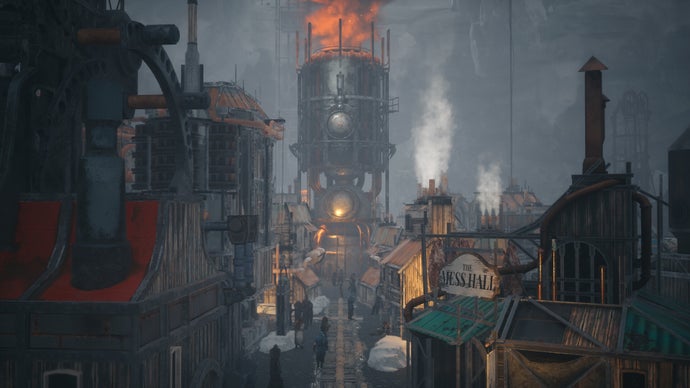
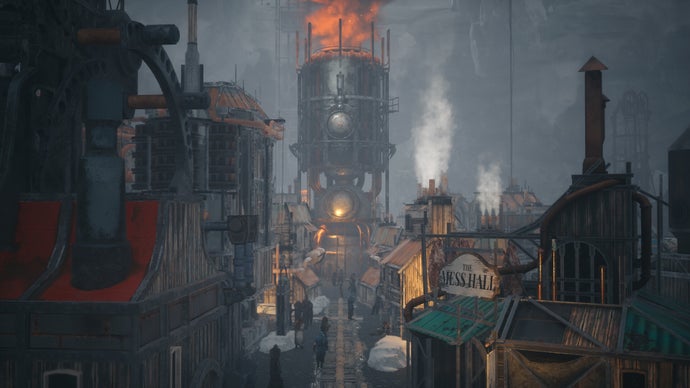
But sprawl Frostpunk has – firstly in the form of DLC expansions, and then in the shape of Frostpunk 2: a looser, fragmented game of expansionism, bickering council members, tangled ideologies, and petrol politics. And now here’s Frostpunk: 1886, an Unreal Engine “remake plus plus”, as game director Maciej Sułecki puts it, in a sector saturated with boutique revivals, some of them landing a handful of years after the original game – a forcing of embryonic nostalgia, huffing on embers, that suggests an industry running out of fuel, giving itself over to cycles of regeneration.
Still, perhaps I’m being too gloomy. I’m definitely being melodramatic. As you’d expect, Sułecki has a more hopeful analysis.