

Mankind is on the brink of survival in Tides of Tomorrow. Not only has the world flooded, forcing the final few hundred thousand people to live on ramshackle ocean platforms, but this is a plastic-fuelled ecological crisis that has seeped its way into our bodies. Thankfully there’s the Tidewalkers, mysterious people dredged up from the oceans with the ability to see into the past and potentially shape the future of the world.
Tides of Tomorrow takes the game takes the very real situation we face with microplastics and twists it into the strange plague of Plastemia, an affliction that sees plasticky patches start to grow on people’s skin, gives them body-wracking attacks as their lungs are affected, and eventually turns them into plastic statues, like some kind of fast fashion Medusa. Even the Tidewalkers are cursed by this affliction, meaning that you too are invested in finding and inhaling the limited supplies of Ozen that are left in the world.

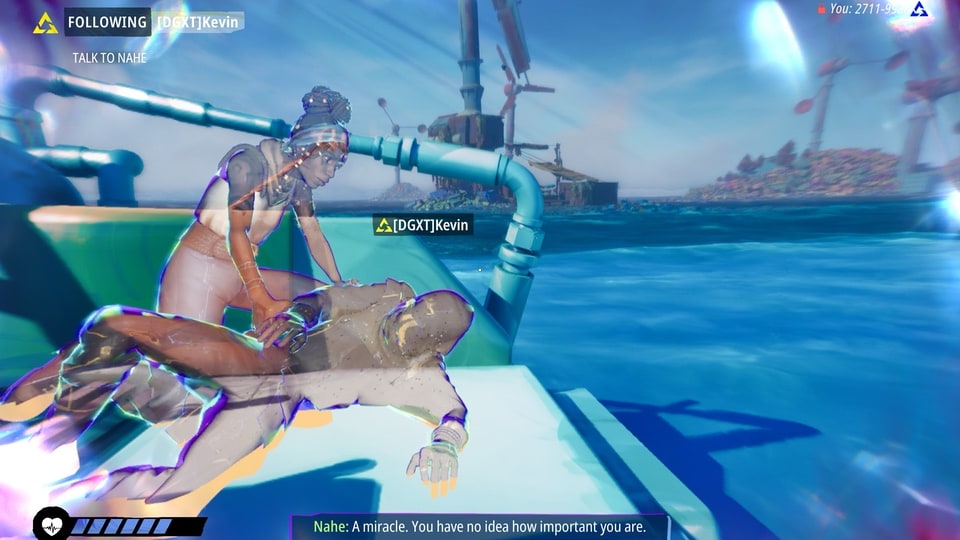
But you have bigger problems at the start of the game, namely that you wake up deep underwater. Struggling to reach the surface, you’re just about rescued by Nahe, who’s trawling for scrap in her boat. That’s when the first vision hits you. An out-of-body experience as a spectral version of Nahe talks to someone who looks just like you, but… she says something different in this vision to what she just said to you. Turns out you’re not the only Tidewalker, and you’re not even the first that she’s found and pulled out of the water this day.
And here comes your first decision. Wracked by a Plastemia attack, she offered me a canister of Ozen, but noted that it’s her last one, and she won’t have any left for the next Tidewalker that she finds. Do you take it for yourself? Or do you leave it behind? Any player that follows in your footsteps will have this possibility affected by your choice.

It’s an effective way of demonstrating the cause and effect that plays out through the rest of the game. While you can view the actions of the player that came before you, this isn’t really like watching ghosts of previous players in Dark Souls. Lesser visions might show how they ran around the world and grabbed piles of scrap and other collectables, and you might find these yourself as well, but for all of the character interactions and decision points, it’s more of a view to the past and what caused the world to adapt to their actions. Is the marketplace locked down by guards? It’s because the player you’re following caused a ruckus or stole from the mob boss. Is a bridge broken? It’s likely because the last player walked across its rickety structure and splintered its foundations.
However, knowledge of the past is useful, because you’re interacting with people who have just experienced it. At a door to a club, you’re confronted by needing to mention he name of someone who might welcome you in. Will Nahe’s name carry enough clout? Or should you mention Eyla who you’re trying to find inside? Perhaps, seeing the vision of the previous player talking their way inside, you can mention them instead? That’s just one of dozens of direct interactions I had in the opening few areas of the game, all of which have been woven together and layers in a fascinating fashion.

The game isn’t limited to dialogue and decision-making, but can also incorporate some stealth and combat. The stealth – needing to sneak through a guard-filled marketplace to reach a resistance cell – was a fairly basic case of staying out of the red cones emitted by the guard’s lights, and when I was caught after bumping into some gas canisters, it simply reset me to the start for another try. It’s best to think of this as more of a first person puzzle to solve as part of the story you’re weaving, as opposed to being on a par with a Splinter Cell.
Face-to-face confrontations were resolved for me as a decision point – run away or stay and fight and then see what happens – while actual game combat was instead about piloting your stolen boat on the high seas. After completing the story of a particular area, you head back out to the rubbish-filled ocean to decide where to go next, with the option to take on an ocean combat scene with potential rewards. This was a good bit of fun. The boat handling is straightforward, and you are blessed with lock-on targeting for the ships you’re battling – in this case a whaling ship where you can free its dangling catches, and easily blow up the escorts it calls for help. With the ship defeated, I was able to board it, racing through its halls before the captain decided it was best to sink the ship instead. Cue a hurried moment of scavenging for scrap and Ozen before getting out ahead of the timer.

Between missions, you’re given the choice to follow a different Tidewalker, whether that’s because you want to visit a different locale next, or because you’d like a different experience. All of your choices are tracks and rated along various metrics, so you could be branded as a troublemaker if you rile up the local guards, a survivalist if you scavenge everything, for being pro-Mankind for giving Ozen and Scrap to those in need and looking to help the resistance. You see the most pertinent ratings of the player you’re following, giving an indication of the kind of situation you might face when you arrive. That marketplace I had to sneak through before? It could instead have been hustling and bustling with sellers and people.
The neat part of this system is that you can share a unique code for your own playthrough, passing those decisions on to anyone that chooses to use you as the seed for their adventure. You also don’t have to play online, as DigixArt has provided some playthroughs within the game for anyone to be able to follow.
Having seen Tides of Tomorrow at Gamescom last year, going hands on really brought home the way that decisions ripple through this world and story. Seeing a world under the heel of selfish gangs might push you to be more generous and improve things for the next Tidewalker to come through, or you might choose to simply be out for yourself, the next player along be damned. It’s a fascinating approach to branching narratives and player-led storytelling, and I’m looking forward to the full game when it arrives next month on 22nd April.