
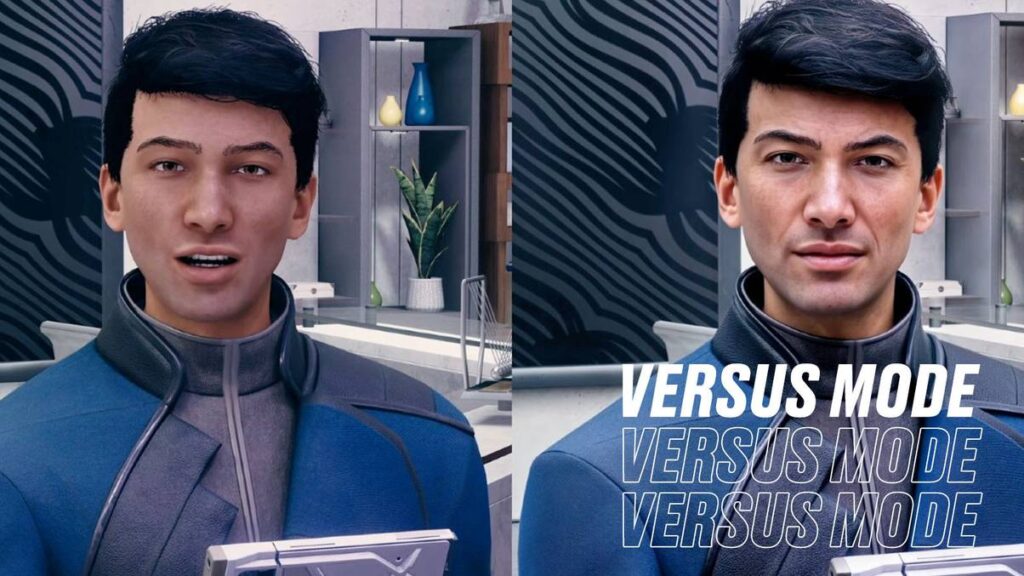

NVIDIA has unveiled NVIDIA DLSS 5, the company’s most significant breakthrough in computer graphics since the debut of real-time ray tracing in 2018. It turns out, this is the latest hot topic of the day the GAMINGbible team just can’t agree on.
For those unaware, this is a NVIDIA-exclusive technology that uses AI to boost gaming performance. Simply put, it runs a game at a lower internal resolution than your monitor – for example rendering at 1080p for a 4K screen. It then uses AI to upscale the image, which gives us the high-frame-rate benefits of lower resolutions without the typical “blurriness.”
Well, the internet doesn’t agree. There’s a lot of memes circulating at how it’s ‘ruined’ our favourite games. But is that entirely fair?
Sara and Olly are back in the latest edition of Versus Mode to debate the pros and cons of NVIDIA DLSS 5. Read both, and see who you agree with.
We’ve also embedded Digital Foundry’s first look at the technology, so you can see it for yourself.
Olly – NVIDIA DLSS 5 Is Ruining Gaming
I’m on record saying that deep learning supersampling technology can be great, but this simply isn’t that.
The new features being marketed by Nvidia aren’t “AI upscaling” anything at all, they’re forcibly changing the artistic intent of the original scene. And worse, they’re making it look awful.
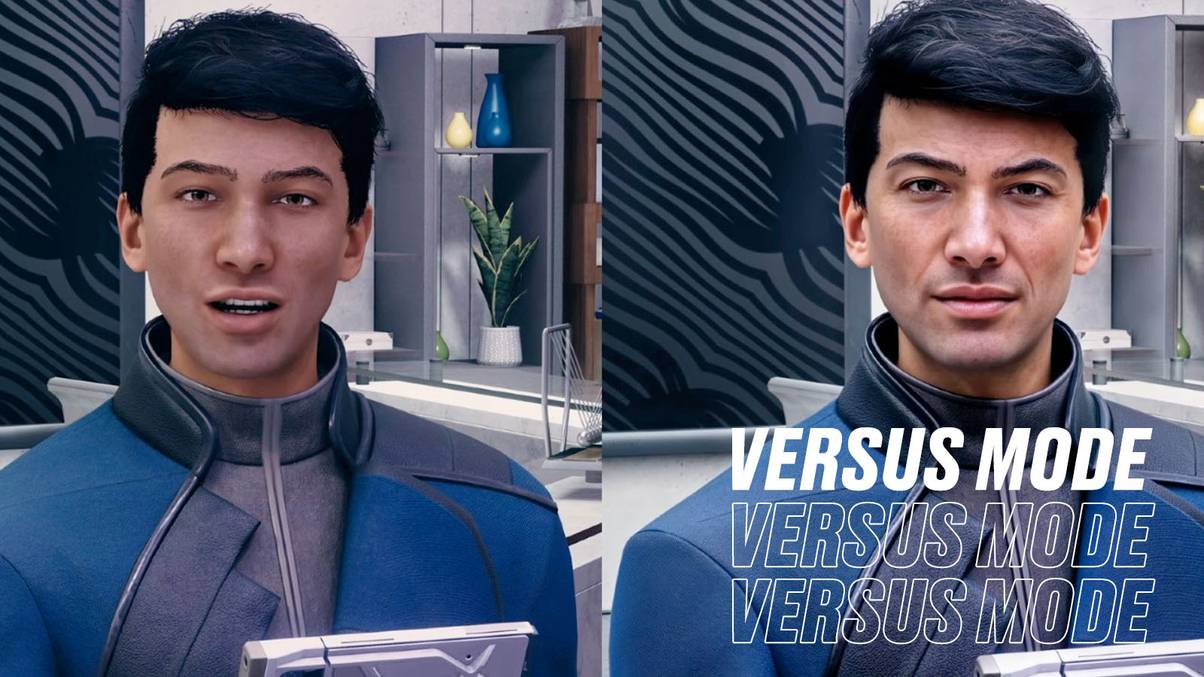
Judging by what we’ve seen so far, particularly the examples for Starfield and Resident Evil Requiem, the characters look completely different. Why does my gal Sarah Morgan look so yassified? She’s an accomplished scientist and veteran soldier, it seems weirdly out-of-character for her to be doing her makeup every morning and looking like a supermodel.
Same goes for the Resident Evil Requiem example, where Grace looks like she’s preparing for the runway. She’s an FBI analyst being sent to investigate a series of brutal murders, I don’t think she’s that bothered with how she looks at that moment. The AI upscaling is so inconsistent too, that she doesn’t even look like the same person between different scenes.
Anyway, I find this kind of style transfer to be quite unforgivable. I’m sure it’s still doing some kind of upscaling under-the-hood, but it really should have been limited to just that.
Once you start meddling with very deliberate choices made by the art teams at Bethesda, Capcom, and many other studios, that’s when things become more murky. It’s the equivalent of those awful I Love Lucy 4K upscales from a few years back, where blurry background extras were given the most horrific faces known to man.
I’m more in favour of calling this what it is: an ‘AI slop’ filter. The kind of over-airbrushed, yassified-style creations that you’d only get when you generate an image by ChatGPT. The images almost always look worse than something made by a real artist, and I think we really just need to bully the companies trying to force this technology on us until they cave. I’ve never believed in “embracing this AI future” and I don’t think I ever will be.
Sara – Actually, We Should Give NVIDIA DLSS 5 A Chance
Look, I’m not blind. I can see the examples where the faces look totally goofy – that whole “yassification” vibe is undeniably silly in Resident Evil. But humans are wired to spot the tiniest shifts in facial expressions, so of course we’re hyper-aware of when something feels off. It’s easy to clown on, but I honestly think those are just bad cherry-picked examples, and I’m still willing to give this update a fair shot.
I don’t agree when Olly says it takes away the artistic intent – it’s the developers implementing it in their games. Arguably, this IS their artistic intent.
When you look past the weird faces at the actual crispness of the details, it’s impressive. Generally, I think the industry’s obsession with hyper-realism is a net negative; video game costs balloon out of control, and today’s “photorealism” will probably look as dated as Heavy Rain in a few years. But if this path is here to stay, DLSS feels like a genuine breakthrough. We’ve mostly seen incremental baby steps since the massive leap from the PS2/Xbox era to the PS3/360, so this level of change is huge – even if it comes with a massive moral dilemma.
The real worry is that these tools are becoming a “crutch” for developers. If a game performs like garbage, a studio can just skip the grueling work of manual optimization and tell players to “just turn on DLSS” to fix the frame rate. There’s a razor-thin line between a tool that pushes performance boundaries and a shortcut that masks lazy engineering.
As we – willingly or not – embrace this AI-driven future, the challenge is making sure these features are used to elevate games, not just lower the bar for how they’re built.