


Fans of immersive sims will not want to miss out on this new entry in the Styx series, which comes close to equalling the best from Looking Glass and Arkane Studios.
If you’re a fan of Looking Glass Studios and their successor, Arkane Studios, the likes of Thief: The Dark Project, Dishonored, Prey, and Deathloop will remain seared on your consciousness, despite the fact that most of them are, by this point, receding in history’s rearview mirror. When Microsoft bought Arkane many players were justifiably nervous about losing their unusual brand of game making (we do so hate the term immersive sim), which was sadly justified given the response to Redfall’s failure and the subsequent shuttering of their Austin studio.
Perhaps typified by Dishonored, their games give players an almost unparalleled degree of agency, letting you approach objectives in a number of ways, using sets of powers that you are rewarded for deploying in as restrained and non-lethal a way as you can manage. They let you lose in a succession of architecturally complex open areas, with guards, locked doors, secrets, and targets. How you make your way through them has always been your own business.
While nothing quite matches Dishonored’s finesse, the Styx franchise has emerged as a worthy, if distant, relative of its gameplay and design ethos. 2014’s Styx: Master Of Shadows and its sequel, Shards Of Darkness, introduced the world to thieving goblin Styx and the faux medieval, steampunk influenced world he inhabits.
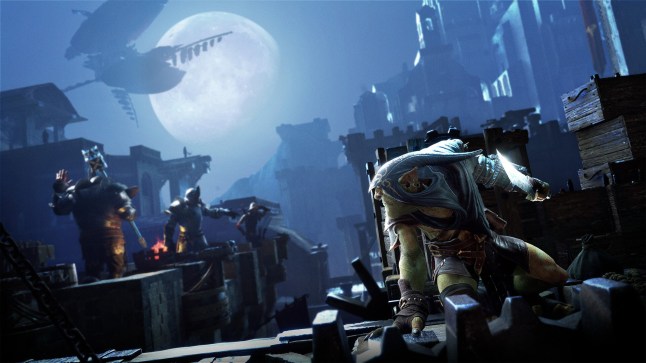
Gravel voiced and cynical, he’s an immediately likeable protagonist, and while Blades Of Greed assumes considerable prior knowledge, you don’t need it, since Styx’s amiably foul-mouthed persona and priorities soon making themselves clear. He may not think much of the law but underneath all the larceny and throat slitting, he’s got a heart of gold.
There is a lot of stabbing people in the neck though. Maybe that’s why nobody seems happy to see Styx, making getting around the multi-layered environments a matter of using rooftops and crawl spaces (the Middle Ages equivalent of ventilation ducts), and wherever possible sticking to the shadows. When you do need to confront guards it’s wise to do it stealthily and one-on-one. Open combat is deliberately clumsy, unrewarding, and best avoided.
Expert, exclusive gaming analysis
Sign up to the GameCentral newsletter for a unique take on the week in gaming, alongside the latest reviews and more. Delivered to your inbox every Saturday morning.
Creeping up behind an unaware sentry, you can either dispatch them silently, which takes a few seconds’ wrestling, or instantly, which makes a noise and may attract the attention of their nearby colleagues. Working your way through markets, boarding houses, shops and storage areas, you’ll find yourself systematically killing everyone you come across, hiding corpses when you can.
It’s a process that gets easier as you open up the game’s skill trees, which amongst other things add brief invisibility, traps, decoys, and acid for dissolving bodies. The latter comes in handy when you kill heavy guards you can’t carry, or once you’ve already stashed dead bodies in all available chests and cupboards. Making more acid and traps requires crafting, and you’ll find lootable ingredients absolutely everywhere, adding to the list of things Styx likes to slip into his pockets.
Your hub is a sailing boat style zeppelin, used to fly between map locations, each of which comprises its own discrete open world. Levels are dizzyingly tall, with Styx’s new grappling hook and miniature glider offering an alternative to all that ladder, stair, and wall climbing. They’re also useful for avoiding the guards who patrol every level of the game’s towering structures, although you’ll still regularly find yourself hanging from balconies or shimmying along ledges to avoid their searches.

Other locations feature natural scenery, their forested areas populated by sightless cockroaches that respond to the sound of your footsteps. While it’s a nice idea to vary the scenarios requiring stealth, those parts of the game aren’t as compelling as the cities and settlements and seem to result in more accidental deaths. Even in towns, though, you’ll be subject to the game’s occasionally unreliable control system.
Snapping Styx into cover is rock solid, and once he clings to a ledge he’s never going to let go, but there are numerous situations where you don’t quite make jumps, slip to your death from roofs, or alert enemies instead of killing them, thanks to the interface’s innate, minor clumsiness. To make up for this you’re encouraged to save frequently, with quick save mapped to L3 so you don’t even need to access a menu to undertake the developer sanctioned savescumming.
Apart from Styx himself, the voice-acting’s a little basic, conveying the exposition it needs to, but often sounding workmanlike rather than characterful. There’s also a scattering of graphical glitches, albeit mostly in cut scenes and not during the action. That generalised lack of polish is often a facet of mid-budget game development and is the price you pay for the game’s huge ambition on other fronts.
That includes a wide world to explore at your leisure, splitting your time between hunting down magical quartz to enhance Styx’s powers, completing missions to further the story, and the side quests offered by the small cadre of fellow outlaws that live aboard your zeppelin. That freeform approach, and the sheer scale of many places you visit, mean the plot tends to take a back seat to the tense sneaking action and thievery.
Fans of Dishonored, who’ve been starved of its unusual mix of exploration, infiltration, and stealth, will find plenty to like in Styx’s thoughtfully crafted and challenging world. It may not have Arkane’s triple-A budgets to play with, but it carves its own path, with a gruffly appealing hero, consequential skill trees, and sandbox stealth arenas that reward experimentation. It’s a cracking addition to the series.
Styx: Blades Of Greed review summary
In Short: The newly vertiginous sandbox levels prove an excellent canvas for sneaking and stealing, in a welcome new entry in what feels increasingly like the spiritual successor to Thief: The Dark Project.
Pros: Maps are designed for playful experimentation with Styx’s expanding skillset, especially the new grapple hook and glider. Large multi-level areas to explore and a likeably roguish antihero.
Cons: The wilderness maps are less interesting than the town ones and there’s a fair amount of mid-budget jank to contend with.
Score: 7/10
Formats: PlayStation 5 (reviewed), Xbox Series X/S, and PC
Price: £44.99
Publisher: Nacon
Developer: Cyanide Studio
Release Date: 19th February 2026
Age Rating: 16

Email gamecentral@metro.co.uk, leave a comment below, follow us on Twitter.
To submit Inbox letters and Reader’s Features more easily, without the need to send an email, just use our Submit Stuff page here.
For more stories like this, check our Gaming page.