
Going Goblin Mode

HIGH Somehow the final boss fight in a stealth title isn’t terrible.
LOW Getting stuck, unsure of where to go, for an hour.
WTF Who knew vomiting on command could be such a versatile tool?
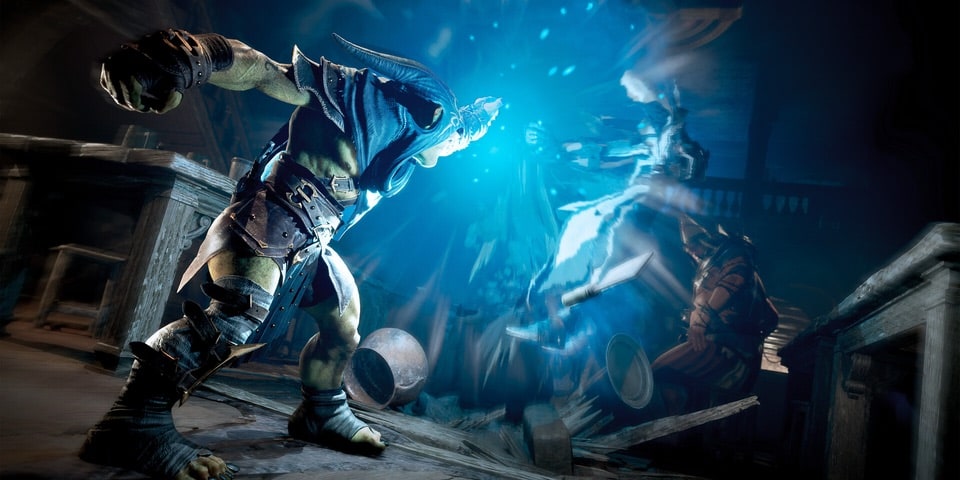
With a larcenous heart and a general distaste for everyone and everything around him, Styx is far from the average protagonist. Whether he’s slitting the throats of cowering civilians to prevent them from raising the alarm or vomiting in fruit baskets to poison hungry sentries, there’s not much he won’t do to earn a buck — so the fact that he continually pops up to play the hero doesn’t bode well for the world of Iseria. However, when juxtaposed against the imperialistic, warmongering humans leading a racist inquisition, Styx’s dubious tactics seem downright quaint.
Such is the state of the world at the outset of Styx: Blades of Greed, a third-person stealth title, and the fourth entry featuring everyone’s favorite foul-mouthed goblin. The oppressive human Empire is hoarding rare and mysterious Quartz to power their industry and war-machine, and while normally this would be none of Styx’s business, it just so happens that Styx can absorb Quartz to power up his own abilities.
Styx isn’t opposed to doing the right thing so long as he gets his cut, and soon enough he and his crew embark on a quest to steal as much Quartz as possible, to both cripple the humans’ imperialistic expansion and just maybe juice Styx’s own strength a little along the way. I was immediately drawn in by this brand of benevolent avarice, the goblin’s villainy only interpreted as good deeds due to the intensity of the evil around him.

The bulk of player’s time will be spent hunting down Quartz across Styx: Blades of Greed’s three, open-ended biomes. This basic mission structure meshes well with the world design, allowing players to approach their objectives non-linearly, carving their own path through the densely packed jungles, cities, and ruins. Furthermore, there is no map and waypoints only vaguely hint at direction — there are no step-by-step guardrails here.
These primary play areas are massive, overlapping honeycombs of hidden paths, alternate routes, and interconnected spaces that seamlessly expand as Styx gains new modes of traversal. The human city called The Wall is a vertically-oriented, impossibly-stacked jumble of buildings and shanties, and a particular standout. Nearly every room has at least two points of ingress, and it seemed like no matter which route I took, I stumbled upon an alternative. Each encounter turned into a puzzle box of navigation – do I start high, low, or head around behind to see if there’s a side entrance? — and there is rarely a “correct” path. This flexible navigation is one of Styx Blades of Greed’s greatest strengths.
There are moments, however, where the developers’ reach seems to exceed their grasp.
The lack of specific direction primarily works because of how many possible routes exist, but when players need to take a specific path forward, this falls apart. At one point in particular, I got hung up at the Zeppelin Docks on The Wall for over an hour and was unable to progress because I had missed a specific climb point that was placed high up. It’s possible I was unobservant and just missed what might have been clear to other players, but the flexibility in pathfinding I had come to love up to that point had vanished, leaving only frustration in its wake.

While the world is fairly open, Styx: Blades of Greed is still a stealth-focused experience, and subtlety is generally the order of the day. However, Styx is an opportunistic little bugger and waiting around isn’t generally his style. Thankfully, he’s equipped with an expansive repertoire of tools and magical abilities to render his adversaries’ lives both short and miserable.
There is little more satisfying than tossing a bottle, luring a guard into stepping on an acid mine, instantly killing them and dissolving their corpse. Equally exhilarating is Styx’s ability to possess enemies before leading them into traps, or even forcing them to jump to their death off a ledge. My personal favorite is Styx’s penchant for creating clones of himself – he pukes up a clone (yes, Styx vomits them up) and quickly turns invisible before slinking into the shadows, leaving his unfortunate offspring to suffer a guard’s wrath in his stead.
On paper, the flexibility of the world design and Styx’s varied arsenal ought to create the perfect recipe for emergent moments and creative solutions. When I first unlocked the possession ability, for instance, I salivated at the possibilities. I imagined using enemies to push one another off cliffs, or causing them to fight amongst themselves as a distraction. Unfortunately, my experiments often went unrewarded, and most of the abilities aren’t as widely useful as one might expect. That’s not to say they are useless — I did find plenty of spots for Styx’s tricks and traps — but I was hoping for a greater degree of synergy and flexibility, on-par with the overall world design.

While its mechanics never quite cohere into a truly transcendent experience, the developers’ understanding of their protagonist helps to bolster Styx: Blades of Greed against becoming just another anonymous sneak-‘em-up. They’ve provided a play space that’s free of judgment and agnostic to the moralistic implications of player behavior, and I felt no pangs of guilt as I went about systematically murdering a fortress full of guards and staff, stealing all I could in the process – after all, it’s what Styx would do, and they probably deserved it anyway.
Rating: 7 out of 10
Buy Styx: Blades of Greed – Xbox – PlayStation – PC
Disclosures: This game is developed by Cyanide and published by Nacon. It is currently available on XBX/S, PS5, and PC. This copy of the game was obtained via publisher and reviewed on the PS5. Approximately 20 hours of play were devoted to the single-player mode, and the game was completed. There are no multiplayer modes.
Parents: According to the ESRB, this game is rated M and contains Blood, Drug Reference, Strong Language, and Violence. The official description reads: Styx: Blades of Greed is rated M for Mature 17+ by the ESRB with Blood, Drug Reference, Strong Language, and Violence. This is an action-adventure game in which players assume the role of a goblin thief attempting to steal Quartz. From a third-person perspective, players traverse through environments and defeat various enemies (e.g., humans, elves, orcs). Players sneak up on enemies and perform stealth takedowns (e.g., slitting throats, snapping necks) to dispatch enemies discreetly. Combat is highlighted by blood-splatter effects, impact sounds, and cries of pain. The game contains a prominent storyline and game mechanic (e.g., skill points, text prompts) about a fantasy drug called Amber, with reference to illicit use/abuse and addiction (e.g.,“[O]ne of our brothers got himself hooked on amber. Had a stash hidden somewhere”; “Just the kick I needed”; “Junkies like that…”; “overdosed.”). The word “f**k” appears in the game.
Colorblind Modes: Colorblind modes are present. This game offers three separate modes for Deuteranopia, Protanopia, and Tritanopia as well as a slider to adjust for severity. Additionally, there is a toggle to Shift Color Spectrum on or off.
Deaf & Hard of Hearing Gamers: This game offers subtitles, they can be resized, and the subtitle background opacity can be adjusted. The sizing options are on a 32-point scale and can be adjusted to be quite large on the screen if desired. While most of the auditory clues have bold on-screen indicators, one notable exception is when taking damage. There is no clear indication of when Styx is being damaged, and this is particularly difficult to discern when being hit by ranged weapons. When playing with sound Styx will cry out in pain, but this is not clearly communicated visually, and I found myself dying more often when playing without sound. Additionally, there were several times that the subtitles did not match the spoken dialogue, and one instance where a crucial gameplay hint was left out of the subtitles entirely, therefore this game is not fully accessible.
Remappable Controls: Certain functions are remappable. While this game does not allow any of the core inputs to be remapped, it does allow for adjustments to the camera inversion, as well as allowing players to adjust whether the input for taking cover requires the button to be held or toggled. Additionally, players can fine tune how directional movement works while in cover or hanging on a ledge.
The post Styx: Blades Of Greed Review appeared first on Gamecritics.com.