
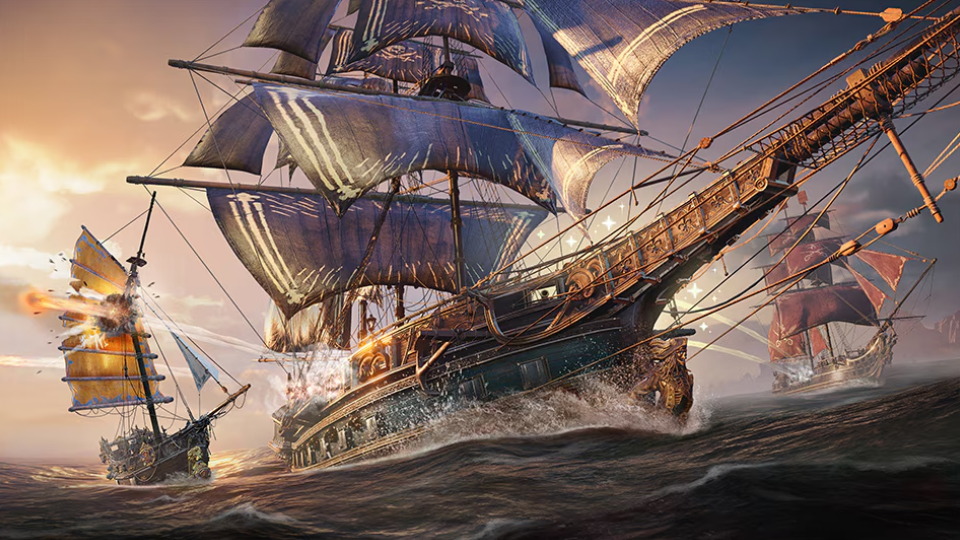

It’s fair to say that Skull and Bones had a somewhat troubled debut. After being infamously labelled as a “quadruple-A” game by Ubisoft CEO, Yves Guillemot, online commentators massed like a flock of ravenous seabirds, circling an impending shipwreck. They would have to wait for their pound of flesh, of course, following multiple setbacks and delays before Skull and Bones finally raised anchors in early 2024.
It wasn’t the breakout hit Ubisoft needed, but truth be told, we rather enjoyed our time with it, especially as the game grew over time. Like most live service games, Skull and Bones experienced a patchy launch, though post-launch updates and a bounty of free content added some much-needed wind to its sails, rolling out PvP fleet battles, seasonal storylines, larger ships, and more.
With the good ship Skull and Bones finally looking suitably shipshape and barnacle-free, it seemed the ideal time to give the dev team a break from plundering and to discuss with them the historical influences that informed the game’s development.
First, we asked why Ubisoft decided on a pirate setting for its ambitious online, open-world RPG. “The Golden Age of Piracy gave us such a rich playground to build Skull and Bones,” explains Producer Paquito Hernandez. “Historically, it was a time full of risk, adventure, and mystery on the open seas where trade, treasure hunting, and legendary naval clashes shaped everyday life. That era of chaos and opportunity let us bring powerful ships, smuggling routes, and unique gameplay features together into something that feels exciting and pirate-like.”

While some gameplay segments take place on land, with players visiting the various ports and settlements scattered throughout the world, most of their time will be spent at the helm of their own fully customisable pirate ship. Skull and Bones boasts an exhaustive armada of vessels that can be outfitted with cannons, ballistae, and even enormous flamethrowers. Some elements may be historically authentic, though others are clearly works of fiction. How did the development team balance these two sides, ensuring naval gameplay is fun and engaging without voyaging too far into the realm of pure fantasy?
“We started with real historical references, looking at ship designs, materials, how vessels handled, and the kinds of weapons used at the time,” begins Paquito. “That research gave us a solid baseline for proportions, silhouettes, and the general “weight” of each ship on the water. But strict realism doesn’t always translate into satisfying gameplay. Real naval combat was slow, methodical, and often required long manoeuvres and reload times, which wouldn’t deliver the action-forward experience players expect today.”

As a potent example of how drawn out naval battles could be, we need only look at the legendary Battle of Trafalgar on October 21st, 1805. The British fleet, led by the heroic adulterer Admiral Nelson, approached the combined Franco-Spanish Navy at a speed of only 2 to 3 knots (roughly three miles per hour) due to light winds. This meant that when the British finally spotted their enemy on the horizon, it took them six solid hours to engage them in battle. Such slow pacing simply wouldn’t work in a video game, even for those who enjoy exhaustive seafaring simulators.
“Realism is our reference point, not our limitation,” Paquito tells us. “So from there, we tuned everything from steering, reload timings, acceleration, even the responsiveness of sails to deliver a more dynamic combat experience. For example, ships still feel heavy and deliberate, but they react quickly enough for players to dodge, angle shots, or make plays that wouldn’t be possible at true 17th-century speeds. Our underlying physics system simulates forces realistically, but with gameplay-driven adjustments to keep manoeuvring fun and readable.”
“On the weapons side, we take similar creative liberties. Cannons, mortars, ballistae, rockets – these are inspired by historical technology, but designed to deliver impactful visual and gameplay feedback that reinforces the fantasy of being a fearsome pirate captain. We look at data, player feedback, and balance tools to make sure each weapon feels powerful while still fitting its intended role in combat. Ultimately, history guides the shape of our ships, but gameplay defines how they fight. Our aim is to strike a balance where players feel connected to a believable period while still enjoying fast, expressive, and tactical naval combat.”

Then there are the pirates themselves. Skull and Bones features a diverse rogue’s gallery of shipmates and rival captains, not to mention the rabble of player-created pirates roaming the high seas. We asked the team whether their characters were based on real pirates from the time period?
“Yes!” Level Designer, Oh Jun Yang, exclaims. “A good example is Scurlock, who is loosely inspired by the 17th-century pirate-merchant, Adam Baldridge. Baldridge was one of the key power players in Madagascar’s pirate history. He built a fortified base on St. Mary’s Island, controlled its harbour, managed trade, and acted as a middleman between pirates and New York merchants. Essentially one of the earliest “pirate kingpins” in the Indian Ocean. We liked how larger-than-life his story was, so we channelled those traits into Scurlock. In the game, Scurlock runs Sainte-Anne like his own personal empire. He’s paranoid, calculating, constantly playing factions against each other, and even operates under the pressure of a demanding New York patron which are all echoes of Baldridge’s real historical dealings. So, while Scurlock isn’t meant to be a one-to-one recreation, using figures like Baldridge as inspiration gave us a grounded starting point to add texture to the world.”
Yet, it’s not just historical happenings that informed the world-building of Skull and Bones; the open sea is a vast and mysterious place, teeming with all kinds of maritime myths. As players gain infamy and unlock bigger ships, they’ll start to encounter legendary pirate captains as well as huge sea monsters, including the iconic Kraken. How did the team go about integrating these into the game?

“We drew inspiration from sailors’ tales and maritime folklore of the era, “Paquito explains.” The very stories pirates would have shared at sea. These accounts helped us identify themes that felt true to the period and provided a foundation for our own interpretations to grow naturally. From there, it became a matter of scaling these myths into gameplay. We want every boss fight or creature encounter to feel challenging, readable, and rewarding. Major threats progress through multiple phases, have distinct move sets, and encourage players to experiment with different ship loadouts and playstyles to find what works for them. Our goal is always to balance fantasy, tension, and gameplay clarity so the encounters feel challenging but fair. This approach opened the door to sea monsters, ghost ships, and other supernatural threats. In fact, coming in Year 2 Season 4: Eye of the Beast, we’re introducing a Kraken-inspired sea monster, one of our most ambitious creature encounters yet. We can’t wait to see how the community takes on this beast!”
Skull and Bones Y2S4 is now live with a bounty of new content including the aforementioned Kraken encounter which is designed for up to 12 players, as well as the new Corvette ship, cosmetics, and other features. You can read more about these in the Eye of the Beast patch notes.
In the meantime, why not check out our upcoming Playing With History book? Featuring over 100 games, 200 pages, and thousands of years of human history, it was successfully funded on Kickstarter in 2025 and will be launching later this year.