
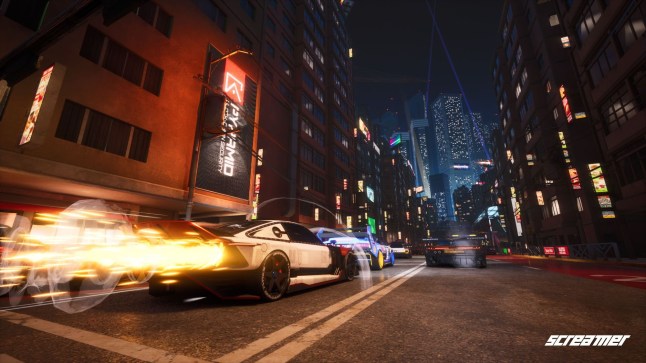


Arcade racers have been out of fashion for years but this new entry manages to reboot not only the 90s original but the entire genre.
In video games’ formative years, there were two competing schools of thought when it came to racing: arcade and simulation. Initially the exaggerated thrills of franchises like OutRun and Hang-On, later followed by the likes of Ridge Racer and Burnout, were clear favourites, but Gran Turismo changed all that. Since then, simulators have become the standard, with arcade racers becoming something of a rarity.
That backdrop makes the revival of Screamer, a franchise whose last outing was exactly 30 years ago, quite the surprise. It’s an unabashed arcade style racer, and to make sure you don’t get the wrong impression about any attempt at boring old realism, it comes with a fully fledged anime story mode, featuring an assortment of whacky characters and their equally zany cyberpunk cars. Rather more surprisingly it turns out to be sensationally good.
Italian developer Milestone has been around since the mid-90s and is best known for serious driving sims, especially motorcycle games like MotoGP and Ride. They were also responsible for the underrated Hot Wheels Unleashed and there’s no doubt this benefits from their experience on that title. It certainly bears little resemblance to the 1995 games that share its name, which featured vehicles that looked more or less like actual touring cars.
This new Screamer is also a third person racer with a handling model heavily orientated towards drifting, but everything else about it is novel. That starts with its narrative-based Tournament mode, in which teams of three drivers compete for a colossal cash prize. As you get to know each of them in turn, you find out that the enormous value of its jackpot isn’t necessarily everyone’s core motivation.
What emerges are amusingly pithy tales of murderous revenge and obsession, the various racers you meet turning out to be entangled with one another in ways that only become apparent as you play. You’ll also unlock them as playable characters in Arcade mode, which along with multiplayer significantly extends Screamer’s entertainment value. Each of its drivers also comes with his or her own car and driving style.
Expert, exclusive gaming analysis
Sign up to the GameCentral newsletter for a unique take on the week in gaming, alongside the latest reviews and more. Delivered to your inbox every Saturday morning.
That’s relevant because races are gamified from start to finish, your ability to steer, accelerate, and brake, subordinate to other driving systems. The most obvious of these is shifting up on each car’s semi-automatic gearbox just as the revs enter the redline. On PlayStation you do that by tapping L1, with timely presses rewarded by a brief burst of speed, flames belching from your car’s multiple exhaust pipes. It also charges your sync bar.
Each segment of that gives you a nitro boost, triggered by holding L1. If you release it at just the right moment, you’ll extend its effect for several extra seconds, and in the case of some of the game’s drivers, even longer. Like Gears Of War’s active reload, it makes every part of the race into its own miniature test of skill, and that’s only the start of the hijinks.
Opposite your sync there’s an entropy bar that governs your car’s offence and defence. That’s charged by activating boost, and lets you trigger a brief shield or a destructive strike on the car in front of you, the latter also acting to charge the sync bar. Deciding when to activate each of those varying abilities, along with their inherent interconnectedness, makes races a network of split-second decisions.
Your final, and potentially most important, power is Overdrive. You can only use that with a completely full entropy bar and it acts like a star in Mario Kart, turning your car into a flaming arrow of destruction, making it both faster than other cars and instantly lethal to everyone you hit. The downside is that if you so much as clip the side of the track in Overdrive, your car explodes.
Fortunately, in Screamer that’s not the end, thanks to the game’s core MacGuffin, the Echo, which not only reconstitutes your car but revives the driver along with it. You’ll lose a few places thanks to races’ aggressive and closely formed packs, but a few well-timed boosts will put you straight back in the running, provided your driving skill’s up to the job.

That’s not quite as is simple as it sounds, because Screamer’s control set-up is initially highly confusing. Acceleration, braking, and steering are all as expected, but you drift using the right analogue stick. That means you can both steer and drift at the same time, or totally different times as track conditions demand, but doing so means undoing years of ingrained muscle memory. It’s not an easy process, although it does eventually click.
When it does, the exquisite rhythms of the game’s multiple, interlocking timing-based systems come into perfect focus, propelling you past and through fellow racers as long as you’re able to maintain that flow state. Getting there is no joke though and Screamer’s learning curve is not for the faint-hearted.
Most racing games start you off gently, either by putting you in a relatively sedate car or pitting you against limp AI controlled rivals. Screamer does a little of that with races whose objective is simply to finish, but as soon as you start needing podium or pole position finishes the gloves are off, the game’s systems and handling model needing to become second nature before you can progress.
The steepness of the learning curve is compounded by the fact that you’re continually being introduced to new drivers, each of whom comes with their own car and skillset. One can chain aggressive strikes together, another gets longer boosts but has to avoid barrier contact, a third benefits from a single-use shield that saves you from one fatal mistake per race, and all handle slightly differently. It’s a lot to take in.
Completing events in Screamer’s storytelling Tournament mode unlocks drivers and their cars, 32 tracks (spread over four locations), endless bodykit modifications, and countless headlight and paint colours. They’re purely cosmetic, but given how insanely cyberpunk the cars look by default, it’s mildly diverting adding to their wild near-future derangement.
The story itself is told in anime cut scenes, and conversations that sometimes interrupt races, each character speaking their own language, so you need subtitles to understand the profusion of Italian, French, Japanese, Hindi, English, and many more. It’s all fairly silly, but impressively well integrated with the action, adding to a hyperbolic fiction that goes well with its driving model.
Once you finish the story, you’ll have access to all the game has to offer, having unlocked every car and driver not only in Arcade mode but also multiplayer. That supports up to 16 racers online and, more impressively, up to four players in local split-screen – a true rarity and a boon for anyone that lives in a house with fellow gamers. They will also need to put the hours in though or risk being routinely trounced.
Finally, it’s worth mentioning Screamer’s abundance of options for disabled gamers, from the ability to slow the game’s overall speed, to left and right one-handed modes, and buttons that are all re-mappable. There are also multiple colour blind modes, making it welcoming for all players. The game may not be easy, but it is generously inclusive.
Screamer is a surprise on so many levels. It’s an arcade racer when most lean towards simulation, it has a fully formed and amusingly convoluted plot, and its anime art style and larger than life characters complement an engagingly over-the-top driving model. Couch co-op is just the icing on an already munificent cake. It might defy dabblers but give it enough time and Screamer is endlessly compelling.
Screamer review summary
In Short: An anime-infused arcade racer with a full-blown story, cracking multiplayer, and an OTT driving model that gamifies every part of its tricky, knife edge races.
Pros: Great risk/reward mechanics and a well-designed trade-off between offensive powers and speed boost. Four-player couch co-op and excellent accessibility options for all gamers.
Cons: Off-puttingly steep learning curve and continually using both triggers and bumpers causes hand ache. Flatmates will need considerable training to be competitive in local multiplayer.
Score: 8/10
Formats: PlayStation 5 (reviewed), Xbox Series X/S, and PC
Price: £59.99
Publisher: Milestone
Developer: Milestone
Release Date: 26th March 2026
Age Rating: 16

Email gamecentral@metro.co.uk, leave a comment below, follow us on Twitter.
To submit Inbox letters and Reader’s Features more easily, without the need to send an email, just use our Submit Stuff page here.
For more stories like this, check our Gaming page.