


Ever since I first started reading forums, the old argument has raged. What’s better: Bleak House’s sharp satire of the British establishment, or finding the jetpack in Grand Theft Auto: San Andreas?
For my money: obviously the latter, but I guess we can finally put that old chestnut to bed, as is often done with chestnuts. Rockstar co-founder Dan Houser—who left the studio in 2020—has been on the interview circuit recently, promoting his new novel, and in the process of a recent chat with The Guardian, settled the debate for good: the Grand Theft Auto games are “not as good as Dickens.” Case closed. Wrap it up, GTAilures.
Alright, yes, I am having fun with words. While Houser does think the GTA games aren’t as good as ol’ Dickens, he made the statement while making a broader point about how he approaches writing and designing them, which is more interesting but less funny. Recalling the time he was doing interviews to promote GTA 4’s expansion packs, he remembered a French journalist telling him, “Well, the Grand Theft Auto games are just like Dickens!”
That stuck with Houser. “I was like, ‘God bless you for saying that!’ But I thought about it afterwards and, well, they’re not as good as Dickens, but they are similar in that he’s world-building.” Houser means that in the sense of giving an impression of, well, an entire world, and not a story isolated in a vacuum. “If you look at Dickens, Zola, Tolstoy or any of those authors,” says Houser, “there’s that feeling of all the world is here—that’s what you’re trying to get in open world games. It’s a twisted prism, looking at a society that’s interesting in one way or another.”
Houser shouts out other 19th-century lit as an inspiration—or at least a point of comparison—for GTA. “There’s that same sense of slightly spread out storytelling that you get in those big 19th-century novels from Thackeray onwards. They are kind of shaggy dog stories that come together at a point. Those books are also very realist, in a way. They’re not leaping backwards and forwards in time. They are quite physical in that sense, and games are very physical.”
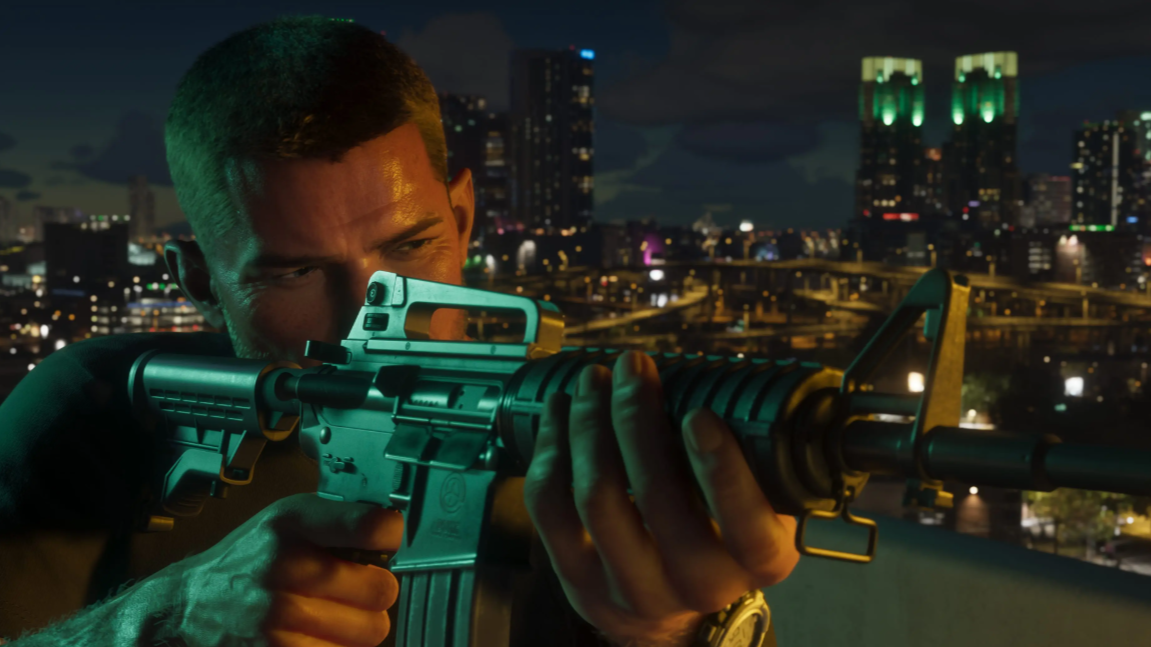
What I find interesting about this, thinking of Rockstar’s past games, is how the studio approaches trying to capture that “physical” and “realist” approach to storytelling in its games. Looking at something like Red Dead Redemption 2, I’m left with the impression that for Rockstar, or at least the Housers, a lot of it comes from detail: the much-memed-on adjustable horse testicles, your clothes getting muddy in spots where you hit the dirt, your hair and beard growing at a certain rate and having to wait for a certain specific length before you can style it in certain ways. You know, that kind of thing.
It’s a perfectly valid, and very impressive, way to design a game world, certainly, but I’m not actually sure it captures the sense of “a world” in the way Houser suggests his Victorian inspirations do, and I think a great deal of that effort goes to waste when it runs into Rockstar’s approach to mission design, which is profoundly artificial and limited—it won’t hesitate to fail you for coming up with a solution Rockstar’s mission designers didn’t want you to.
Anyway, it’s an interesting lens to look at Rockstar’s games through, and now Dan Houser has departed from the company, I wonder if we’ll notice his absence in GTA 6. Perhaps Rockstar’s return to Vice City will be less, uh, Dickensian than before.

This is an interesting take on the ongoing debate! It’s fascinating how both GTA and Charles Dickens can spark such passionate discussions. Each has its own unique impact on culture and storytelling, making comparisons quite intriguing.
bring different storytelling techniques to the table. While GTA offers immersive experiences through interactive gameplay, Dickens masterfully crafts intricate characters and social commentary. Both have their unique strengths, which makes the comparison even more intriguing!
I agree, different storytelling techniques definitely shape our experiences with each medium. It’s interesting how GTA’s interactive narrative allows players to feel like they’re part of the story, while Dickens’ work invites deep reflection on societal issues. Both have their merits, but they engage us in such different ways!