
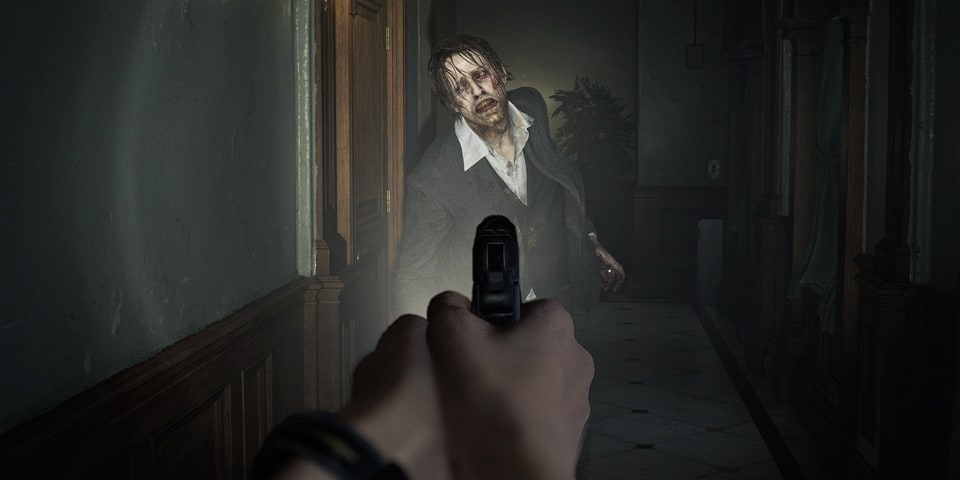

After a series of fantastic remakes and two games focusing on the misadventures of Ethan Winters, Resident Evil Requiem finally returns to continue Leon Kennedy’s attempts to take down the Umbrella Corporation and end its legacy. Once again, he is not alone in his task, although rather than a series staple we now have a new character in the form of Grace Ashcroft, an FBI agent who is also the daughter of a character from the PS2 Outbreak spin-offs. This connection between different strands of Resident Evil is emblematic of the game as a whole; a game which at times feels like a compilation of highlights from the series in terms of references and set pieces. This isn’t a criticism, though, as the pacing is so well judged here that any long-time fan will be grinning for the duration.
The dual protagonists – and more interestingly, dual perspectives – in the game have drawn a lot of attention. In practice, this feels like another way in which Requiem is paying homage to the whole series that precedes it, with Grace’s first-person parts having the overwhelming tension and fragility of Resident Evil 7 while Leon’s more gung-ho third person action is straight out of the Resident Evil 4 playbook. You can override the camera view, but this isn’t just a gimmick and the dynamics in gameplay and atmosphere make every part of the game feel like a high point. Revisiting areas that you anxiously snuck around as Grace when fully armed as Leon has the same freeing effect as a New Game Plus often does.
The story here is pure Resident Evil, and as such is wonderfully daft. Following the plot closely requires more than a passing knowledge of the series as a whole, but there is plenty of internal narrative to keep it interesting for a newcomer too. Grace begins the game as a FBI investigator sent to check out the mysterious deaths of individuals who survived the initial outbreak in Raccoon City, before being caught up in a conspiracy that takes you to the very heart of Umbrella’s nefarious schemes. While chasing up leads for this conspiracy, Leon discovers Grace’s involvement and sets out to rescue her. From this point on, the game takes you on a tour of both new and familiar locations, culminating in an endgame face-off that has fascinating ramifications for the series going forward.

Grace’s sections are characterised by stealth, but she isn’t totally helpless. The titular Requiem handgun – a ridiculously overpowered handcannon – is given to her by Leon early on but ammo for this is incredibly scarce so it remains a last resort throughout. She does have a more basic pistol and knives for protection but it can often be a better choice to avoid conflict. That being said, on the standard difficulty I did find Grace’s sections to include enough ammo to take out most of the zombies, an approach which took away from the survival horror a little. Then again, I tend to prefer the action-orientated approach over the creeping in shadows, so this suited me.
Grace’s sections also contain the more defined puzzles, with Leon’s mostly involving finding key items. With Grace, you’ll need to carefully scan photos and documents to find the solution to environmental puzzles, but there is nothing here to act as a real roadblock as is often the case in Silent Hill games. Grace’s unique mechanic is a blood collector that enables her to use the infected blood of enemies to craft items, ranging from ammunition to health upgrades. This is a novel take on the usual upgrade aspect of modern RE games, and is echoed by Leon’s more traditional credits obtained from defeating enemies in combat.

As Leon makes his way through the game he has access to the full range of weaponry you’d expect, from various pistols with different strengths to high powered rifles and machine guns. I found all the weapons to be useful in the various combat encounters that litter his sections, with switching between them often being more efficient than reloading in the middle of a fight. I can certainly see huge potential in speed-running the game through expert use of each weapon to navigate fights in the most time effective way. Weapons can be upgraded as you progress but there isn’t a standard New Game Plus mode in which you retain all of these upgrades. You can use credits from defeated foes to buy the weapons earlier in subsequent playthroughs however, so this feels like a suitable substitution.
The in-game achievements and related challenge points are once again used to purchase special items, upgrades, costumes, concept art etc. Many of these challenges are familiar from the recent remakes and provide a great amount of replayability and extra ways to enjoy the central game. This is particularly important as there may well be some negative responses to Requiem’s ten hour duration, somewhat shorter than the most recent Resident Evil 4 Remake. The game’s length is far more in keeping with the rest of the series, though, and is well judged to be all killer and no filler.

The RE Engine continues to be one of the most impressively optimised gaming experiences, reviewing on PC. I played through the game on desktop with an RTX4060 ti and Ryzen 3600 (still going strong) with a stable 75fps on high settings aside from one mid-game boss fight which tanked the frame rate for a few seconds. Requiem even performed at a playable level on Steam Deck straight out of the box, and we’ve been able to check out the game on Nintendo Switch 2, with Capcom making all the right compromises to get a good feeling experience, albeit with a more variable frame rate – see our Resident Evil Requiem Switch 2 impressions here. On PC, I stuck to mouse and keyboard due to the first person parts but found that third person view controlled excellently this way as well.