
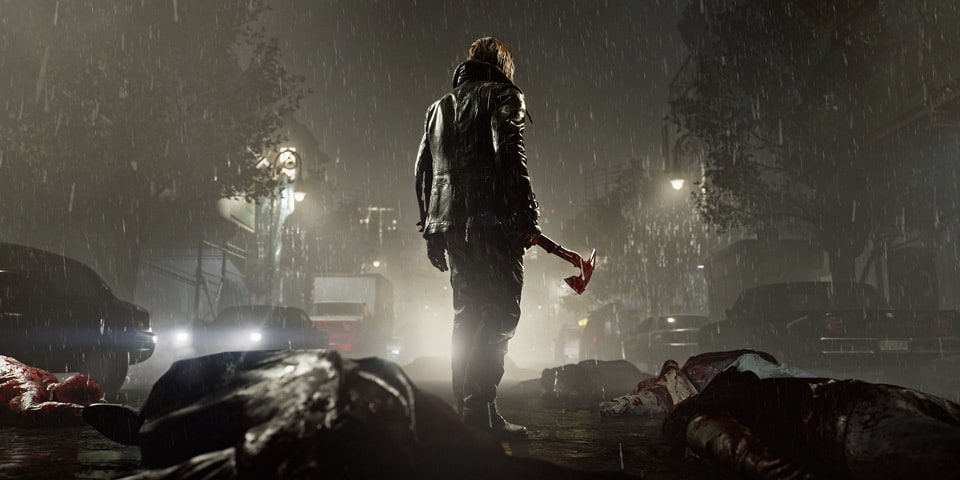

Until very recently, everything we’d seen of Resident Evil Requiem was framed through one lens: Grace Ashcroft’s reluctant, fearful exploration of unfamiliar and hostile environments. It was quiet, tense, and deliberately uncomfortable. Then Leon Kennedy steps in, and suddenly the tone shifts.
Leon is no longer the wide-eyed rookie we first met in Resident Evil 2. He isn’t even the cocky, quip-throwing action hero of Resident Evil 4. This version of Leon feels like a natural endpoint to everything Capcom has built toward: a grizzled veteran who has survived too much, seen too much, and now moves through horror with brutal efficiency. And honestly? I loved it.
Our hands on time began by putting me firmly in Leon’s shoes, and as you’d expect, the action ramps up almost immediately. Leon is armed to the teeth: a large gun, a trusty hatchet, and the confidence of someone who knows exactly what they’re doing. He swings that hatchet with reckless abandon, carving through enemies in a way that almost made me feel like I was playing Devil May Cry, albeit grounded by one important limitation. Overuse dulls the blade, forcing you to think about when to commit and when to fall back.

That restriction keeps the melee from becoming mindless, but the dulling blade rarely feels punishing. If the hatchet isn’t enough, Leon can simply blast his way out of trouble. The balance between melee and gunplay feels deliberate, encouraging aggression without completely abandoning the survival roots of the series.
At this stage in his career, Leon feels closer to John Wick than a traditional survival horror protagonist. He handles his weapons with extreme flair, holding his gun at angles that suggest years of hard-earned muscle memory. Every movement communicates experience. This is a man who has survived Raccoon City, cults, bio-weapons, and government conspiracies. Seeing his progression realised so confidently is genuinely satisfying. It feels earned.

That contrast becomes even more apparent when Requiem switches perspectives back to Grace Ashcroft, and it’s here that the game really starts to show its ambitions.
In many ways, Resident Evil Requiem feels like two games sharing the same world. Grace’s sections are deliberately slower, more methodical, and far more vulnerable. Her default perspective is first person, and the reasoning is obvious: first person is scarier. You can’t see your own back. You feel boxed in. Every sound feels closer than it should.
This isn’t new territory for Resident Evil, but what Requiem does smartly is allow you to play both characters from whichever perspective you prefer. That flexibility feels like Capcom fully embracing the idea of a “customised horror experience.” Want more action? Switch to third person. Want maximum tension? First person has you covered. It’s a smart evolution of what Village experimented with, but this time it’s reinforced by having two protagonists who are fundamentally different.

Grace, unlike Leon, is a fledgling FBI agent. This is her first real exposure to this kind of horror, and the game communicates that clearly through both mechanics and animation. Her movements are cautious. Her reactions feel human. Her inventory space is limited, meaning classic Resident Evil backtracking returns in full force, unlike Leon who is still lugging around his very large attache case!
You’ll be visiting item boxes often, making hard decisions about what to carry, and constantly weighing risk versus reward. Ammo and health are scarce, and I never once felt truly comfortable while exploring. Every encounter demanded consideration, because the zombies are aggressive and varied.
One standout moment had me entering a bar area where I spotted a female zombie dressed in white, quietly humming to herself. It was unsettling in that distinctly Resident Evil way. The moment she noticed me, she began screaming and suddenly I was swarmed. That calm-to-chaos transition is something the series has always done well, and Requiem nails it.

Enemy variety plays a big role here too. There’s a clear nod to Resident Evil Remake’s Crimson Heads – zombies that can return later, faster and far more dangerous if they aren’t properly dealt with. These new variants scramble like wild animals, leaping over obstacles, swiping relentlessly, and forcing you to rethink how you approach combat. They are a nightmare in the best possible way.
Dealing with them ties into one of Requiem’s more interesting new mechanics: blood collection. Blood is now a resource, used in crafting alongside traditional materials. You can find it in buckets scattered throughout the environment or harvest it from defeated enemies. How you kill a zombie affects how much blood you can extract, adding another layer of strategy to encounters. One item that can be crafted is a neat injector that once inserted into a zombie, will make it explode in a shower of blood… yum.
It’s an elegant system that reinforces Resident Evil’s identity: everything has a cost, and efficiency matters.

Of course, no Resident Evil game would be complete without puzzles, and the section I played delivered exactly what you’d hope for. Nothing overly obtuse, nothing insultingly simple; just solid, classic puzzles that reward observation and attention to detail. Combined with light backtracking, it all feels comfortably familiar.
Requiem is stunning to behold. Every surface gleams. The lighting is moody and precise. Blood splatter feels tactile. Every little detail is ridiculous, right down to seeing individual beard hairs on Leon’s face. It’s one of those games where you constantly stop to take in the surroundings, even when you really shouldn’t.
Naturally, there are larger threats lurking. What little I saw of the primary antagonist was intriguing enough to make me want answers. There’s also a giant, bloated zombie that stalks you through corridors, shouting and taunting as it goes. It barely fits through doorways, slowly forcing its way through tight spaces, and if it catches you, that’s it.
The idea of zombies now being able to chin wag is… unsettling. And I’m very curious to see how that’s explained.
After a couple of hours with Grace, control switches back to Leon — and the tonal whiplash is incredible. That same hulking enemy? Leon just fights it. Head-on. His action heavy gameplay is relentless: Crimson Heads, window dives, grenades flying everywhere, and some of the most stylish gunplay I’ve experienced in a Resident Evil game. It was pure adrenaline.

What really strikes me about Resident Evil Requiem is how confidently it embraces this division. These days, the fanbase is split: tank-control purists, third-person lovers, first-person fans, and those who just want more Resident Evil, regardless of format. Requiem feels like Capcom acknowledging all of them and saying, “Why not?”
For me, this is an evolution. Not a reinvention, not a rejection of the past, but a synthesis of everything the series has learned.
Resident Evil Requiem will divide people, but in a healthy way. For me, this is an evolution that is a synthesis of everything the series has learned. It’s bold, confident, and unafraid to let different playstyles coexist. And honestly? It’s just good to have Leon back, to revisit Racoon City, and to be introduced to a new protagonist who feels genuinely tied to the series’ roots.
Resident Evil: Outbreak was a banger, and I cannot wait to see how Requiem ties everything together.