
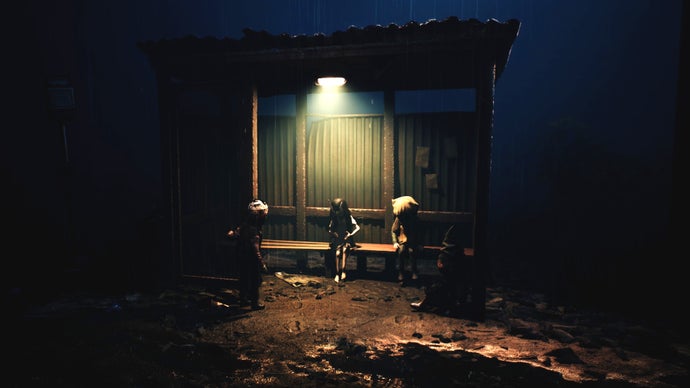

Let’s address the elephant in the room first: Tarsier Studios created two exceptional Little Nightmares games, but not the third instalment in the series, which was handed to Supermassive Games. Reanimal is, quite clearly, Tarsier’s vision for Little Nightmares 3 and a darker breed of horror.
The Little Nightmares games were, true to their name, little nightmares — unsettling, occasionally grotesque, yet reminiscent of Brothers Grimm fairy tales, where children are shoved into ovens. Reanimal, despite its visual similarities, is a different beast entirely. Its atmosphere is far more oppressive, leaning heavily into visceral body horror. Deformed giants convulse and contort into scuttling crab-like creatures that snap the necks of the protagonists. Boneless corpses hang from trees, slithering down trunks and pursuing you like filthy, limp serpents. It is unrelentingly unsettling.
The game follows a brother and sister navigating a nightmarish island they once called home, attempting to rescue their friends from the twisted horrors stalking the shadows. The tone is established immediately: the brother steers a rickety boat through thick fog in search of his sister. Her lifeless body is discovered floating in the sea as distant bells toll ominously. It takes agonising moments to revive her; she splutters seawater and whispers faintly as consciousness slowly returns. It is a bleak and unforgettable opening.

The boat itself becomes integral to the experience, as Reanimal presents a much broader world with light open-world elements. Subtle visual and audio cues gently propel you towards the next objective, yet there are ample opportunities to wander off in search of collectables — though you are arguably more likely to stumble upon something horrific that will end your journey abruptly. This expanded scale allows Tarsier to fully embrace a more cinematic presentation. The camera pans and swoops dynamically as you traverse the island, zooming out to emphasise scale and zooming in for intimate moments. It is, paradoxically, quite beautiful for a game so saturated with decay and death.
Exploration is central to progression. Locked doors require keys and grotesque whale-serpents demand eyeballs, the usual necessities in such a world. Stealth and chase sequences will feel familiar to Little Nightmares veterans, and the puzzles are generally logical, with one notable exception that left me utterly flummoxed. I ultimately brute-forced my way through by attempting nearly all sixty-four possible switch combinations.

Comparisons with Little Nightmares are clearly inevitable, but two other titles came to mind as I wandered through this macabre landscape. Early in the game, you arrive at an abandoned town whose visual storytelling and sound design evoke the oppressive atmosphere of Silent Hill. There is a constant sense that something lurks just beyond sight. It is not traditional fear that defines these moments, but suffocating dread — the lingering weight of catastrophe embedded in every building, open book, and broken shopfront.
The second game it brought to mind was Death Stranding, and not merely because of a shoreline strewn with whale carcasses. Reanimal ventures into deeply unexpected territory, both physically and psychologically. It is the first game since Kojima’s masterpiece that compelled me to set down the controller and step away, needing a moment to process what I had just experienced. Let me be absolutely clear: Reanimal is absolutely not for children, some scenes are truly disturbing.
Tarsier also deserves praise for crafting a horror experience that largely sidesteps genre clichés. There are no possessed dolls, no crackling televisions broadcasting cryptic images, and almost no jump scares. Instead, the game offers Lynchian body horror infused with British folk sensibilities and fragments of childhood anxieties. As kids, many of us were warned about strange men offering sweets from a van, and that horrific scenario is played out in Reanimal.

At roughly eight hours in length, the game feels perfectly paced — long enough to tell its story without overstaying its welcome. New gameplay elements, including light combat, are introduced gradually. The game can be played solo with an AI companion, in local co-op, or online. Having experienced both solo and local co-op modes, I can confirm that the AI partner performs admirably, illuminating dark paths when needed and responding reliably to player commands.
My only minor criticism is structural familiarity. Much like Little Nightmares I and II, the game follows a largely episodic format. Each area introduces a looming antagonist glimpsed fleetingly in the background, followed by escalating encounters and chase sequences before their eventual defeat. While Reanimal introduces new mechanics like driving and scuba diving, the overarching rhythm may feel somewhat predictable to returning players.