
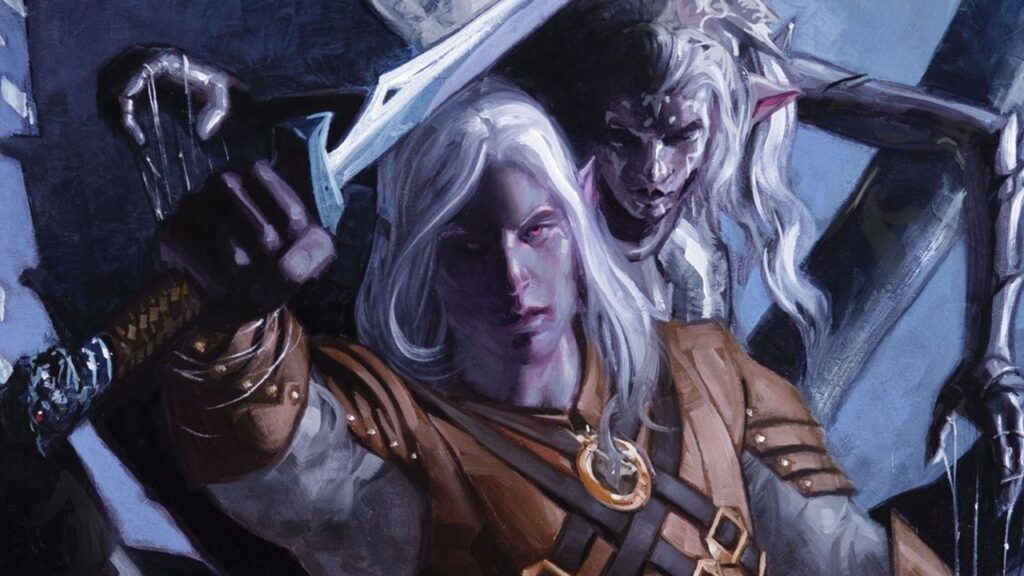

In a new interview with Polygon, fantasy (and sci-fi, and videogame) writer R.A. Salvatore dished on some of the unique challenges of writing stories that have to stay consistent with an ever evolving tabletop ruleset and world state.
Salvatore has notably contributed to the Star Wars Expanded Universe (RIP), but is most famous for his novels set in the Forgotten Realms, a world shared with classic PC games including Baldur’s Gate, Neverwinter Nights, and most of the Gold Box RPGs.
Like Realms creator Ed Greenwood’s Elminster, Salvatore’s characters have gotten cameos in Baldur’s Gate. Heroic cleric Cadderly pops in to say hi near the end of Baldur’s Gate 1, while Salvatore’s signature Drow Ranger and memetic Best Swordsman Ever, Drizzt Do’Urden, can be befriended or fought in both Baldur’s Gate 1 and 2.
According to Salvatore, making sure the action in his books hews close enough to the D&D rules of the day has been one of the job’s more challenging demands. “That’s been one of the toughest parts,” said Salvatore. “4th Edition D&D almost broke me, not because I didn’t like 4th edition D&D. I’m not making any judgements—positive or negative—on any of the editions, but the changes were so sweeping.”
Even with the addition of feats and prestige classes, as well as fundamental reworks of systems like AC and attack bonus (goodbye THAC0) when moving from AD&D to 3rd Edition, it still felt more mutually intelligible with previous rulesets than the controversial 4th Edition. I’ve always found it telling that the explosively popular 5th Edition—which Baldur’s Gate 3 is based on—plays like a more approachable riff on D&D 3.5.
But mechanics aren’t the only 4th Edition zag Salvatore had trouble adapting to: He and Greenwood both objected to The Forgotten Realms’ world state shakeup. Previous new editions moved the timeline forward a decade each, while 4th Edition skipped a century and introduced The Spellplague, which altered Faerûn’s geography, politics, and cosmology. Drizzt would still only be a spry 180 years old or so (of a 700-year lifespan), but his human buddy, Wulfgar, and wife, Catti-Brie, weren’t so lucky.
“Ed looked at me and says, ‘Bob, what are we going to do?'” Salvatore recalled from the moment when the two found out about the changes. “I said, we’re going to figure out how we’re going to fix it because in about five years they’re going to come to us and say ‘Bob we got to fix this.'”
That timeline was pretty much on the money: Just as 5th Edition’s rules hewed closer to 3rd Edition, The Forgotten Realms moved forward another decade or so, but underwent yet another metaphysical calamity that made its politics, geography, and metaphysics look suspiciously similar to how they did 120 years previously.
Salvatore even got a mulligan on Do’Urden’s dead friends, with Catti-Brie, Wulfgar, Bruenor Battlehammer, and Regis the Halfling all getting a second chance at life. Salvatore’s most recent novel, the 39th in the Legend of Drizzt saga, was Lolth’s Warrior in 2023.
2025 games: This year’s upcoming releases
Best PC games: Our all-time favorites
Free PC games: Freebie fest
Best FPS games: Finest gunplay
Best RPGs: Grand adventures
Best co-op games: Better together


It’s always interesting to hear insights from such a prolific author like R.A. Salvatore. His perspective on the challenges of working with different editions of D&D really highlights the complexities of game writing. It’s clear he has a deep passion for the craft and the lore surrounding it.
It’s fascinating to see how much the evolution of game mechanics can impact storytelling. Salvatore’s experiences highlight the challenges writers face when adapting to changes in a beloved setting, which can really shape the narrative flow. His foresight about needing to address these changes shows his deep understanding of the genre.
Absolutely, the interplay between game mechanics and narrative is crucial in D&D. Salvatore’s insights highlight how changes can shape not just gameplay, but also character development and plot depth. It’s interesting to think about how future editions might learn from these past experiences to enhance storytelling even further.
It’s interesting to see how deeply intertwined the rules and storytelling are in D&D. Salvatore’s experience highlights the importance of maintaining a balance between mechanics and narrative flow. When the rules overshadow the story, it can really hinder creativity and immersion for both writers and players.
I completely agree! The rules can really shape the narrative experience in D&D. It’s fascinating how a shift in mechanics can impact character development and plot direction, as Salvatore mentioned. His insights highlight the importance of balance between rules and storytelling in creating immersive experiences.