
Some of the best and most beloved Pokémon games are the ones that put the grind of catching wildlife and training them up to one side. Pokémon Snap puts you on a track to take photos on a safari, the Pokémon Mystery Dungeon series transforms the player character into a Pokémon and drop into mysteries with other Pokémon, and then there’s Pokken, TCG and more. Pokémon Pokopia might be about to eclipse them all.
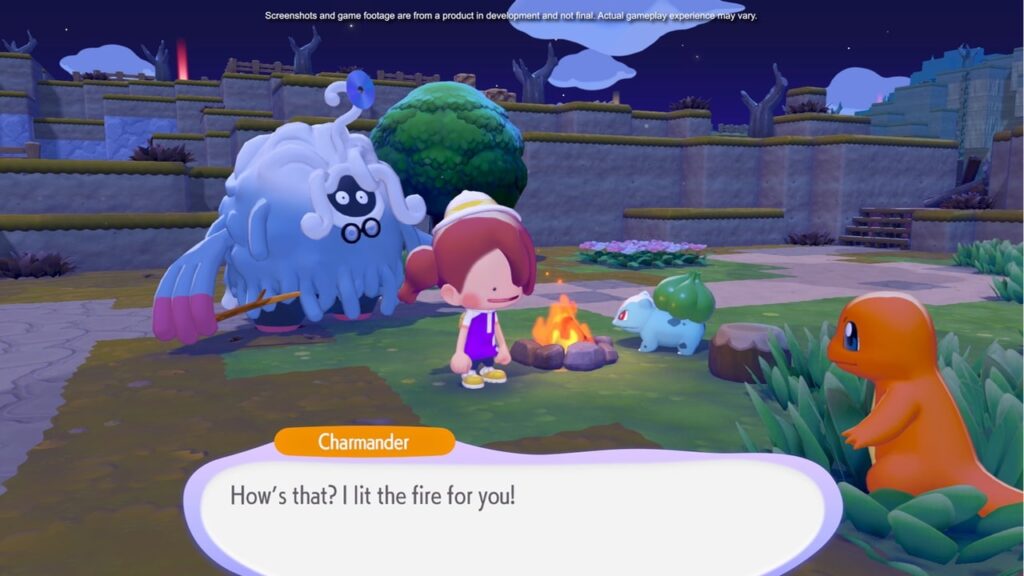
The initial announcement of Pokémon Pokopia brought with it a fair bit of hand-wringing from the most diehard lore experts of the franchise. Ditto hasn’t been able to mimic a human form before, so why can it do so now? Also, isn’t this the stuff of horror films? But to question this game is to forget the most important thing: it’s all make-believe and honestly shouldn’t bother you after that initial head-tilting “Wait, what?” moment. This initial oddity is immediately brushed aside as you try to figure out what has actually happened to the wider world. Ditto wakes up all alone in a cave and decides to copy the shape and form of the trainer that they know and love as a self-soothing act. After some jelly-armed Naruto running, you’ll bump into Professor Tangrowth and be shepherded through to the world outside, the questions start to grow. Where are all the people? How has this land become such a desolate waste, ruined Pokémon Centre and all? What do we do now?
The answer to that is pretty obvious: you need to rebuild, you need to nurture, and create a paradise for all the Pokémon you can find and befriend.

Ditto is the perfect character for this job. Meeting a Squirtle on the verge of dehydration, you’re able to learn Water Gun and provide them with some water. Prof. Tangrowth comments on your latent transformation ability – pulling off this move doesn’t turn you into a Squirtle copy, but just sprouts a tail from your more human form, and this carries through to all the other abilities you learn, from Bulbasaur’s Leafage sprouting from your back, to Scyther’s Cut turning arms into vicious blades and beyond. Later moves, such as a Lapras Surf and Draginite’s Glide enhancing your movement skills, show that full transformations are possible, but I guess you’ve got to build up to that.
Of course, you need to meet new Pokémon in order to learn their moves, and that’s where a key part of the exploration and rebuilding comes into focus. You need to provide to each Pokémon’s base desires and habitat in order to draw them in, and in order to discover what that might be, you need to find the sparkling clues within the world. Bulbasaur wants a nice big patch of tall grass, Scyther needs a bit of shaded grass by a tree, and if you’ve got a punching bag next to a bench? Well, that’s perfect for Hitmonchan to get their workout routine going. It’s a bit nebulous getting this to happen, and you then need to keep an eye out for a rustle in the grass or other sign that a Pokémon has emerged, but after that you can befriend them and bring them into your growing community.

To earn their friendship, you’ll need to complete a simple task for them, at which point you can learn their key move, but that’s not the end of your interactions. As you start to explore the desolate world, you happen across a Poké Centre with a computer terminal, and Professor Tangrowth suggests that you might want to restore it – perhaps the humans will come back? This needs resources, it needs bricks and wood and other things, and so you can start to build little production lines with the Pokémon that have the relevant skills to meet the requirements. Far from a Factorio situation, there appears to be a relatively light touch to construction and crafting, though you’ll need to supply both materials and then ask Pokémon to follow you and fill the key jobs for the building effort.
There’s a simple charm to all of this, and it certainly feels more goal-oriented than Animal Crossing: New Horizons. There’s better comparisons to Dragon Quest Builders for the cubist look and feel of the environments and gameplay – perhaps with Omega Force able to draw upon experience making DQB2 with Square Enix – and to Viva Piñata for the way that you curate the environment to bring Pokémon to your lands.

There’s also some great multiplayer support that really shows some of the shortcomings of Animal Crossing online. Other players can visit your game world and save, but then they can take full part in completing missions, messing around and transforming the world. We got to play as a foursome, tasked with rebuilding another Poké Centre, but quickly got distracted by the set of later game abilities that we suddenly had, letting us fly off to a completely different part of the map and a town for Pokémon. Once again, it’s funny to see how the Pokémon are adapting to a human-less world, able to move into houses, whether they were left behind when people vanished, or were something that you built. We spent so much time running around and exploring that we had a hurried five-minute scramble toward the end of our session to try and figure out a way to actually build that Poké Centre.
Our solution? Grind our way through all of the sand on the beaches of these separated islands, filling our pockets and then build a thin land bridge between the two, meeting in the middle like the engineers of the Channel Tunnel and then escorting the Pokémon we needed across. Alas, our time with the game ran out just before we were able to complete the goal, but that really just left me wanting more.

Pokémon Pokopia is shaping up to be much more than I expected it to be. The Animal Crossing comparisons are inevitable, from how much of the UI and even the tone of the music feels to be borrowed from New Horizons, but it’s far too surface-level for a game that is more proactive and faster to evolve over hours instead of days and weeks. I’m still unsure how the story will develop through the course of the game, or how multiplayer will hold up for longer play sessions, but there’s an awful lot of potential here, and I absolutely can’t wait to play more.