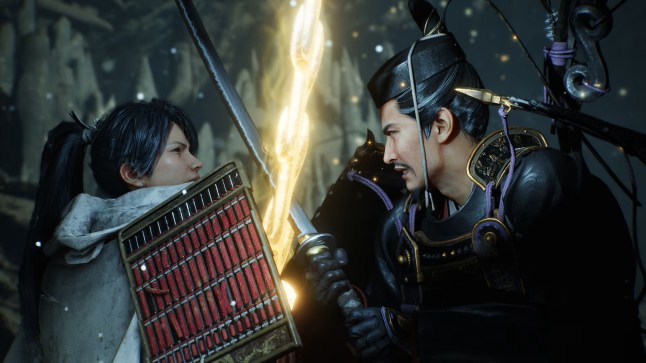


One of the best Soulslike games ever made is also distinctly different to Dark Souls and its cousins, although there are some obvious similarities to Elden Ring.
It’s 15 years since Dark Souls first arrived and forever changed the industry’s attitude towards gameplay difficulty. Prior to its appearance, mainstream publishers had been slowly and steadily removing any hint of challenge or complexity from their games, convinced that it was putting off more casual players. But Dark Souls proved that people don’t like to be mollycoddled and that, at least on occasion, they relish a challenge.
As a result, not only have many unrelated games changed their approach but there have been legions of clones as well, most sticking so frustratingly close to the originals as to be almost pointless. First appearing in 2017, the Nioh series has always been the best of copycats, not just for its overall quality but because by focusing on more complex combat it offers a notably different experience to all the other wannabes.
The only problem is that neither of the two previous games seem to have been that popular and we assumed 2020’s Nioh 2 was going to be the last one. We’re glad to see that’s not the case but if the franchise’s luck runs out with this one then developer Team Ninja can be satisfied that they’ve created a game that even Dark Souls creator FromSoftware would be proud of.
Given how sloppy the storytelling is, you’d never guess that the original game was based on an unfinished Akira Kurosawa script, based on the life of English navigator William Adams – the basis for the character of John Blackthorne in the Shōgun novel and TV series. How much of that unfinished script ever made into the game we’re not sure though, considering Adams was transformed into an Irishman and the story involves ancient Japan being overrun by evil yōkai.
Nioh 2 was a prequel, but this third game is set after the events of the original and has you playing as a grandchild of the former shōgun, locked in conflict with your evil brother. It’s very basic stuff and adds absolutely nothing to the experience, other than providing a thin excuse for a spot of time-travelling, across four distinct eras of Japanese history.
Expert, exclusive gaming analysis
Sign up to the GameCentral newsletter for a unique take on the week in gaming, alongside the latest reviews and more. Delivered to your inbox every Saturday morning.
It’s hard not to resist comparisons between Nioh 3 and Elden Ring – not because the two games are very similar but because the evolution from Dark Souls to Elden Ring is reminiscent of what developer Team Ninja is doing here. Although they already experimented with open world design, with mostly successful results, in last year’s Rise Of The Rōnin, so this feels more like a combination of several of their greatest hits, including Wo Long: Fallen Dynasty and the Ninja Gaiden games.
A lot of different games have paved the way for Nioh 3 but the most impressive thing about it is how different it feels from its two immediate predecessors, at least within the bounds of an established franchise. This is still a sequel and while there are now two completely separate combat styles to choose from the samurai one works similarly to the previous games, with three weapon stances and the all important Ki Pulse move that allows you to steal back stamina to continue your attacks.
The other play style is based around being a ninja, and so is focused on dodging and aerial and ranged attacks. Instead of weapon stances you have special ninja tools, like shuriken and caltrops, as well as more fantastical special attacks. As a ninja you can’t use the Ki Pulse but you do get the ability to clone yourself, primarily as a distraction so you can get in round the back of an enemy for a stealth kill.
This is where the game begins to borrow lightly from Tenchu, but impressively you can switch between either style whenever you want – even though the two character types can’t use each other’s equipment.
All of this is on top of a skill tree for each class type and the return of the Guardian Spirts from the previous games, that allow you to drain an enemy’s Ki by using elemental attacks. You can also transform into a Guardian Spirit for a short time or summon a defeated boss to fight for you.

Nioh 3 is not exactly a pick up and play arcade game but despite so many different systems and options, this is probably the most accessible of the three, given the ninja style is a lot more straightforward – as a result of the lack of stances and the simple fact that it takes a while to introduce everything. Nioh 3 demands you pay close attention to it, but it doesn’t require superhuman reflexes to play and every effort you make is rewarded tenfold.
In terms of the open world, it really isn’t that much like Elden Ring. For a start, it’s not a single contiguous map but a number of separate ones, like Rise Of The Rōnin. Some areas are still designed in the same linear manner as the first two games (and Dark Souls), while others are more open-ended and filled with secrets to discover.
Another key difference, compared to From’s games, is that you have explicit side quests to complete, with the game almost nudging its way into Ubisoft design territory at times, as you clear out enemy camps and chase after frivolous collectables. But like all open world games the greatest benefit is that it allows you to tackle challenges at your own pace, always providing something to do if you get stuck on a boss or other obstacle.
As far as most Souslikes go, Nioh 3 is on the easier end of the spectrum, although that still makes it harder than average. However, the combat is so satisfying and physical it’s always a pleasure to persevere, especially given the wide variety of weird looking enemies and monsters, inspired by Japanese mythology.
Graphically, the game can be impressive, but it does vary a surprising amount, with some areas a lot more extravagant in their detail than others, and some suffering old fashioned frame rate problems. It’s not a widespread problem but it’s a strange thing to see in a PlayStation console exclusive.
Apart from the ineffectual storytelling, Nioh 3 perpetuates the key flaw of the series, in that the loot you collect is made almost meaningless by its unmanageable volume. Although at least now you can both pick it up and recycle it automatically, as well auto-equip the good stuff. Making the game do all the busywork for you is definitely an improvement but loot you actually care about would’ve been even better.
Since the first two games have always been unfairly overlooked we fear it’ll be the same for this third one. We’ve always considered them to be the best non-From Soulslikes and this is the best of the trilogy, especially as it’s so surprisingly daring in its new features. After 2025 proved a quiet year for the genre this is welcome evidence that it still has the ability to surprise and delight, setting an impressively high bar for the return of FromSoftware themselves.
Nioh 3 review summary
In Short: The best Soulslike not made by FromSoftware, which expands and improves on the series’ exceptional combat with two separate play styles and a fantastically wide range of enemies and locations.
Pros: Combat is superb, with a huge range of options for both combat styles and yet the ninja class, at least, remains relatively accessible. Hugely involved role-playing systems and lots of variety in terms of equipment, enemies, and settings.
Cons: The loot system is still rubbish and automating it all just sweeps the problem under the carpet. Comically bad storytelling and a few graphical issues.
Score: 9/10
Formats: PlayStation 5 (reviewed) and PC
Price: £64.99
Publisher: Koei Tecmo
Developer: Team Ninja
Release Date: 6th February 2026
Age Rating: 18

Email gamecentral@metro.co.uk, leave a comment below, follow us on Twitter.
To submit Inbox letters and Reader’s Features more easily, without the need to send an email, just use our Submit Stuff page here.
For more stories like this, check our Gaming page.