
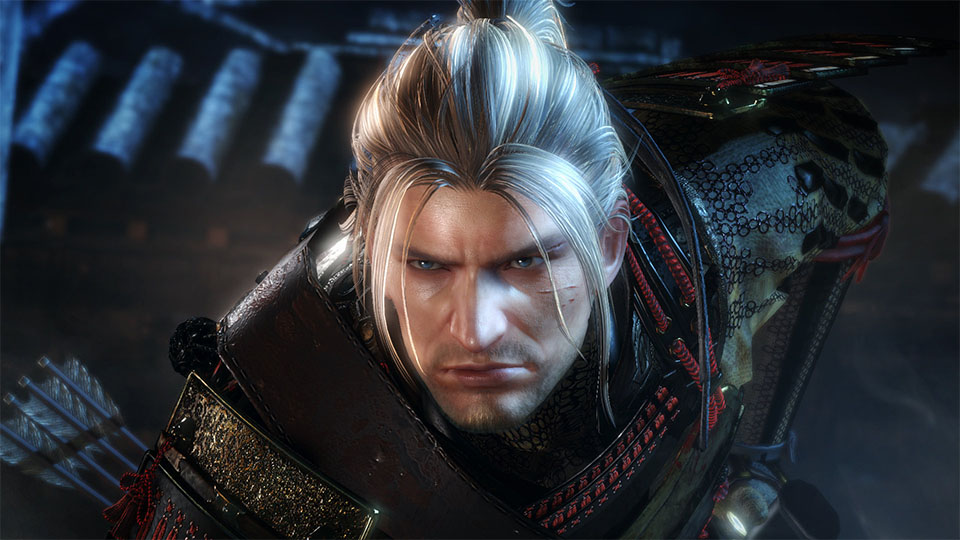

From Koei Tecmo, the Japanese publisher that brought us Samurai Warriors, Ninja Gaiden, and Nobunaga’s Ambition, Nioh was one of few games to successfully channel the mammoth popularity of Dark Souls, FromSoftware’s breakout action RPG that birthed its own addictively hardcore subgenre. In truth, Nioh existed long before the game it would one day try to emulate, and was based on an unfinished script written by Akira Kurosawa, the legendary Japanese filmmaker who brought the samurai to the silver screen, directing classics such as Yojimbo, Throne of Blood, and The Seven Samurai.
After working on Nioh for several years the project was scrapped, though Koei clearly believed there was still a strong concept. After all, it was based on one of the most fascinating stories from the Sengoku period: one that would later be adapted in James Clavell’s best-selling novel, Shōgun, which later spawned the award-winning TV epic of the same name. Nioh was therefore revived with developer Team Ninja at the helm. Players take on the role of William Adams, an English navigator who arrives on Japan’s shores in 1600 and would later serve Tokugawa Ieyasu as hatamoto – a high-ranking samurai. It’s an incredible side story to the Sengoku unification saga, albeit one given a heavy dose of supernatural flare in Nioh. For a start, Adams is portrayed as an Irishman who battles his way through hordes of yōkai – spirits from Japanese folklore which can take the form of demons and guiding spirits. To squeeze some extra alternate history juice from the time period, Nioh stars Edward Kelley as its main antagonist – an occultist and alchemist who became the right hand of Queen Elizabeth I’s royal magus, John Dee. As Kelley scours Japan for Amrita, a magical reagent that could help the crown in its war against Spain, William witnesses the main events of the Sengoku Jidai, rubbing shoulders with various historical figures. These include big names such as Oda Nobunaga, Date Masamune, and Kanbei Kuroda, their fates somewhat altered amidst Nioh’s yōkai invasion.
Koei Tecmo’s dark fantasy spin on feudal Japan proved to be a major hit and was quickly followed up by Nioh 2 which served as both a prequel and sequel to the original game. Mostly set in the 1500s, it leans much more heavily into mythology and supernatural elements than the first game, allowing players to customise their own hero who also happens to be half yōkai. As in Nioh, real historical events – wars, betrayals, and political alliances – unfold much as they did in reality, but the game reframes them as being subtly influenced by the supernatural, suggesting that the chaos of the era may have been driven as much by otherworldly forces as by human decisions alone.
Adding a dark yet thoughtful dimension to Japanese history and the folklore that surrounds it is the driving force behind the franchise, Nioh 3’s director, Fujita Masaki, explained to us in a recent interview:
“We always have respect when dealing with subject matter in the game and try to represent yōkai as something with different aspects, not just as monsters. The same goes for people who are treated more like villains. When adding original settings, we try to make sure that they are rooted in cultural foundation and spirituality based on real anecdotes and lore. The expression of cultural foundation and spirituality extends not only to art and text, but also to details such as specific dialogue of mob characters and is intended to convey a comprehensive experience to players. Things that cannot be provided as experiences are presented as reading materials, and if you do an online search based on these descriptions, you can dig deeper and find out more. Knowing that it is based on lore rather than just fiction is a wonderful experience with intellectual excitement.”

Nioh 3, the fastest-selling game in the franchise, returns with yet another fantastical take on a historical saga. Players begin their journey in the Edo period, as Tokugawa Ieyasu’s grandson, Tokugawa Takechiyo who, confusingly, shares a name once used by a younger Ieyasu. Interestingly, Nioh 3 allows you customise Takechiyo to your own preferences, even creating a female version, which the game’s Shibata Kohei, discusses:
“There were a lot of players who enjoyed character customisation in Nioh 2, so we wanted to implement it in Nioh 3 as well. We were hesitant because the protagonist is based on a real person in history, but since Nioh 3 is a game, from an entertainment angle we chose to prioritise the freedom that allows the player to become the main character they want to be and progress through the story.”
In the game’s narrative, Takechiyo shows an aptitude for harnessing supernatural powers afforded to them by the yōkai world and their own guardian spirit, Kusinagi. Where Takechiyo is a gentle soul who favours the arts, their brother Kunimatsu is a strong and skilled warrior who craves to become shōgun. Therefore, an inevitable rift occurs when Takechiyo is chosen as heir, though they don’t get to enjoy their tenure as Japan’s ruler for long. On the day of Takechiyo’s accession, their brother – now corrupted by a dark spirit – orchestrates a demon invasion, casting the land into ruin. As we’ve seen before in past Nioh games, the spirit world latches onto human emotions and can sometimes warp them into terrifying monstrosities.
“Since there were many historical materials left about Takechiyo, we had no difficulty coming up with material,” said Fujita when asked about casting Nioh 3’s main character and the sibling rivalry at its core. “For Kunimatsu, we referred to books that studied his life. I think Kunimatsu had the potential to become shogun if Japan had been drawn into a war again. This is because in turbulent times, the focus is more on skill. However, in reality, the daimyo did not start a war, and there was no sudden appearance of Crucibles, and the order of seniority was observed. Since the shogunate would not be stable if there was a family turmoil in the shogun’s family every time there was a succession, Ieyasu may have set a precedent so that succession could be carried out without any turmoil.”

Thankfully, amidst the chaos, our protagonist has a secret weapon at their disposal. Kusanagi, the guardian spirit, can morph into a mythic blade capable of cleansing evil which is perfect for eradicating the Oni hives known as Crucibles that are found through Nioh 3’s open world. In the aftermath of Kunimatsu’s betrayal, just as he’s about to murder his sibling in cold blood, we also discover that Kusanagi can teleport through time and space, opening an escape route for Takechiyo and a bounty of Japanese lore for Nioh’s developers to explore.
“The main reason for introducing the different time periods was that we wanted to add a visual change to the vast landscape of the open field,” Shibata explains. “Different eras have very different visual characteristics. In addition, Crucibles appear in each era. In Japanese lore, there are various types of hell, and each era has its own stage with their own characteristics. The Warring States has the ‘Hellfire’ that is burned with magma, the Heian has the ‘Eight Cold Hells’ of extreme cold, the Bakumatsu has ‘Hariyama Hell’ characterised by ominous thorns, so players will be faced with worlds where the natural environment and structures of that period in Japan are fused with dark fantasy that make it unique to Nioh 3.”
These three distinct timelines chart Japan’s evolution over several centuries, from the cultural golden age of the Heian period (794 to 1185) to the Bakumatsu period of the mid-nineteenth century, triggered by the arrival of western powers. This would be immediately followed by the fall of the Tokugawa shogunate as part of the Meiji Restoration that abolished the feudal system, introduced a centralised government, and destroyed the samurai class amidst rapid industrialisation and the adoption of western technology.

While many of us are just as fascinated with modern Japan, there’s something so raw and compelling about the Sengoku period that keeps drawing writers, game developers, and filmmakers back for more. As Fujita describes, “during the Sengoku period, various battles and incidents occurred, and the situation was intensely dynamic, so it was rich in drama, and it was easy to prepare blood-pumping action scenes, making it a perfect stage for entertainment. In addition, many unique characters appear, and stories with universal themes such as the glory and downfall, and the loyalty and betrayal of these alluring characters are woven in a way that keeps us engaged.”
Developer Team Ninja has already spun out its action RPG formula to explore different timelines and mythologies. This can be seen in 2023’s Wo Long: Fallen Dynasty which delves into China’s Three Kingdoms period, and Rise of the Ronin which launched a year later, this time focusing on Bakumatsu-era Japan. When asked if there were any other historical settings the team gravitated towards, Shibata said that they would like to look beyond the Warring States:
“I’d like to explore that post-war period. Since there are still mysterious figures and legends that remain unresolved even today, I believe there is plenty of potential to explore further and discover interesting subjects.”
Want more historical insights into video games? Then you should check out the upcoming Playing With History book! Featuring over 100 games, 200 pages, and thousands of years of human history, it was successfully funded on Kickstarter in 2025 and will be launching later this year. Late pledges are still available until 31st March, after which point we’ll be turning to the final production stages of the campaign.