


Reviewed on:
PC
Platform:
PlayStation 5, Xbox Series X/S, Switch 2, Switch, PC
Publisher:
Focus Entertainment
Developer:
Douze Dixièmes
Rating:
Everyone 10+
Mio is a tiny robot who awakens on a vast spacefaring vessel that is rapidly deteriorating. You must guide her on a path to save all that she knows, even without any memory of who or what she is, and as both the ship and Mio herself are gradually falling apart. Following in the footsteps of challenging, artistic, and sprawling search action games like the Ori and Hollow Knight series, Mio is a study in meticulous design decisions, subdued but gorgeous audio and visual aesthetics, and an approach to difficulty that is best expressed in words you wouldn’t say in front of your mother. It’s a thoughtfully crafted and rewarding game, squarely targeted to genre faithful ready for their next obsession, and potentially impenetrable for many others.
Every step forward in Mio must be earned, and when you do, the game often hands you setbacks to balance things out. Even the early parts of the game offer significant hurdles, from lengthy precision platforming sequences to punishing bosses. You can spend hours trying to get one more life segment added, but natural story progression through the game readily sees Mio weakened and a life segment taken away. Checkpoints might be far away, but without any of the difficulty assists applied, you can easily die. Where another game might present the next essential path forward as a clearly marked door, Mio often requires that you apply some new upgrade in an out-of-the-way corner you might have easily missed, leaving you to wander without direction for long stretches.
At times, this unforgiving structure lends the game depth and demands hard-won mastery. Still, I found some of the insistence on arduous progression tedious, especially when it requires replaying conquered sections just to get another try at the next area. Parts of the game seem purposefully built to infuriate rather than entertain, which doesn’t land for me.
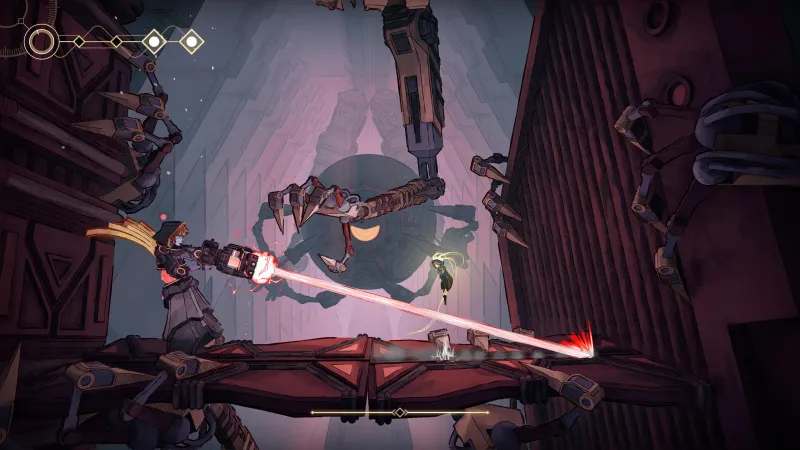
Nonetheless, despite my frustration, Mio is an undeniably beautiful and fun game. Watercolor backdrops bring color and life to this ruined spacecraft. A sparing, haunting score mixes gentle ambient beats with brief melancholic choral harmonies. Upgrades give Mio great versatility to navigate the environment with double jumps, wall-climbing, and more. Enemies (especially bosses) demand careful attention and the deployment of dodges, quick reactions, and the learning of a wide array of telegraphed attacks. And the complex map is a puzzle in its own right, especially as the game rounds its final corner and offers a compelling new twist on navigating the ever-expanding corridors, rooms, and elevators.
Rather than supply a steady mix of upgrades to turn Mio into a powerhouse, progression is restrained and all about giving options rather than dramatic power growth. Want to see your enemy’s life bar? You might need to turn off Mio’s status and health display. Want that desperately needed extra layer of protection? You may need to lower your combo attack power to make it happen. Even by the end of the game, Mio is in many ways the opposite of a power fantasy; she has greater flexibility to move and traverse, but she remains fragile and small right up to the credits – lending her journey’s arc an increased impact for the way she might finally save the day.
Like the rest of the game, Mio’s narrative is limited and leaves much unexplained. In this regard, I think Douze Dixièmes missed an opportunity to drive home an emotional core. By the end, I felt like some of the hoped-for investment in relationships and characters – and especially one of the main antagonists – felt unearned. Even so, the sense of loss and sacrifice at the game’s core shines through.
With many great games, I am eager to shout from the rooftops to get as many people as possible to play. I sincerely enjoy Mio, but I’d also be extremely hesitant to recommend its rigors to all but very experienced players, eager for platforming, bosses, and exploration that are often more chore than satisfaction. However, if that kind of thing sets your heart aflutter, Mio should be very high on your list of must-plays.