

The developers behind Halo and Destiny 2 reboot one of their very first games into a flashy new extraction shooter, which requires perseverance to see its full potential.
Bungie’s Marathon couldn’t be more aptly titled, given its arduous journey to release. Originally announced in May 2023, the extraction shooter’s development has been complicated by restructurings at the studio, mass layoffs, and a plagiarism controversy (now resolved to the affected artist’s ‘satisfaction’) which threatened to bring it crashing down entirely.
A significant delay later and Marathon arrives in 2026 with a steep hill to climb. It’s one of the few remaining pillars of Sony’s live service pursuits – an overzealous bid to land its own Fortnite or Apex Legends which has left a trail of dramatically short-lived failures and cancelled projects. The other awkward hurdle is Arc Raiders, a fellow extraction shooter which pipped Marathon by a few months and has achieved the breakthrough success Sony has so desperately craved.
In theory, if anyone could deliver a persistent hit it would be Bungie. The studio has built its reputation on everlasting multiplayer shooters like Halo and Destiny. In fact, when you consider its pedigree, the buzz around Marathon feels oddly low key – which might be a byproduct of its troubled development lowering expectations, the changing make-up of the studio, or the broader unfamiliarity with the niche shooter subgenre it’s targeting.
Ironically, the title hoping to springboard Bungie into the future harkens back to the studio’s roots. This is a reboot of its Doom-esque first person shooter from 1994, which hardly anyone played because until recently it was only available on the Apple Macintosh. Beyond the title and some broad story strokes, though, the only connective tissue appears to be the loud, strident colour palette of its sci-fi aesthetic, so it’s a somewhat bizarre decision to bind it to such an obscure, 30-year-old curio.
Based on what we’ve played in the Server Slam ahead of launch (servers for the final game were not active ahead of launch), 2026’s Marathon is an odd proposition. It’s unwelcoming, convoluted, and can be frustratingly impenetrable for those unfamiliar with extraction shooters. If you persist with its steep learning curve though, and bear with its irritations, a glimmer of the compelling, high-stakes shooter it’s trying to be starts to shine through.
Expert, exclusive gaming analysis
Sign up to the GameCentral newsletter for a unique take on the week in gaming, alongside the latest reviews and more. Delivered to your inbox every Saturday morning.
At first, Marathon’s slick cinematic qualities are a dazzling jolt to the system. The opening neo-futuristic sequence – a pleasing smorgasbord of vibrant graphics and wireframes – introduces the premise. You’re a Runner, a disconnected consciousness who inhabits a biocybernetic shell of your choice, who is hired to retrieve salvage from the ruins of a human colony on Tau Ceti, in response to a distress signal from a lost colony ship called the UESC Marathon.
After you’re beamed into a shell, the tutorial shows you the basics of extraction. If you’ve played Arc Raiders, you’ll know the PvPvE (player versus player versus environment) gist. Land in an area, whether solo or in teams of three, rummage for loot to stock up on gear or to complete objectives, and get out alive via an exfiltration point placed at various points on the map. If you’re killed in action, whether by a fellow Runner or patrolling AI robots, you’ll lose everything you’ve accrued or equipped.
It’s a simple loop, but an intimidating one for newcomers trying to find their feet among the vast areas, abundance of gear, and dangerous stakes. Arc Raiders and Escape From Tarkov have smartly implemented ways to ease the pain, and Marathon borrows some of these – like free loadouts you can use to eliminate fears of losing your gear. Marathon has another alternative in the Rook shell, a solo-only class with a free loadout and the ability to temporarily disguise itself from enemy AI robots. As you’d expect, it’s not very helpful for fending off enemy Runners but if you’re in desperate need to farm supplies, it’s a good option for stocking up.
While Marathon has these assurances, the game is obtuse and unforgiving in almost every other facet. As many have highlighted already, the menu interface is a perplexing mess – and an example of where the stylish presentation veers into an overproduced headache. Swapping out loadouts takes four steps longer than it should, the inconsistent fonts and colour schemes make it difficult to parse what’s actually important, while the process of digging through your vault for specific mods and consumables is a cumbersome buzzkill.
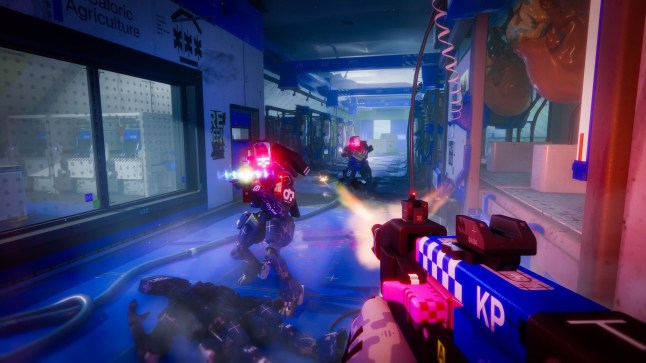
At the outset, the gameplay mirrors these frustrations. In comparison to Arc Raiders, the time-to-kill is more punishing than you’d expect, and when combined with the high volume of surprisingly tough AI robots populating loot-filled areas, runs can end abruptly before you’ve even tracked an objective. It doesn’t help that the fog of war feels conjured by John Carpenter himself, leading to instances where we were shot from afar by AI we could barely even see.
A high difficulty curve is fine if you’re told what you need to succeed, but it feels like Marathon has a communication issue. This single tips tweet from Bungie does a better job of guiding players than anything in the actual game – and its mere existence implies some failure to onboard players effectively. In many respects, between the opaque menus and the sharp difficulty at the outset, Marathon carries an assumption you’ve played an extraction shooter before – which is odd considering how niche the subgenre is, especially pre-Arc Raiders.
If you study its quirks and brute force through some of the faction missions, however, elements of Marathon’s design start to click. The time-to-kill becomes more manageable once you have enhanced shield implants in place. When you realise how the rewards system functions, with quests and data cards giving you credits even if you don’t survive a run, your mindset shifts towards prioritising these for upgrades and not being too disheartened by death.

At one point, we decided to avoid gunfights altogether – a jarring idea considering Bungie are known for their great gunplay, which is certainly present and correct here – and found ourselves in a far better groove with Marathon’s pacing. After sliding past some close calls, we found an unstable sample glitching electrical pulses around the nearby environment. We picked it up and had to take it to a stabilisation device across the map, before we could extract it, all while sneaking our way around patrolling enemies and keeping an eye out for opposing players.
The long stabilisation process triggers intense paranoia, with gunshots and robot footsteps sounding off outside. So we hunkered down into a corner, sights set on the door, until a green light signals it’s completed. Turns out, the purple item it produces is pretty valuable. This starts a scramble to an exfiltration exit and, in this instance, we saw another player had already started the countdown. A fellow gamer can’t be trusted to be reasonable in these situations, so we hid nearby until the last few seconds, before running out and sliding into the exit field to escape – to the surprise of the trigger-happy foe who, quite rudely, tried to kill us off.
It’s during these runs – when you’re prioritising the completion of tasks over gunfights – where you start to see the potential of Marathon’s emphasis on speedy bitesize extraction. We didn’t have enough time with the Server Slam to see how the gameplay evolves once you have more upgrades and bountiful runs under your belt, but we felt more compelled to dive back in by the end, despite the frustrating first impression we were left with initially.
Whether enough people will persevere with Marathon, to understand its nuances, is the big question but Bungie is promising a lot over the coming months to keep the grind appealing. Along with a ranked mode, the big selling point the developers are hyping up is the upcoming Cryo Archive – an endgame zone aboard the Marathon ship which sounds like the game’s equivalent of a Destiny raid, with close quarters fights and puzzles to solve.
Marathon does show some promise, but it falls short in some pretty fundamental areas, compared to its competitors. Despite the great art direction in matches, with its block-coloured sci-fi future coming off like Splatoon meets 2017’s Prey, the atmosphere has a one-note sterility to it.
There’s a hanging, unnerving dread in the post-apocalyptic world of Arc Raiders, amplified by the sense of scale and not knowing whether fellow players will be a friend or foe, but Marathon’s tighter spaces – and the faster urgency of its gameplay – feels like it suffocates the possibility of more interesting interactions. During the Server Slam, we didn’t have any exchanges with opposing players that didn’t end up in gunfire, and it doesn’t feel like Marathon is encouraging anything other than gunning down everything that moves.
This might be a conscious move to distinguish Marathon from its rivals, but between the steep learning curve and the terrible tutorials, it’s difficult to know whether people will stick with Bungie’s shooter over other titles scratching a similar itch.
At the moment, Marathon shows signs of being able to go the distance, especially if its thrills deepen the more you sink into its breadth of upgrades and weapons. But after this early test, it feels like there are a lot of obtuse hurdles, and peculiar design choices, stopping it from being a true contender.
Formats: PlayStation 5 (reviewed), Xbox Series X/S, and PC
Price: £34.99
Publisher: Bungie
Developer: Bungie
Release Date: 5th March 2026
Age Rating: 16

Email gamecentral@metro.co.uk, leave a comment below, follow us on Twitter.
To submit Inbox letters and Reader’s Features more easily, without the need to send an email, just use our Submit Stuff page here.
For more stories like this, check our Gaming page.