


This review in-progress includes my experiences from playing both the Server Slam that took place Feb 26 – March 2, as well as the first few hours of the full release. Further thoughts will be available after the first batch of updates and the game’s raid is complete.
Bungie is a studio that needs little introduction, as their first-person shooter pedigree is etched into history. The Halo series defined modern console shooters and established many important elements in modern online PvP modes and communications, while Destiny and Destiny 2’s ever-evolving nature was the blueprint for live-service looter-shooters. While Bungie didn’t invent the online shooter or even the concept of an online loot-based experience, they improved upon those formulas and became a success story that many current devs aspire to and base their work on.
With extraction shooter titles like Escape From Tarkov and Arc Raiders dominating the charts, Marathon is Bungie’s attempt to threepeat and rise to the top of this popular subgenre. Set on a planet called Tau Ceti IV, this first-person extraction game serves as both a reboot and follow-up to 1994’s Marathon — Bungie’s precursor to their Halo series.
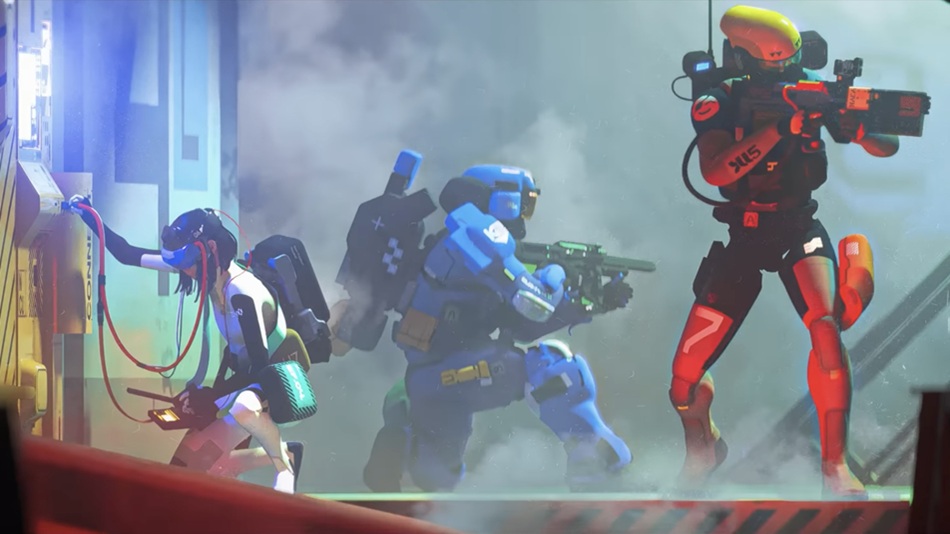
Players control characters called runners, each equipped with a robotic shell that acts as their respective class, complete with specific abilities and attributes. I mostly ran with Destroyer, a tank/assault shell who had a riot shield and the ability to run faster at the cost of heating up (it’s Marathon’s equivalent of using up stamina.) A few other shells were part of my rotation, like Vandal and her ability to double jump, and Triage, who throws medical drones to teammates for healing and to prevent bleeding out when downed.

Gameplay consists of deploying into a map shared with other teams that are composed of real people as well as random NPC bots from the in-game antagonists, the UESC. Players can choose to be in a group of three or even play duos or solos, though this comes at a clear disadvantage. Within a 30 minute time limit, players explore a map while completing missions called “contracts” and extracting whatever resources they want or need off the map.
If they successfully exfiltrate before the time limit, everything they pick up is safe and brought with them, but if they die before making it back, it’s all gone. Anything they’ve previously brought back to their vault within the game’s lobby is safe, however. Before each match, there is a preparation phase where players can build a loadout, buy guns from the armory and choose their contract.
The contracts serve as both a guide to help ease the player into the mechanics of Marathon, and as goals to set before each match — things like looting lockers or activating different terminals across the map. These contracts are given to players by one of six factions, each focusing on different aspects of gameplay and offering rewards and separate upgrade tress that unlock weapons, upgrades, and other useful perks.
Players can choose to focus on one faction or switch between them. I opted for a variety of contracts based on factors like which the three maps I was picking, or which weapons I had on me. For example, the PvP-focused Arachne faction required me to actively engage with enemy players, and their contract proved to be quite a challenge. After hours of grinding it out, I was rewarded with a sweet sniper rifle among other goodies. Other factions focus on things like basic upgrades or survival elements, like health boosts and shield upgrades.

What these factions also provide are bits of the overarching narrative. Rather than a traditional campaign or linear narrative, Marathon’s story is provided via conversations from each of the factions, as well as tabs within the codex menu. There’s a lot to dig into with story, lore and thematic elements that I’ll cover in a full review later.
Being an extraction shooter, the loot within each of the three maps varies in rarity and value, and there’s a high level of risk vs. reward at play, as the longer someone stays within a map, the more likely they’ll be killed and lose their stuff. Sure, there’s a chance to extract some high-quality loot, but the looming threat of death is always near, not just from other groups of players who envy their haul, but also from roaming NPC enemies ranging in rank and abilities. I’ve gotten shot a few times from lingering a bit too long at a supply drop or looting the body of another runner.
Each of three launch maps range in difficulty and loot quality. Perimeter is full of buildings with labs and a lot of verticality, allowing for some great recon and long-range firefights to take place, while Dire Marsh is a hostile swamp with strange anomalies and an overwhelming amount of NPC bots. The last map, Outpost, is a dangerous, close-quarter series of hallways full of NPC enemies and one main exfil point, making for tense firefights that can completely ruin a good run.

As one might guess, the gunplay is nothing short of exceptional, marrying the heavier and tactical shooting from Halo with the exceptional aiming and smooth firing from Destiny. Characters are weighty and the guns pack a powerful punch.
25 hours in, I can safely say that I am enjoying it immensely. Playing with a full squad of friends results in smart and tactical gameplay as we coordinate specific tactics and sift through the best loot to extract. Taking down an enemy team by the skin of our teeth or extracting successfully after being downed by another player is both stressful and rewarding, and in this vein Marathon provides great stories to tell.
In fact, some of my favorite moments so far involve clutch performances, like rescuing my squad from a team who ambushed us, waiting patiently to get the jump on unsuspecting players, and successfully reviving downed teammates. Of course there are moments of frustration, like losing a powerful, Halo-esque battle rifle I randomly found because I got too cocky and pushed towards an enemy team when I should have pulled back. However, even in death and loss, I never felt too angry or disappointed, as each defeat came with some sort of progression, be it XP to level up things like my vault space for held weapons, or meta progress in knowing how to better navigate the map and approach firefights.
As with all live service games, Bungie has provided a roadmap to detail what their plans are. Season 1 will run from March to June, which brings with it a raid, new map and the introduction of a ranked mode. There is a rewards pass with both free and premium items, though the premium rewards are purely cosmetic, as they are bought with real money. In June, players will have their vaults, level and faction reputation wiped — basically, each season will have players start fresh. It’s an interesting system and I look forward to seeing what changes come with Season 2. Seasons and new maps are free to all players.

There’s a lot to dig into with Marathon, and many work nights have been lost to my awful “just one more run” compulsion kicking in. Given Bungie’s reputation and track record with online games, I’m confident that this will grow into a strong competitive experience that has a great shot at becoming the top competitor that Bungie surely wants it to be.
The post Marathon (2026) Review-In-Progress appeared first on Gamecritics.com.


Thanks for sharing your insights on the Marathon review-in-progress! It’s always interesting to see how games evolve during testing phases. Looking forward to your final thoughts!