

Wages Of Fear

HIGH A great gameplay loop paired with exceptional gunplay.
LOW Dying.
WTF Missing so much sleep thanks to this game.
On one of Marathon’s three launch maps, Perimeter, there’s a randomly-appearing boss NPC called the Warden. This ultra-hard bot can clone itself and has a shield that takes forever to break, so naturally myself and two other teammates decided to test our luck.
After dumping hundreds of light machine gun rounds into this one enemy (and each of us reviving the others in the process) I delivered the final blow to the Warden. Sudden shock and disbelief hit our comms and we looted the body, finding solid weapons and valuables to sell, as well as a piece of loot needed for the then-upcoming endgame content.
In all that excitement, we forgot to make sure the coast was clear.
We got greedy and reckless in a brief moment of downtime, we got picked off my another team that got the drop on us, and we lost some great stuff in an embarrassing and frustrating way. Yet, rather than dwelling on that loss, we simply decided to run it back and loaded into another round.

Developer Bungie knows a thing or two about crafting compelling first-person-shooters. Within the last 25 years, they’ve gone from changing the console shooter landscape with Halo to diving head-first into the looter-shooter and live-service territory with Destiny. Those franchises thrived on engaging gameplay loops and some of the tightest gunplay ever crafted. As the rest of the industry plays catch-up with the studio, Bungie has taken their wizardry into a new subgenre — extraction shooters.
Played from a first-person perspective, Marathon’s loop is simple. Players load into a map, loot what they can, be it weapons, upgrade materials or even junk that’s worth money, and get out alive. If players die before they’re able to exfiltrate, they lose everything they came in with as well as anything they might’ve picked up. If they survive and exit successfully, they keep everything.
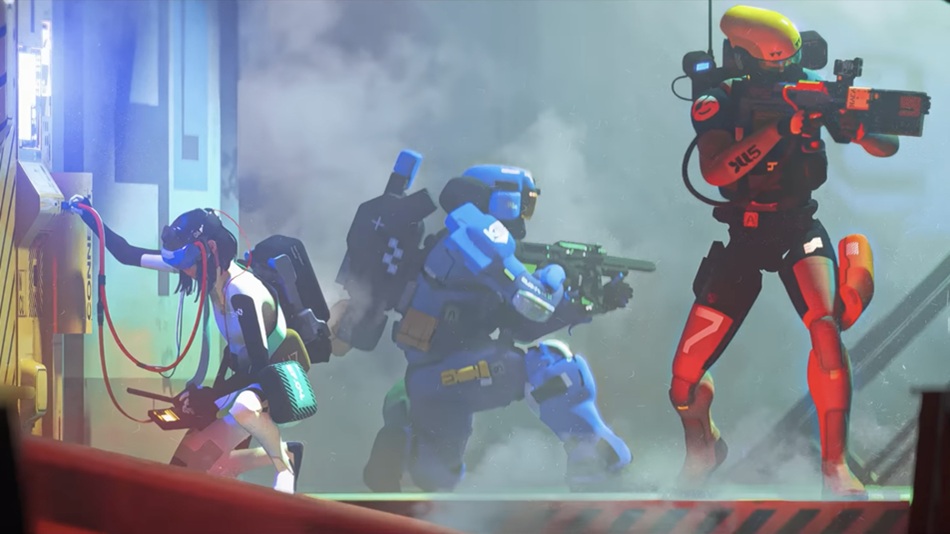
Players control characters called runners, each equipped with a robotic shell that acts as their respective class, complete with specific abilities and attributes. I mostly ran with Destroyer, a tank/assault shell which has a riot shield and the ability to run faster at the cost of heating up (it’s Marathon’s equivalent of using up stamina.) A few other shells were part of my rotation, like Vandal and her ability to double jump, and Triage, who throws medical drones to teammates for healing and to prevent bleeding out when downed. Each of the shells provide plenty of variety for different playstyles.
Throughout each match, players must not only try to survive while hanging on to good loot, but they also have to contend with a variety of hazards like NPC enemies and real-life enemy players, all within a 30-minute time limit. As the clock winds down, specific zones on a map are marked for players to exfil from, each slowly disappearing as they’re used by other teams.

Players can choose to be in a group of three or even play duos or solos, though this comes at a clear disadvantage, barring the latest update that allows for duo-specific runs on certain maps. Before each match, there is a preparation phase where players can build a loadout, buy guns from the armory and choose their contract.
The contracts serve as both a guide to help ease the player into the mechanics of Marathon, and as goals to aim for before each match — things like looting lockers or activating different terminals across the map. These contracts are given to players by one of six factions, each focusing on different aspects of gameplay and offering rewards and separate upgrade trees that unlock weapons, upgrades, and other useful perks.
I opted for a variety of contracts based on factors like which of the three maps I was picking, or which weapons I had on me. For example, the PvP-focused Arachne faction required me to actively engage with enemy players, and their contract proved to be quite a challenge. After hours of grinding it out, I was rewarded with a sweet sniper rifle among other goodies. Other factions focus on things like basic upgrades or survival elements, like health boosts and shield upgrades.
The core gameplay is exceptional, as gunplay and movement strikes a fine balance between Halo’s heavier and methodical approach to combat and Destiny’s fast-paced aiming and firing. The player shells are slower than most online-shooter characters and most movements, and I found myself taking a measured approach to gunfights by staying low to the ground, and walking instead of running.

Like most extraction shooters, running into other players is an inevitability. Barring a few exceptions, Marathon actively discourages PvP fights, as the low time-to-Kill (TTK) means matches can end seconds after loading in. However, I noticed a trend in which every player would shoot first, without hesitation. There’s certainly an aggressive community here, as if everyone playing is collectively anxious at the idea of losing good loot.
Proximity chat is also a major part of Marathon, allowing for communication with players who are close by. I had one memorable match where an enemy Vandal and I traded a few shots back and forth, only for me to stop when I heard them say “Friendly!” over and over again via proximity chat. I approached them and we each dropped a few items as a sign of good faith and went on our way.
Each of three maps available at launch range in difficulty and loot quality. Perimeter is full of buildings with labs and a lot of verticality, allowing for some great recon and long-range firefights to take place, while Dire Marsh is a hostile swamp with strange anomalies and an overwhelming amount of NPC bots. The third map, Outpost, is a dangerous series of close-quarter hallways full of NPC enemies and one main exfil point, making for tense firefights that can completely ruin a good run.
All of these maps culminate in the endgame level known as Cryo Archive, set within the titular Marathon ship. Here, players are tested in tight spaces where enemy NPCs are incredibly strong. There’s also a huge buy-in, as players need to be able to construct a loadout worth about 5,000 credits. The Cryo Archive is also only available during weekends this season, giving players a chance to work towards building up for it throughout. I have yet to complete a successful exfil, but I’m looking forward to trying again soon.

The gameplay loop is an effective one and even though dying and losing everything sucks, I rarely ever found myself truly upset after death. Most of the time, my group and I reflected on the nature of a loss and determined what we could do better on the next run. Like the best roguelikes, the appeal of ‘just one more run’ is always there.
A major aspect of Marathon that surprised me was the storytelling and aesthetic. Rather than featuring a traditional campaign, the narrative is told via cutscenes within each faction’s menu and through bits of lore. Here, Bungie details harrowing stories of unchecked capitalism and the dangers of artificial intelligence. It’s all dark and brooding, with incredible style and plenty of hard sci-fi elements. I loved the bold colors and minimalistic, computerized look throughout. Also, special shoutout to Ryan Lott’s score, as the heavy electronic music adds to the tension and sense of dread that permeates every match.
As a huge speculative fiction nerd, I many of parallels to my favorite authors, like the transhumanism and capitalistic themes reminiscent of William Gibson’s works (Neuromancer) or the strange and unfamiliar worlds players touchdown in that feel ripped straight out novels like Jeff Vandermeer’s Annihilation. If Halo and Destiny are about fighting for a better future, Marathon’s darker approach is about saving oneself from a horrible gig economy, as each runner is in debt and extracting all this loot for a hefty neck-saving payday.
Marathon is an excellent experience, and a great shooter made by a great developer. Taking all the lessons they’ve learned from decades of FPS design, Marathon succeeds with gameplay and gunplay that’s leagues better than anything else on the market. I’ve lost more sleep in the last few weeks than I have playing any other game recently, and while the online crowd may be a bit too hostile at times, those willing to engage with its dynamic loop will be rewarded with one of the finest first-person shooters this generation.
Rating: 8.5 out of 10
Disclosures: This game is published and developed by Bungie. It is available on PC, XBX/S, and PS5. This copy was obtained via publisher and was reviewed on PS5. Approximately 50 hours were spent across the multiplayer. There is no single-player.
Parents: According to the ESRB, this game is rated T for Animated Blood, Language, Violence. The official description reads: Marathon is rated T for Teen by the ESRB with Animated Blood, Language, and Violence. Also includes Users Interact and In-Game Purchases. This is a first-person shooter in which players assume the roles of bio-cybernetic mercenaries that perform missions on a distant planet. Players engage in salvaging/extraction missions across the planet’s surface and a derelict warship, completing contracts and obtaining loot. Players use pistols, machine guns, and explosives to defeat opposing mercenaries and military robots. Combat is often fast-paced, accompanied by realistic gunfire, large explosions, and cries of pain. Players can trail blue-colored blood on the ground when downed by enemy fire; some areas depict corpses lying in pools of the blue liquid. The word “a*shole” is heard in the game.
Colorblind Modes: Colorblind modes are present in the options menu.

Deaf and Hard of Hearing Gamers: Sound plays a major part of the game, be it for listening to gunfire or hearing player chatter. There aren’t any options to convert these to visual elements. There are no quick text phrases or other non-verbal options available for the proximity chat function. Subtitles can be adjusted. This game is not fully accessible.

Remappable Controls: The controls can be remapped.

The post Marathon (2026) Review appeared first on Gamecritics.com.