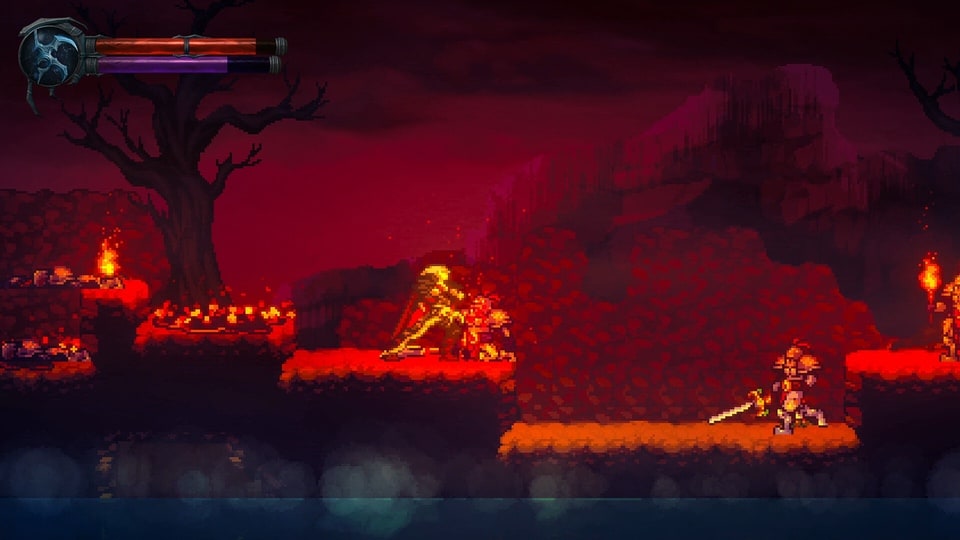

After years of complete silence from the Legacy of Kain series, this month has seen it resurgent, first with a remaster of Defiance (which I sadly found pretty underwhelming), and now with a brand new title in the world of Nosgoth. Resulting from a successful Kickstarter campaign, and accompanying a graphic novel detailing the story, Ascendant gives players the opportunity to delve back into the bloody scheming of gaming’s greatest antihero, Kain, along with series stalwart Raziel and the new character of Raziel’s sister, Elaleth. All of this is wrapped up in a striking 16-bit pixel style that is provides a fresh take on the Gothic excesses of the franchise. But, most importantly, how does it play, and will it usher in a new wave of Kain fans?
The introduction of Elaleth is the most obvious new aspect of Ascendance. All previous games have featured the dual, and duelling, protagonists Kain and Raziel. Elaleth comes into the narrative in the gaps between the first game and Soul Reaver. Trapped in the vortex of time by the scheming of Morbius, she seeks revenge on her brother because he was forced to kill her beloved after witnessing him transform into a vampire. In doing so, Raziel cut off Elaleth’s hand to try and prevent her being infected but was unsuccessful. This twisting story of vengeance and self-righteousness pushes the gameplay along and also helps to fill in the gaps from the original series. Elaleth is a relatively one-track character, though, and lacks the complexity of the other two.

During the game’s brief playtime – I finished in 4 hours on Hard difficulty – you will switch between Elaleth, Raziel in both human and vampire form, and Kain himself. Each character has some unique skills, but the controls largely revolve around a simple trio of buttons with jump, attack, and dash being your mainstays. The final face button is used for each character’s powers with vampires being able to swoop down on enemies, Kain being able to cross distances as a flock of bats, and human Raziel having a torch to burn vampire foes and stop them from respawning. The controls perfectly suit the SNES-style aesthetic and it does feel like a lost game from that era much of the time (this is a good thing, by the way). There is also a block and parry mapped to the right shoulder button, but I killed over 1000 enemies and have apparently used this only 26 times.
The problem with such stripped back controls, however, is that combat lacks much in the way of variety. There are some difficulty spikes (perhaps as a result of my not realising I was playing on Hard until the final stats screen appeared) where it is easy to get overwhelmed and die quickly, and countering these requires you to take a slow and steady approach which feels counterintuitive to the arcade combat style. When playing as one of the vampires, this steady approach is further disincentivised by the fact that your health is constantly draining and you need to feed off defeated enemies or collect blood orbs to recover. Managing your health while deciding which encounters to avoid becomes a key strategy, although there are regular chokepoints where you have to kill everything to progress. Fortunately, checkpoints are pretty frequent so you rarely have to repeat too much when you inevitably succumb.

The game proclaims that it is based on verticality (hence the Ascendance name) and this is true to a point with the winged vampire levels (both Raziel and Elaleth) being able to fly upwards at the cost of magic power (which regenerates slowly or can be boosted through green orbs). These sections play out as mini puzzles where you have to navigate obstacles whilst replenishing your magic along the way and are mostly fun, with a couple proving frustrating. Aside from these sections, though, much of the game is a more traditional left to right hack and slash action platformer. Not a bad thing in and of itself, but not quite what was advertised.
As a Kain game, a large part of the appeal comes from the lore and voice acting and Ascendance holds up well here. Series regulars reprise their iconic roles and each feel very in character, with Kain dripping condescension and Raziel tormented by his fate. Elaleth mostly displays anger, but there are some scenes where a little more range is allowed and her voice acting is on par with the rest of the cast. The story itself feels like a fitting addition to the wider lore, although there have been some eyebrows raised at the way that Elaleth is inserted into iconic moments. A special mention needs to be made for the music by Celldweller which is excellent, including some banging remixes of series favourites.

One of my main complaints with the game as a whole is the weird lack of aesthetic coherence. The playable parts are good, with a pixel aesthetic that reminded me of classic GBA and SNES Castlevania, and the level progression feels heavily reminiscent of Super Castlevania IV in particular (this is very much not a search adventure game although there are hidden collectables to find across the levels). However, there are regular cutscenes that shift between anime style, PS1 3D, and even a weird chibi flashback. These had the unfortunate effect of making the game sometimes feel like a piecing together of deleted concept art rather than a fully cohesive vision.