
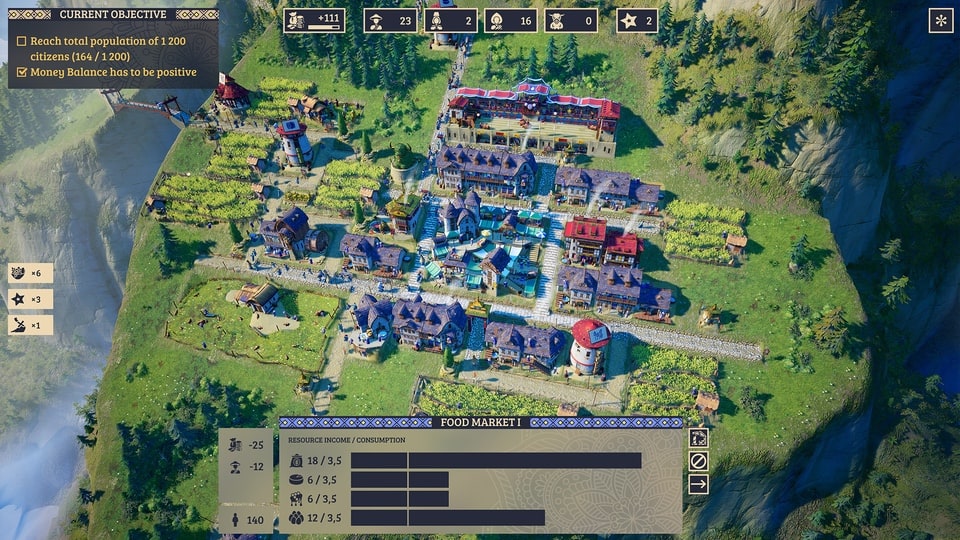

City builders are one of my favourite types of game. Building an idyllic little town, putting together efficient production lines, and planning where more of them will go later is an addictive and immensely satisfying loop. Of course, mess it up and you’ll find yourself in a budgetary black hole, creating a death spiral as your town slowly perishes. Laysara: Summit Kingdom is one such game, but this time, you’re building on the side of a mountain, planning for avalanches, and building bridges to access other parts of the mountain.
The kingdom of Laysara is awash with a thick fog that blankets the entire region. The obvious solution, then, is to literally rise above it and build your towns on the mountains, so that’s what you set out to do with three bickering advisors at your side. One is a monk, one is nice and friendly, whilst the last and least of the trio is obviously focused only on dangers and profit. They’ll guide you through a very necessary tutorial, because whilst the basics here are what you might expect, there are a few crucial differences.
For one thing, you’ll need to set up supply chains yourself, which means you need to tell newly constructed building where it will send its production and supplies, or it will just sit there doing nothing. You’ll also need a good amount of bridges to connect up the buildable slopes of the mountain you’re on, and shafts – which are basically lifts – to get higher up the mountain. This is important, as certain resources will grow more efficiently at certain altitudes, not to mention the preferences of the different worker types.

Monks prefer higher altitudes, while there are also lowlanders, who will work farms and other more menial jobs, and artisans, who do skilled work like blacksmithing. You’ll grow familiar with these groups, as meeting their needs allows you to upgrade their housing, increasing the amount of people that live there. Unsurprisingly, space is a bit hard to find when you’re building on the side of a mountain, and upgrading your housing saves a lot of it. To please them you’ll have to have a look at what they want, obviously, then build it. It can be types of food, access to tools, baths, places of worship, some of which can be really tricky to accomplish depending on the mountain you’re working with.
Technically speaking, if you don’t have enough workers to fulfil your needs they’ll be imported, but at a huge cost to you. Seriously, building a mine, then a forge, then a building to distribute the goods, could take you from +500 income down to the negatives if you have to import all the workers.

At least you don’t have to worry about your workers dying in battle as there is no combat in this game. It’s pure building, and the enemy is the elements. More specifically, it’s avalanches, which can decimate large parts of your town if you don’t plan ahead. This isn’t an “I’ll cross that bridge when I get there” kind of problem, it’s a “This will destroy the whole bridge if I don’t plan first” thing. You can use foresters to create natural tree barriers, both for a resource and to block weaker avalanches, but they won’t stop the stronger ones on their own. Instead you’ll need another layer of walls to stop the avalanche after it’s been weakened by the tree barrier. It’s a simple enough system, but it works well enough.
As your town gets more advanced there are a variety of quite fiddly, but very effective and satisfying tools. Your buildings can only send their supply so far, so you can use carrier posts to not only enhance that range, but also distribute a resource to multiple different buildings. For example, a mine that delivers to a blacksmith, that delivers to a distributor is inefficient, as the mine provides more copper than the smith can use. If you deliver it to a carrier post, you can build additional mines and have the carrier post distribute them automatically.
The range on buildings on carrier posts is quite short, but you can send stuff through a cart post to basically do the same thing throughout most of the island. These are incredibly useful tools that really allow you to set up pretty complex chains, which is really enjoyable provided the slight fiddliness doesn’t bother you. Playing on console, that’s accentuated by the controls as well. For example, in the tutorial you’re told you can connect buildings for a supply chain using triangle on the DualSense, but this button also opens the floating campaign mission window, so doesn’t work most of the time. Thankfully, you can do it from the building’s menu as well. There can be a little awkwardness with how the menus work on a controller as well, but as there isn’t a huge amount of space to comb over and the cursor speed isn’t too high, so it’s not the biggest problem.

Whilst you’re doing all of this, the game just looks beautiful. In addition to the sky-scraping setting, it’s bright and colourful and every little thing you add just somehow fits into the idyllic little mountain village you’ve built. It’s a great looking game, even the avalanches look good, though you’ll be too distracted to notice if you’ve forgotten to plan for them.
There aren’t too many negatives here really. It’s a bit light on the strategy really, there are definitely more complex city builders out there, so if that’s what you’re looking for then you might be a little underwhelmed by the difficulty on offer. If you’re playing on console there are a few control issues you might expect, but less so than in many other similar games. Other than that, it can be a little difficult to find what you’re looking for in the building menu, but you adjust to that pretty quickly.