
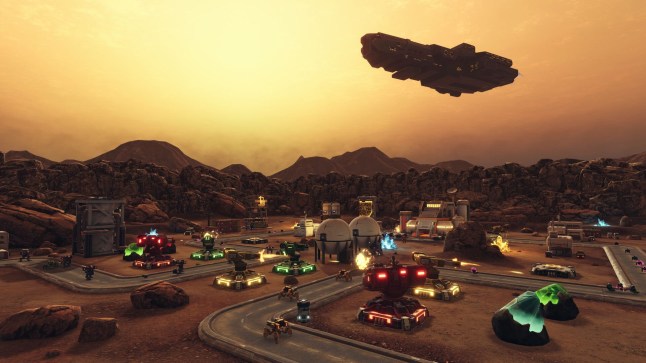


PSVR2 is still getting a steady supply of new games and this tower defence sequel is one of the best VR experiences of recent months.
Virtual reality is incredibly effective at making you feel immersed in the fiction of games. Rather than watching events unfold on a screen a couple of meters away, there’s a sense of being part of the action in a way that simply isn’t possible using a TV. Not all genres are affected equally though, and while shooters, driving games, and flight sims can all lay easy claim to being radically enhanced in VR, how does that work with tower defence?
A bit like playing Sony’s classic platform game, Astro Bot: Rescue Mission, which placed you in the middle of its charming robotic world, hopping your bot rescuing droid around the space where you were sitting, the original Iron Guard had you roaming a virtual battlefield about the size of squash court. In your right hand you held a drone with a laser you could use to help defend your base, while your left hand held a controller that let you build and upgrade turrets.
Scudding about the battlefield, you could quickly move towards any area causing you trouble, adding towers or using your miniature spaceship to pump rounds into mobs. But there was always an odd tension between holding what felt like a toy-sized ship, and a disembodied game controller of a similar size, while hovering over industrial sites that were meant to be a representation of the real world.
Are you supposed to be some sort of massive, benevolent giant? Or are you more like a visitor to a model village that’s being invaded by aliens? It’s never really made clear, but once you get used to performing so many actions with your left hand, it’s a set-up that works surprisingly well. The sequel, Iron Guard: Salvation, uses the same premise, but arrives with a far greater degree of polish and poise than its slightly rough around the edges predecessor.
You’ve still got a little handheld drone to shoot with, but this time you can set it to automatic when you’re busy with the more tactical work of building towers. It flies autonomously, getting on with the job of shooting enemies, starting with any target you’ve marked as a priority. That’s useful, because your turrets do the same, making it straightforward to tag, for example, enemies with a healing ability, to take them out first.
Expert, exclusive gaming analysis
Sign up to the GameCentral newsletter for a unique take on the week in gaming, alongside the latest reviews and more. Delivered to your inbox every Saturday morning.
Another issue with the original was that most of its towers just weren’t that useful. The overwhelming majority of missions were best completed by building and upgrading legions of its most basic cannon towers. That’s no longer the case in Salvation, as you’ll need to include a greater diversity of defences to deal with attackers that have quite specific sets of skills and attacks.
Flying enemies are only targeted by rocket defences, while long range lasers are best at taking out shields, leaving your kinetic weapons to finish them off. It encourages you to adopt a range of approaches, the make-up of each level’s enemies informing the most efficient mix of towers to defend against them.
You also now have a hero you can position anywhere on the battlefield. Along with an airstrike that operates on a fairly lengthy cooldown, each of the three available heroes balances their own firepower with tertiary abilities, like buffing nearby turrets, or winning extra loot for each downed enemy. Along with using your drone as a blaster, or to activate the exploding barrels enemies occasionally drop, it adds to your sense of agency in each map.

Things get agreeably hectic in the confines of its miniature landscapes, all of which now look a lot sharper and more detailed. Battles take place on various planets across the solar system, with views of Saturn from its moon, Titan, competing with views of Earth from our own moon, and then engagements across terrestrial biomes, before heading back into space for the last 10 fights of its generous 30 level campaign.
There’s a new range of goals to go with straightforward base defence, with some maps now requiring you to earn and save a certain amount of currency, forcing you to think about how much you spend building turrets, versus how much you save for your stockpile. Others have you defending slow moving evacuation craft, your towers and drone attempting to stop the procession of mobs before they reach and damage them.
There’s also a wider range of enemies. Some heal, others fly, some take off when their shields are depleted, while others drop fast moving mini-bots when they’re destroyed. Each requires its own choices in your turret selection, and you can now also change your mind about where to place them, with tower bases easy to drag around the battlefield before you build on them, which provides a lot more flexibility.
You can comfortably finish the campaign in easy mode over a couple of leisurely afternoons, and even though cranking up the difficulty makes a difference, it rarely gets particularly tricky. You will find being in VR handy though, when the game adds a sprinkling of pyramid-shaped, enemy spawning dropships. You can see their shadows passing over you as they fall into place, something that would be a lot harder to spot on a flat screen.
Iron Guard: Salvation’s only significant failing is its plot and voice-acting, both of which are bizarrely terrible. The script’s stilted, the story’s turgid, and conversations go on too long. Thanks to a glitch we also found that the second character to speak in almost every dialogue scene would cut off the words of the person talking before them. Like the first game, your best bet is to skip the tedious chatter entirely, the action making perfect sense without the need to dress it up in a half-baked narrative about robot terraformers getting hacked.
The important thing is that Salvation’s got it where it counts, delivering a polished and tactical game of tower defence. The set dressing of levels looks great in VR and the well balanced, strategically compelling maps provide more than enough variety to sustain interest across its whole campaign – although it’s a shame there’s no multiplayer. Major publishers may be winding down their interest in VR but Iron Guard: Salvation is proof that great games are still being made.
Iron Guard: Salvation review summary
In Short: Absorbing VR tower defence that improves on the original game in almost every department, but is let down by a pointless, tacked on narrative.
Pros: Good variety of enemies, mission goals, and turrets. Graphically crisp with detailed structures and attractive settings. Impressively polished all round, in terms of gameplay and visuals.
Cons: Abysmal dialogue and voice-acting; glitched conversations have characters interrupting each other. No multiplayer.
Score: 7/10
Formats: PlayStation VR2 (reviewed), Meta Quest, and PC VR
Price: £8.99
Publisher: Xlab Digital
Developer: Xlab Digital
Release Date: 5th March 2026
Age Rating: 7

Email gamecentral@metro.co.uk, leave a comment below, follow us on Twitter.
To submit Inbox letters and Reader’s Features more easily, without the need to send an email, just use our Submit Stuff page here.
For more stories like this, check our Gaming page.