
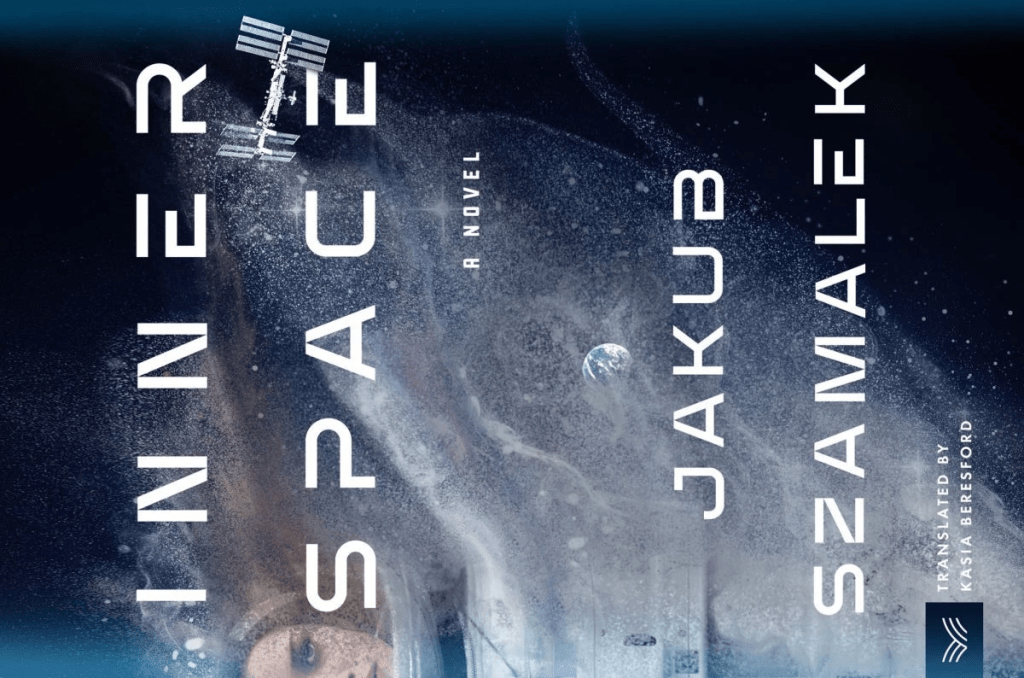


Polish author Jakub Szamalek’s skill in writing conversational dialogue may be known to some gamers from his work on many of CD Projekt Red’s most successful games, such as Cyberpunk 2077 and The Witcher, both being RPGs made all more immersive thanks to stellar writing.
That said, his ability to tell a good novel-length story remained to be seen until I read Inner Space: his first full-length book, originally published in Polish in 2023, and now available in English.
It takes a lot to hold my attention these days between texts and emails (not to mention video games) constantly pulling my mind in different directions, but every time I reopened this book, I was drawn in by Szamalek’s swirling vortex of scandal, political intrigue and crime set aboard the International Space Station.
Usually, sci-fi stories take place “long ago in a galaxy far, far away” or in the distant future with only some mention (if any) of our own galaxy, but Szamalek’s tale is decidedly hard sci-fi, presenting an alternate reality that runs parallel to our own. It refers to recent developments such as Russia’s invasion of Crimea, and touches on space tourism facilitated by eccentric billionaire sponsors – at one point he even name-drops SpaceX.
Structure and point of view contribute to the story’s sense of momentum. It kicks off with an excerpted transcript of a government commission’s hearing concerning an accident that’s being investigated as a crime. Then it alternates between legal proceedings and scenes that lead up to the accident, building suspense with a non-linear structure that allows readers to follow more than one time period, much as director Christopher Nolan structured his 2023 blockbuster, Oppenheimer.
The narrative switches perspectives between highly competent astronaut Lucy Popalsky, who travels to the ISS to fulfill her duties as one of the first female ISS commanders, her neurotic worrywart of a husband Nate, and no-nonsense NASA executive Steve Ayers.
We quickly learn that the end goal of Expedition 75 is to colonize Mars. To accomplish it, Lucy must manage a team comprised (mostly) of scientists who study the potential of fertilizing barren soil on another planet by testing it in space. What could possibly go wrong?
When faced with a crisis that threatens not only the integrity of the ISS, but also the stability of relations between Russia and the US (each country occupying separate wings of the station) Lucy’s confidence falters and the ISS becomes the theater for what could become Cold War II.
Many of the book’s historical references remind the reader of the Soviet Union’s powerful legacy — the author compares remnants of the space race, such as the Cosmodrome, to relics of an ancient civilization.
Szamalek also makes the reader feel just how brutal day-to-day life can be in space. He details the excruciating pain and discomfort of being a passenger during both a rocket launch and return journey, as well as trivial things like the hilariously awkward prospect of zero G sex and, of course, the sheer terror that comes with being trapped in a claustrophobia-inducing hunk of metal orbiting Earth with a fragile life support system, easily compromised by even a slight imbalance of chemicals in the air.
As one character observes, “Reality [is] much more complex. More hostile.”
After a first chapter that establishes the characters and the situation, comes the incident that puts the plot in motion — an ammonia leak of mysterious origin which turns the story into a whodunit. The atmosphere becomes increasingly tense as Mission Control attempts to handle the situation by scrutinizing the team’s every move, even down to their individual heart rates and mental acuity.
Soon after, Szamalek focuses on co-protagonist Steve Ayers and paints him as a workaholic with old-school sensibilities, often staying after-hours to study files under the dim light of a desk lamp. He’s also sort of a chaotic neutral character (to borrow some RPG terminology) by saying all the right things on TV, making false promises to the Russians, and then directing Lucy to do what needs to be done on the ISS by any means necessary.
Supporting characters add layers of complexity, and one of the most poignant scenes occurs when one of the Russian crewmates, Lev, apologizes to Lucy. The moment carries a double meaning – he’s sorry not only for his part in the situation they find themselves in, but also for past Russian conflicts with the US, making it both a personal and political apology.
It’s scenes like this that lead me to praise Szamalek for his ability to stir powerful emotions which lie at the core of good entertainment, especially considering the salience of Lev’s apology for such dark times.
By the end, I was also impressed by his flair for coming up with interesting exchanges, his ability to elucidate many of the harsh realities of life in space, his control over the reader’s attention with clever story beats, always keeping them on their toes, and the slickness of his writing style, especially considering how everything was translated from Polish to English – so props to the translator as well.
A few scenes didn’t quite land for me, and some clunky analogies here and there took me out of the story, but despite those small rough edges, Szamalek has proved his talent as an author here, and if this is only his debut, then not even the sky is the limit.
Rating: 9 out of 10
Inner Space was written byJakub Szamalek. It was published in paperback, e-book and digital audiobook formats by HarperVia. A digital copy of the book was provided for review by the publisher.
The post Inner Space Book Review appeared first on Gamecritics.com.


This sounds like a fascinating book! It’s always interesting to see how authors like Jakub Szamalek bring their unique style to storytelling, especially with dialogue that resonates with gamers. Looking forward to hearing more about it!
I completely agree! Szamalek’s ability to blend dialogue with deeper themes really enhances the reading experience. It’s also intriguing how his background in gaming influences his storytelling style, making the characters feel more relatable and dynamic.