
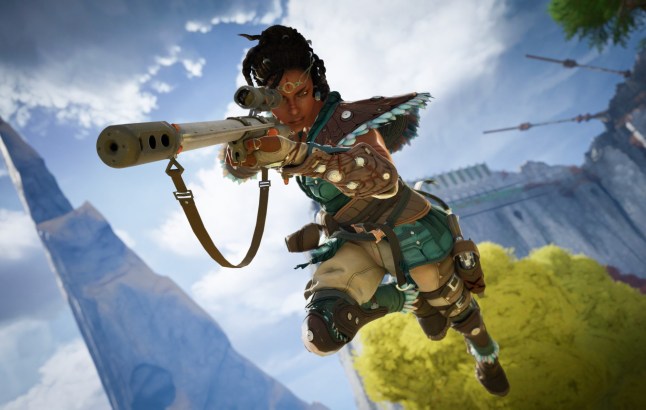


GameCentral speaks with the developers behind Highguard about live service longevity, a potential single-player mode, and the fall of Call Of Duty.
Highguard might be the debut game from Wildlight Entertainment, but it’s a project built from the brains behind some of the biggest first person shooters of the past century. Titanfall, Call Of Duty, and Overwatch are just some of the credits on the team’s collective CV, but for the majority of the 100-plus team, the binding glue is Apex Legends.
Around 60 staff members at Wildlight worked on EA’s battle royale shooter, and its influence is clear on Highguard. Along with being a free-to-play shooter, the gunplay is snappy, there’s an emphasis on ziplines, and you’re scavenging for loot in drops across the large-scale maps. However, there’s plenty of other obvious inspirations, from Rainbow Six Siege and League Of Legends to survival shooters like Rust.
The journey from its announcement to launch has already been rocky, but as with any live service shooter, the actual release is when the hard work begins. Highguard has come out the gate to a mixed reception so far, but with a year of additional content already deep in development, the team is confident they can make it stick.
Ahead of Highguard’s launch, we sat down with Wildlight Entertainment CEO Dusty Welch and game director Chad Grenier, who co-founded the studio together, to discuss the project’s genesis and the changing shooter landscape.
GC: You guys have a huge history with shooters, from Apex Legends and Titanfall to Call Of Duty, what did you want to accomplish with Highguard specifically?
Expert, exclusive gaming analysis
Sign up to the GameCentral newsletter for a unique take on the week in gaming, alongside the latest reviews and more. Delivered to your inbox every Saturday morning.
CG: I think that’s a two-part question, and Dusty you can maybe go into why we started this company with this team, but the game’s vision really just came from a place of looking at what inspired us, playing a lot of games, and four years of trying different things and following what was fun. Four years ago, we didn’t set out to create a game about attacking and defending, and this Shieldbreaker gameplay. It just came to that over three years of experimentation and us play-testing, giving feedback, and realising what the fun parts are and what the not fun parts are.
So, early on we played tons of games, just like always, but now it’s our job to figure out what we’re going to make. So we played a ton of survival games, we played a lot of battle royale games – obviously had all of our experience from Apex and what we liked and felt like we could improve on. We played Rainbow Six Siege. And I think we just pulled inspiration from all of those things. Over the course of three years, we had our game vary wildly from genre to genre, and ultimately settle like a blend of genres.
Hence the ‘raid shooter’ thing. We really just coined the term because we needed a way to describe our game. We don’t really feel like it fits in any one subgenre, so we took inspiration from a bunch of different games we played, and we just knew we wanted to create something that felt really good and, at its core, was a top-of-the-line shooter that had best-in-class shooting mechanics, movement mechanics, offered a lot of new things to players that they’ve never done before.
So that’s essentially what our game mode is. It’s a lot of things that feel familiar – people have planted bombs before and defended them, we’re not the first game to have mounts – but I think what we offer is a unique mix of all of these things in one fresh game mode, in a way that it just feels really good, addictive and fun.
GC: Based on the trailers, I thought the mounts were going to play a bigger role in the game than they actually do. Is that something which changed a lot during development?
CG: I’m curious to hear your ideas! They’re essentially a movement mechanic, right? Instead of having vehicles, we have mounts. We’re excited about it. We’ve got a lot of animal lovers on the team and people who just like making animals. Cute ones, scary ones, big and small ones. It’s a really fun creative outlet for the team. They feel like an extension of your player and not something that you’re on and is clunky, but something that is fluid and on-off. Just very quick.
GC: It does control very well, especially compared to other games with mount combat. Was it challenging to get that movement right?
CG: It’s very hard. One of our designers that cares the most about that has been on mounts for quite some time – one of our engineers. You take people who are really passionate about the motion model, the movement, and the fluidity, and let them work on that for a while, and that’s what you get.
We all care about that, and ironing out all the little edges that the movement can, sort of, stop you. It goes into like, not getting stuck on little tiny rocks and things in the world – it extends everywhere. You want players to feel really good and [that it] feels like an extension of you. That you’re not fighting it.

GC: You’ve said how Highguard was originally going to be shadow-dropped like Apex Legends in 2019. There’s a lot more competition now in the live service space, do you think it is harder to launch a game within that realm now, in 2026?
CG: I will say, we were terrified to launch Apex because it was a saturated battle royale market. As we were developing Apex, it seemed like every week a new battle royale game was coming out, and people were telling us that then. They were saying, ‘You’re making a BR? There’s a BR out every week, and some are coming and going out of business. There’s big reputable studios making them, Call Of Duty has got a BR mode now.’ And that was scary. So we’ve been here before. Now the conversation is, ‘You’re making a shooter in a crowded shooter space’. Well, it’s always been that way, for us. There’s always something.
DW: That’s absolutely right. I think I’m speaking for you and the team, we were far more terrified launching Apex than we are with this – even with the reception we’ve had at The Game Awards. Chad is right, ‘oh the market’s crowded and saturated.’ OK well, the great news is, if we take a 30,000ft view of the shooter space, it’s never been healthier. Sure there’s people who are experiencing fatigue, and some of that fatigue is a lack of innovation, and maybe some OG franchises that are a little bit stayed out there. But there’s new entrants that are constantly doing really well.
Arc Raiders is a great example. Shooters as a category remains the rocket fuel that is propelling the entire games industry. All the KPIs, the compound annual growth rate, is fantastic for the first person shooter space, like +5%. Five of the top 10 PC games by monthly active users are shooters. The playtime continues to grow. The shooter playtime is 40% of all games, and it continues to grow.
So all of that being said, there’s a super, healthy, vibrant large global market for all of us, including Highguard, to exist in the shooter space. And fans, including us, because we play all kinds of shooters – I’ve been playing since Duke Nukem and Quake and Doom, all the way up to Highguard. We’re just looking for fun, new creative experiences to play with. If Highguard is one of those, it will find its place in the market.

GC: As an independent studio launching a game like this, I imagine the expectations are different versus when you were under EA. What does Highguard need to achieve to sustain itself? Are there figures in mind that it needs to hit to be considered a success?
DW: What I can tell you is what we hoped for when we built this studio, which is to make a game that we, as employees, are passionate about and wanted to make. And ultimately, that appeals to a bunch of players and gamers, and they really love playing it. That they’re engaging, they want to talk with us and communicate with us, and we’re engaging back with them.
If we do that, and do it really well and keep delighting them, the business side will all work itself out. I’ve got no pressure on the quarterly this, or the KPIs and all that, because Chad and I own the company. So we’re just set to make a really fun and engaging game to play.
GC: So there isn’t an immediate concern around launch numbers?
DW: Since day one, [when] Chad and I built this company, we’re not worried and we’re not focused on the business of running a business. We’re in the business of delighting players and making engaging games. And I think when you realise that you’re in the entertainment business, it gets a lot easier to find the right people with the right vision going in the same direction to delight players and find something new, than to be like, ‘let’s make a business about making video games’. There’s a lot easier ways to probably make money. This is about passion and doing things we like to do and delighting fans.
GC: So if it doesn’t necessarily perform how you want to at launch, you have the space and time to turn things around?
DW: Our plan is always to listen and iterate and keep going. We as a group have a long track record, a proven track record, of building big sustainable franchises that have staying power. We’re not going anywhere. We plan to keep doing this and delighting our fans and putting new content out for them.
GC: I know I’m pressing the point but it’s because we see a lot of live service games come and go and it is such a volatile area, and I think a lot of the time they do get cancelled because of inflated expectations.
DW: We’re just going to keep focusing on making a great game for our players, and the rest of it will take care of itself.
GC: Cool. To pivot back to the ‘raid’ concept being a hybrid of modes, are there plans to introduce more conventional modes into Highguard? Or potentially split apart what you already have?
CG: We are planning lots of different types of content for our live service. One thing we do want to do is introduce new ways to play the game, so you’ll see over time various ways to play, both permanent [and] some temporary limited time modes.
Anywhere from super casual to highly competitive, and anywhere in between. So we’ve built a really cool toolbox in Highguard, of toys and mechanics, and with those building blocks, we can create a lot of really cool modes. And so you can absolutely expect some of those to be coming.

GC: A slight aside but my favourite part is the Siege Towers – the whole sequence gives me Helm’s Deep vibes from The Lord Of The Rings.
CG: *laughs* It feels good. It feels kind of violating when they’re doing it to you.
GC: Yeah! Just waiting for the other team to barge through. I wanted to ask about the studio in general, actually. We see a lot of veteran developers take a similar path in forming their own studio and leaving established companies. Why do you think that’s happening a lot recently? And personally what sparked that jump for you guys?
DW: I don’t know about the industry and what other people’s motivations are, and why they’re doing it. For Chad and I, it was pretty clear, right? It was to provide a really fun space where we could unite people, most we’ve worked with before, that share that same kind of development philosophy and that passion for shooters – that’s what we love to do – and put them in one place with very little barriers and guardrails or constraints, so that you can nurture that little spark. And in that fun period of time, where you can find something that’s new, and innovate on that.
Then, when you do that, continue to do it. And then maybe do it for another product. And provide a home where you can just continue to do that. That’s why Chad and I left and formed a company. We knew so many talented people that were itching to get back to that entrepreneurial, free space, that was great.
Personally, I love the challenge of creating new businesses, putting great teams together, creating franchises and IPs. I’m a junkie that loves that kind of stuff. I want to sit and run businesses for 15 and 20 years. I love that change and that dynamic and environment of doing that. My role is to remove roadblocks so that Chad can have the easiest time possible to innovate without any other obstacles, and let the team come to what that new innovation might be. And I love watching being a part of that process.
CG: It’s a lot about carving our destiny and making our own decisions as well. So the game we want to make, we don’t have to worry about aligning with shareholders or a board or convince anybody, right? We can ultimately carve our own path, it’s on the wall there [‘carve your own path’ is the Highguard slogan]. That was an accident *laughs*.
EA’s not a bad place, we enjoyed our time there, but there are extra processes to go through to get projects greenlit, and things like that, and we don’t have any of those roadblocks anymore. We can do what the team is into, and if our Highguard fans someday want a single-player experience, it comes down to us and the team if we want to do it or not. We don’t have to go and convince anyone else. I like that personally and being able to have that ability, in addition to what Dusty said.
DW: Also I think providing an environment in this day and age where everyone in this company has got skin in the game. Chad and I own the company but every single employee has equity also, and to me that’s important. I want that ownership. I want that buy-in. I want that feeling of, like, this is mine. And I want to be proud and work hard for this thing that we’re doing, and be a part of it. It’s harder to do with a public company obviously, so it’s much easier for us [as a private company] to do it and pull that off.
GC: A lot of people might see making a single-player game as less risky than a multiplayer game today, especially for a new studio, would you agree that it is? Why did you choose to make a multiplayer shooter?
DW: I looked at that like five years before we left the company. Four or five years ago, I don’t know if that would be the case. I think we’re in a different dynamic now where single-player games are making a comeback and you can have a business model around that to support the extraordinary time and cost it takes to make a single-player game. That was not necessarily the case maybe four or five years ago, so that has shifted a little bit. Just as a starter.
That didn’t stop us, but our passion was, initially we wanted to make a multiplayer shooter. But a lot of this team made Titanfall 2, which is considered [to have] one of the top single-player campaigns of all time. Chad worked on the single-player. Everybody’s worked on single-player stuff, like Call Of Duty, to great success. Even Apex had those single player-y spiritual feeling moments. So it’s a super passionate area for us that we’d love to get to.
GC: Does that mean you are considering a single-player component for Highguard?
CG: We’re not really thinking beyond the game that you’re seeing today and the live service. And we really want to listen to what the fans want and see where that takes us. If there’s an audience there that wants single-player content, either in Highguard or a standalone single-player game, we’re all about that. Our team loves making single-player games, just as much as we like making multiplayer shooters. We’ve done some games one or the other, and some games we’ve done both, so we’re definitely into that and we’re very passionate about it. But we need to see what the fans want.
GC: To wrap up, I wanted to ask your general read on the shooter market at the moment. Last year we saw Battlefield 6 outsell Call Of Duty, Arc Raiders being a breakthrough hit. Do you think, as veterans, we are seeing the start of a big shift in the shooter space?
DW: There certainly are changes and there are subgenre changes where there’s massive growth percentage wise, in the space where Arc Raiders is playing, for example, so you would naturally tend to see more games tend to flood into that area – whether that’s wrong or not, I don’t know – but flood into that area.
So there is some subgenre expansion and growth and change. I think I mentioned before, but hero shooters, despite all the noise, are still growing. And there are some segments that are still growing, so that’s super interesting. The whole category is up, which is great. Business models continue to flux and evolve between freemium or premium lite, or free-to-play, and we’re seeing different entrants kind of play around in that space, with their mix.
I think from an OG standpoint, the big huge established franchises, we might be seeing a changing of the guard from that perspective. We all know Fortnite is the number one [most played] shooter. So we’re probably going to look back on 2025, and 2024 actually, as being like, well there was maybe the pinnacle of some OG.
I think from my perspective, having been at Activision as well in my career, I think the acquisition of Activision and the Call Of Duty franchise probably puts it in a little bit of a challenging situation for a few years, while they sort through and digest the acquisition naturally. And maybe enhance their development resources and come back with even more creativity, and maybe even more freedom, at Microsoft for the franchise. As someone who was there day one helping to create that franchise, I’m still passionate about it.
So I think there’s some interesting things going on in the space, all of which to me is great for Highguard because it provides an opportunity to innovate, for people to experience something new, to mash-up these experiences that Chad talked about for other games which feel familiar but different in a unique way, which is where Highguard is going to play. So I think it’s an interesting opportunity and a time for us. As long as the genre keeps expanding, which it does because new companies are innovating, like we are, I think we’re all in a great space.
You also have a huge market in Asia which is blossoming, so the opportunity for all of us versus five years ago to partake in the Asian marketplace is unparalleled. That’s a whole incredible opportunity.
GC: Yeah I think it’s going to be interesting to see in 2026 what franchises shift and slide, and what sticks.
DW: I think 2027 will be really telling, if GTA 6 lands before then *laughs*. I think GTA at the end of the year will be really interesting and 2027 should be a lot of fun. I know a lot of different indie devs like us, who are doing different things in 2027. It should be fun to watch.
GC: I look forward to it. Thanks for your time and all the best with Highguard!

Email gamecentral@metro.co.uk, leave a comment below, follow us on Twitter.
To submit Inbox letters and Reader’s Features more easily, without the need to send an email, just use our Submit Stuff page here.
For more stories like this, check our Gaming page.