
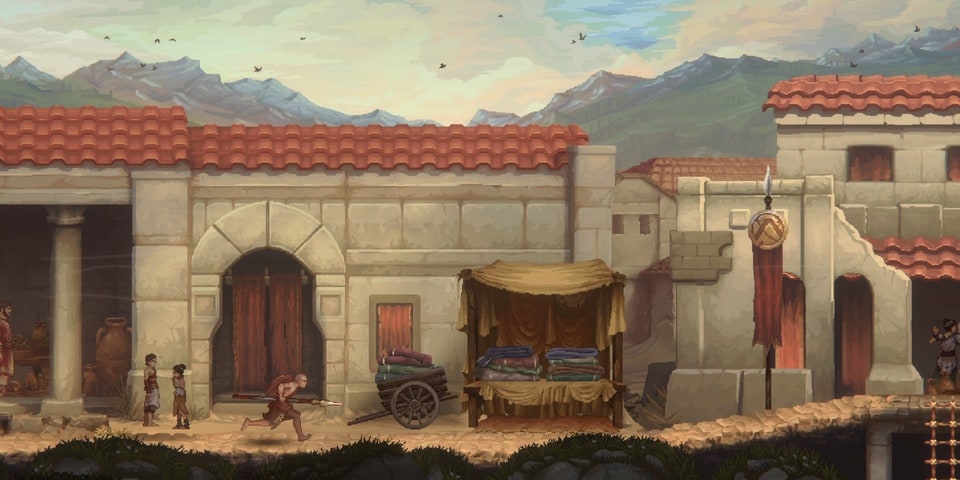

I really wanted to love God of War: Sons of Sparta. As someone who is fascinated by Ancient Greek mythology, adores a 2D Metroidvania or two, and has played and almost finished every God of War game going – curse you Ragnarök for being so long! – the shadow drop of Sons of Sparta had me very excited, giggling with glee like someone who was just seduced by a swan. Upon playing this prequel though, my excitement soon drained to a mundane ‘meh’ kind of vibe. You see, God of War: Sons of Sparta, despite carrying the pedigree of such an iconic franchise upon its burly shoulders, is merely an OK game.
Prequels are a tricky thing to get right. Take too many risks and a backstory can leave a fanbase feeling cold. Stick to expectations too rigidly though, and you end up being predictable and feel unnecessary as a result. It’s a fine balancing act for a prequel to be both fresh and familiar. Unfortunately for Sons of Sparta, it skews to close to the latter approach, offering an origin story for Kratos that adds little of worth. Compared to that twist in the original God of War… well, the narrative here lacks the addictive potency to keep you playing in order to find out what happens next in the story.
What of the gameplay? It’s your standard Metroidvania fare. You run and climb around a 2D maze-like landscape, fighting monsters, killing bosses and unlocking new abilities to make further progress. You’ve probably played this game dozens of times before. Which isn’t necessarily a bad thing, it’s just to say that Sons of Sparta does the basics that expected of the genre, and little more.

Level design is bland, lacking the alluring sense of discovery that makes for a classic Metroidvania. This isn’t helped by the vanilla visuals, which are far too muted in their tone to carry the larger-than-life aesthetic that one has come to expect from a God of War game. This dull and diminutive look carries over to the rank-and-file monsters too, which, despite the over-the-top brilliance of ancient-Greek mythology, are utterly forgettable. Loads of similar looking skeletons, little crawly slugs, ghosts in various colours, it’s not exactly a thrilling force of foes to eviscerate. Much better are the bosses, which provide some genuinely spectacular showdowns and come closest to emulating the classic encounters from God of War games of the past.
When it comes to the success of the bosses, it helps that, even with the restrictions of two-dimensions, teenage Kratos still handles great in combat. Here your primary weapons are a spear and aspis – the distinctive circular shield of the Hoplite. Kratos can dish out a number of different jabs and slashes, with an impressive number of upgrades, before hunkering down behind his shield to see off any reprisals. It’s a satisfying dynamic, encouraging you to deal as much damage as you can before assessing your enemies attack patterns and waiting patiently for the next moment to strike.
Though, as a caveat, I wasn’t too keen on the range of different coloured attacks a foe could hit you with. A glowing cornucopia of colours highlight any attack that must be dealt with in a specific manner. But the game throws the variations at you so rapidly that, despite checking the tutorial several times, I struggled to remember what each colour is meant to indicate in the heat of the moment. Is a blue attack one you can’t parry? Or is that the yellow? Fundamentally, what is it about the colour blue that suggests it can’t be parried? Thankfully, for the most part, dodging everything your foes throws at you works fine and sticking with this approach will see you through the ordeals in your way, rendering the mechanic moot.

On the plus side, there’s a host of additional special weapons to gather, as you’d expect, and integrating these into your combat rhythm is a delight. Hurling fireballs at a foe before closing the distance to attack, then overwhelming them with a menagerie of jabbing pointy spear pain, before hacking them to pieces with a gory finisher that releases a swarm of blood-red experience orbs, this is when God of War: Sons of Sparta finally feels right.
One of the controversies surrounding Sons of Sparta at launch was that, while it looked an awful lot like a co-op game and said as much on the store page, the main game itself is entirely solo. The co-op mode, Pit of Agonies, which is a combat trial affair, was also originally locked behind completion of the main storyline, though thankfully this has been amended in a patch. Still, it seems a real shame not to have true co-op here.

Thanks for sharing your thoughts on God of War: Sons of Sparta! It’s always interesting to see how games interpret historical themes. Your passion for Ancient Greek culture really shines through in your review.
Thank you for your comment! I agree, the connection to Ancient Greek mythology adds so much depth to the game. It’s fascinating how the storyline intertwines with historical events and figures, making the experience even more immersive for players.
Absolutely, the way they weave mythology into the narrative really enhances the storytelling. It’s interesting how the characters’ motivations often reflect the complexities of those ancient myths, making the experience even richer for players.
I completely agree! The integration of mythology not only enriches the story but also adds depth to the characters, making their motivations more relatable. It’s interesting how the game explores the consequences of their actions within that mythological framework.
the gameplay. It’s interesting how the characters embody traits from their mythological counterparts, making the experience even more immersive. Exploring these connections can really enhance our understanding of the stories behind the gods.
Absolutely, the character traits really enhance the storytelling! It’s fascinating to see how the developers weave in those mythological elements to create a deeper connection to the lore. It adds another layer to the gameplay experience, making it feel more immersive.