

Having just celebrated the series’ 25th anniversary, 2026 is shaping up to be a huge year for Total War and Horsham-based studio, Creative Assembly. For more than two decades, these games have helped define the strategy genre on PC, keeping fans hooked with new titles and impassioned post-launch support, exploring numerous historical eras and, more recently, the timeless world of Warhammer. Somehow, Creative Assembly has managed to pull off the remarkable feat of releasing game after game without Total War feeling too oversaturated, avoiding the kind of aggressive rehashing we see in other popular video game series.
The past several years have taken the developer on a number of historical detours, starting with the wildly successful Three Kingdoms, to Troy and Pharaoh. Then, of course, we’ve had three back-to-back bangers set in Warhammer’s Old World, carefully adapting the Games Workshop tabletop game into one of the best video game trilogies available, bursting with bonus content.
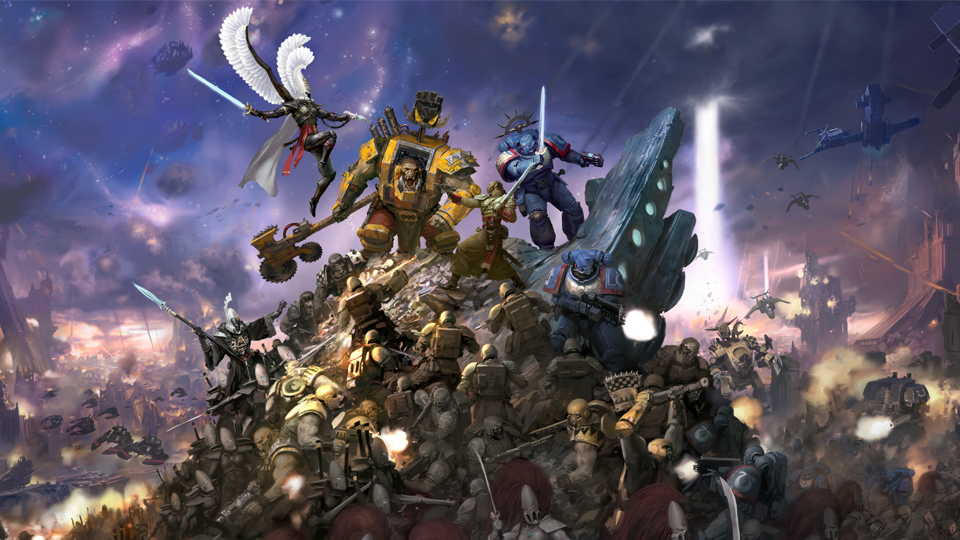
Now, Creative Assembly is ready for an ambitious new pincer formation. Its next big game, Total War: Warhammer 40,000, will be the franchise’s most experimental title to date, transporting players to the grimdark future of the 41st millennium. It’s not just a tonal shift, but also one that has various gameplay implications given the arsenal of sci-fi weapons and heavy armour at play, not to mention galactic-scale campaign maps.
At the same time, the studio is returning to one of its three core historical pillars. After more than twenty years since the launch of its predecessor, Total War: Medieval III will be a culmination of Creative Assembly’s work on refining its strategy game formula, boasting a truly tantalising sense of scale and depth.

Wanting to know more about the series and the prestigious team that brings these games to life, we recently interviewed Franchise Content Director, Kevin McDowell, Ian Roxburgh (Principal Creative Director), Jack Lusted (Product Owner), and Scott Pitkethly (Battle Architect) about Creative Assembly and the origins of Total War. You see, while it’s impossible to separate these two big names now, there was a time when the fledgling English developer worked on a very different kind of simulation game.
“Back in the late 90s, Creative Assembly was still a tiny studio and we were almost entirely known for making sports games for Electronic Arts. That was our identity. At the same time, there was this itch inside the team to try something new. Our old Executive Producer had been hired to lead an RPG based on Monkey: Journey to the West, and the plan was to build a whole new studio for it in Singapore… but for various reasons none of that ended up happening.”
“So, while the sports team kept the lights on, the rest of the studio started asking, ‘Well, what could we make?’ Command & Conquer had just blown up, and everyone was talking about real-time strategy. The idea was to knock out a quick RTS to raise some money for the RPG they really thought they’d make next. However, once development started, the project quickly turned into something else entirely. We had this experimental tech that allowed for rolling 3D hills, voxel characters from the sports games, and then one programmer figured out how to transform that top-down RTS camera into what became the defining feature of Total War: the general’s-eye view. Suddenly you weren’t looking at sprites anymore; you were looking across a believable battlefield. Once the team saw that, the whole genre pivot happened almost instantly.”
“From there, the idea of combining massive real-time battles with a strategic layer just made sense. The team realised the battles alone weren’t enough; you needed a campaign map to give context and consequence to them. The studio shifted from sports games and the cancelled RPG to building something that nobody had ever really tried before. In a way, Total War wasn’t the result of a master plan. It was a chain reaction: abandoned projects, new technology, a bit of opportunism, and a small team willing to experiment. All those ingredients came together and suddenly we weren’t a sports studio anymore – we were building Total War.”
This was a huge gamble for the up-and-coming studio. Not only was it attempting to break new ground in a genre that was already dominated by the likes of Starcraft and Age of Empires, it was also delving into the Sengoku Jidai, a historical era that was still pretty alien to western gamers at the time – even the most cultured and sophisticated RTS enjoyer. On top of the new and experimental gameplay concepts showcased in Shogun: Total War, players had to learn the names of various Japanese generals and factions as they engaged in a bloody, katana-swinging civil war to unify the country.
Despite these challenges, Shogun would go on to become a critical and commercial success for Creative Assembly, paving the way for countless Total War sequels and spin-offs. Having built a solid foundation, Medieval: Total War soon followed in 2002. However, for a great number of fans, their first encounter with the franchise would come four years later, with the Rome: Total War, which was also the star of the BBC’s 2003 game show, Time Commanders. We asked Creative Assembly about this collaboration and the impact it had on Rome’s development.
“Time Commanders came about surprisingly early in Rome’s development. We’d only just started showing the new engine around internally when the BBC reached out. They’d seen what we were doing with these huge, fully 3D battles and thought it would be perfect for a historical TV format where real people replayed famous battles. Almost overnight, we suddenly found ourselves building tools and features not just for a game, but for a television production as well.”
“It didn’t hinder development. If anything, it pushed Rome forward. To make the game presentable for national television, we had to build proper scripting systems, cinematic camera controls, and ways to choreograph battles long before those features were scheduled. Those same tools ended up shaping how we built Rome’s historical battles and how we showcased the game to press.”
“There were quirky restrictions, though. In the UK we couldn’t advertise our own game in any way during the show, which was a bit surreal. But even without that, the exposure was huge, and all the TV work happened within my first six months at the studio. It brought eyes to Rome long before it launched and ultimately helped shape the game into what it became. What a lot of people don’t know is that, on the back of the BBC version, we also did a pilot for an American TV series. Because it wasn’t the BBC, they were happy to lean into the Total War branding and the pilot literally opened with, “Welcome back to Total War,” with the logo everywhere. If that show had gone ahead, it would’ve been even more massive for us.”
Even without this major marketing push, Rome: Total War firmly cemented itself as one of the great strategy games of its age. While Creative Assembly has visited myriad flashpoints and timelines in the decades since, fans continue to revisit this earlier game in the series and its ancient historical setting.
“I think Rome has this enduring pull because it taps into a period almost everyone grows up learning about at some point,” the team explains. “The legions, the emperors, the conquests, it’s one of the first slices of history that really captures your imagination as a kid. When you see it recreated at scale, it hits that nostalgic memory as well as that fantasy of commanding these iconic armies. For our series in particular, Rome was also the first time we pushed into a fully 3D campaign map. That was a huge shift. Suddenly, instead of looking at something that felt like a board game, you were looking at a living world: mountain ranges, coastlines, settlements, terrain that felt real. You weren’t just reading about the Mediterranean – you were navigating it. The sense of physical space made Rome’s already epic history feel even bigger and more immersive.”

“Our old colleague used to describe Rome as the ‘ultimate box of toy soldiers,’ and that’s exactly what it felt like. With that 3D map, those iconic units, and battles that suddenly looked cinematic in a way we’d never achieved before, you had this perfect marriage of recognisable history and cutting-edge technology. Even though it wasn’t the first Total War game, Rome hit a sweet spot: a universally familiar setting, larger-than-life experiences, and a brand new visual and technological leap that made the whole era feel alive in a way players hadn’t seen before.”
As for the history of the Roman Empire itself, it spans many centuries, from the republic’s early founding in ancient times to its eventual splintering and later fall. For Total War, how did the team decide on which Roman eras to feature in their campaigns and expansions?
“Rome’s history is just too big to cover in one go, so the first step is figuring out which eras naturally lend themselves to strong campaign gameplay. We look for those flashpoints where multiple powers are colliding, borders are moving, and the whole region feels like it’s at a tipping point – moments where the player can jump in and genuinely reshape what happens next.”
“That’s why we tend to focus on periods like the late Republic or the rise of the Empire. They’re full of internal crises, ambitious rivals, external pressures, and distinct faction identities. Those eras also give every faction, not just Rome, a meaningful place on the map from the very start. That balance matters to us. We want the campaign to feel alive across the whole space, not like a story where everyone else exists just to watch Rome grow. The choice ends up being a mix of what’s historically iconic, what naturally creates interesting gameplay, and what allows the entire world to feel dynamic. The goal is to build a setting where Rome is important, of course, but not the only story worth playing.”
Indeed, one of the most appealing parts of playing Rome: Total War and its sequel is leading factions such as the Carthaginians, Gauls, or even the Britons to rewrite history, during a time period where Rome was rapidly ascending as an ancient superpower. Rome II kicks off its Grand Campaign in 272BC and spans 300 years, witnessing the republic’s transition into an empire. This choice of setting makes perfect sense, given Creative Assembly’s approach, with historic turning points such as the destruction of Carthage, the collapse of Hellenistic Greece, and the rise of Parthia, not to mention a number of civil wars within Rome itself.
From a game design perspective, this time period presents a great many pieces that can be placed on the board before hitting play on Total War’s strategic simulation and watching the various factions duke it out. Within this virtual sandbox, players can orchestrate countless “what if?” scenarios, both on and off the battlefield.
Speaking of battles, despite the vast amount of knowledge we’ve gleaned over the centuries, we still don’t really know how ancient armies fought. There are very few historical sources that go into specific details regarding tactics and battle formations. We asked Creative Assembly how this impacted the team’s depiction of sweeping strategic battles, considering how central these are to the Total War experience.
“That’s a really good question, because even when we do have sources, they rarely tell us what we actually want to know. We’re dealing with a period where huge parts of battlefield behaviour just aren’t recorded. Even something as fundamental as how hoplites fought is still debated today. Was the ‘push’ a literal scrum of shields, a more symbolic back-and-forth as morale ebbed, or something much looser? Right from the start, we’re working with incomplete information, even in places where the historical record feels relatively strong.”

“What we try to do is anchor ourselves in the areas historians do broadly agree on: archaeology, surviving texts, experimental archaeology, and insights from similar cultures. Those give us the foundation. From there, we shape mechanics that feel believable and readable in a Total War context. We’re not aiming for perfect historical reconstruction, nobody can, because the sources just don’t support it, but we want battles to feel authentic within the limits of what we know while still giving players the drama and clarity they expect.”
“A lot of that comes from taking the broad principles ancient writers talk about – Roman discipline, Celtic charges, Greek phalanx tactics – and then figuring out how those ideas translate into a game where units need to behave as cohesive groups. For example, in Rome II we gave hoplites a shield-wall formation that tightens them up, boosts their defence, and gives that sense of a heavy, disciplined block of soldiers. It’s not claiming to be a perfect simulation of a phalanx, but it captures the logic of how they potentially fought.”
“When the sources fall silent, we fill the gaps the best way we can: good scholarship, a lot of experimentation in the engine, and making sure whatever appears on screen feels coherent to the player. And of course, popular media has an influence. It would be silly to pretend films like Gladiator haven’t shaped player expectations of ancient combat. We’re not going full Hollywood with everyone duelling one-on-one in a big melee, because that’s neither accurate nor good for gameplay, but a little spectacle – a fire arrow here, a dramatic shield wall there – can work, as long as it still feels grounded.”
“And yes, we absolutely consult experts and research heavily. For Rome II, we built up a whole library on everything from cavalry use to Greek warfare to Roman infantry tactics. We won’t always get every detail right, and sometimes we deliberately prioritise gameplay over strict interpretation, but the aim is always to be as informed as possible so that even when we’re making educated guesses, they’re supported by the best knowledge available.”
Even with the Roman legions being well-known for their cohesion and discipline, they probably didn’t tuck as neatly or as quickly into formations as the Total War games would have us believe. Yet, overall, the way these games depict ancient battles is so believable, driven by on-the-fly calculations that compare unit statistics as they engage in combat, from Celtic Slingers and Spartan Pikemen to Ptolemaic Cavalry and the Praetorian Guard. So, how do the developers of Total War go about assigning stats to various historical units?
“There is a lot of number-crunching behind the scenes, yes,” the team tell us, “but [our] guiding philosophy is pretty simple. We don’t want any faction to feel like it’s inherently disadvantaged just because of the stat sheet. If you’re playing as the Iceni, Rome should feel like a heavyweight opponent, but the game should never make you feel like the numbers are fully stacked against you. You should win because you used your units better tactically, not because the AI was mathematically unbeatable.”

“We start with historical context. Who was well-armoured? Who hit hard? Who excelled at charges? We then convert that into a set of behaviours and stats, and we balance it so that every roster has a path to victory if you play to its strengths. That’s also why different units end up being ‘the best’ depending on their battlefield role: Roman Evocati Cohort as elite infantry, Oathsworn for the Celtic tribes, Shield Bearers for the Greeks, Companion Cavalry or cataphracts on the shock-cavalry side. They all excel in different areas. There isn’t one single stat monster – it’s about what problem a unit is designed to solve and how players choose to use it.”
There is one Rome: Total War unit we’ve always found particularly amusing: the Incendiary Pigs. As their name implies, these unfortunate hogs are coated in flammable material before being herded towards enemy ranks and then set aflame. Remarkably, these pigs aren’t some kind of twisted invention concocted by a deeply troubled and twisted Total War developer.
“The flaming pigs are a great example of one of those things that players assume we just made up, but we had this internal rule back then: if we could find one historical reference, no matter how obscure, then it was fair game to put into the title. And that’s how a lot of the stranger units made it in.”
“The pigs really were mentioned as a tactic to panic war elephants – cover them in tar, set them alight, and let chaos do the rest. Horrifying, but historically referenced. The same goes for the head hurlers. People still think we invented those, but someone on the team dug up a single line in a text mentioning warriors throwing severed heads, and that was it – green light to develop. We even used photos of our own faces for the decapitated heads. One of us still swears you can see his on the back of the game box.”
“So yes, even if it looks like wild fiction, it was probably because we found one dusty mention in a source somewhere and decided that was enough justification. That was the balance we struck back then between history and gameplay: if history gave us an inch, we took a mile.”
We’d like to thank the team at Creative Assembly for taking the time to speak with us. If you’re a Total War, why not check out our upcoming Playing With History book? Featuring over 100 games, 200 pages, and thousands of years of human history, it was successfully funded on Kickstarter in 2025 and will be launching in the coming months.


It’s exciting to see the Total War series reach such a significant milestone! The evolution from sports simulations to strategic gameplay has really captured the interest of gamers. Looking forward to what 2026 brings for the franchise!