
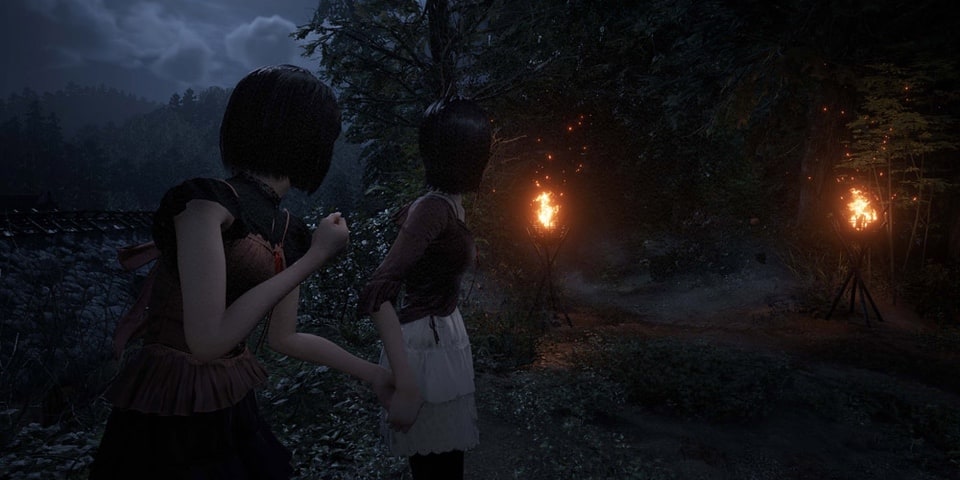

While never as commercially successful as the big two series in horror, Fatal Frame (previously known as Project Zero in Europe) has always been a favourite amongst horror connoisseurs. The emphasis on spookiness and fragility over action and gunplay has always given Fatal Frame a distinct identity – one in which blood and gore is replaced by atmosphere and supernatural terror. This identity is also characterised by a unity of setting, with mysterious Japanese villages lost in time taking the forefront over laboratories and urban environments.
While some of the series features numbered titles, there is no real continuity between the games, each game offering different takes on the same spooky world-building. Any attempt to follow the series as a whole is complicated by the bizarre remake schedule as well, with this being the second remake of this game – originally release for PS2 in 2003, remade for Wii in 2012, and now remade again – while the original game remains stranded in the past. The previous two remasters in the series have actually been of the most recent two original games in the series, so arguably the ones least in need of such treatment (availability of the hardware notwithstanding). With all that said, I’m hoping that a positive reception for Crimson Butterfly will result in the other games being updated for a modern audience too.
Players familiar with the original will remember the fixed camera being a key aspect of its presentation. The narrative control this gave the game exacerbated the sense of dread and fragility, so some may lament the switch to a modern over the shoulder viewpoint here. However, the freedom this gives doesn’t undermine the terror anywhere near as much as I thought it might, with the atmosphere and audio design leaving you constantly on edge. HD graphics do help to increase the visibility of wraiths, but the visual design and use of light and darkness still ensure that you don’t feel too safe.

The story sees you play as Mio Amakura, a Japanese schoolgirl who is visiting a forested valley with her sister Mayu. Flashbacks hint at some animosity between the two, but they are forced to rely on one another when they find themselves in the hidden Minakami Village, a place from which it is seemingly impossible to escape. As you explore the village, variously with or in search of Mayu, it becomes apparent that the twins are trapped in a cycle of ritual and sacrifice that offers a terrifying glimpse of Japanese folk horror. Haunted by spectres and wraiths, Mio’s only defence is the Camera Obscura, a strange device that can destroy ghosts.
Minakami Village is wonderfully realised here, with a complex geography that expands as you progress, yet always feels like a hostile place. The Japanese architecture and interior layout has an uncanny effect as well, with sliding and traditional doors making exploration feel confusing to this British player at least. There is a map to help with navigation and this also offers some degree of waypoint signposting which some may find obtrusive but I welcomed at times.

The real star of the show here is the audio design. Horror is almost always better experienced through headphones and this is certainly the case here. The translucent nature of the ghosts you encounter means that they can disappear through walls or teleport around the areas so tracking them through sound becomes vital. When aiming your Camera Obscura, a compass directs you to them but you are hampered by holding it up to your face and sometimes it is better to run and hide. Even when there are no spectral entities around the village is a place filled with dread, and droning ambient noises emphasise the feeling of discomfort.
Most of the game follows familiar survival horror tropes with keys to find, puzzles to solve, and severe limits on the amount of ammo (in this case, film) that you find. Early on your camera does very little damage and making the best use of different film types is essential. Later you discover pearls that can be used to upgrade various aspects of the camera and there comes a point at which you can swiftly dispatch basic enemies. Alongside the upgrades to power and reload speed that prove essential for combat, you’ll also find different camera lenses that are essential to solving environmental puzzles or tackling enemies with specific properties.

The first lens you unlock allows you to follow spectral trails and see into the past to some extent. This is largely used for navigation, though it can also help with some puzzles and collectables. Next you obtain a flash that can reveal hidden objects and stun powerful red ghosts. Finally there is a purple lens that can destroy the blood locks that litter the village. These lenses are more focused and streamlined than the original game which I think is a positive change.
Combat takes place through the camera, with the perspective switching to first person when you aim. Film takes a while to reload, so choosing when to shoot is vital, as is making sure that you aim carefully. Shooting at the exact point a ghost attacks can stun and inflict extra damage (the titular Fatal Frame), so expect to spend some time familiarising yourself with the nuances of combat. It is often better to conserve film and run away, but this isn’t always possible. There are some enemies that cannot be fought at all and so you have to find hiding spots and rely on stealth. These sections were a little frustrating as the view shifts to a black and white filter that makes it very difficult to see where hiding spots are and felt too much like trial and error.