
For a long time, the episodic adventure game as established by Telltale Games has been declared dead and buried. Which is a shame, because at their peak, Telltale produced some of my favourite ever games; The Wolf Among Us, The Walking Dead – Season 1, heck, I even have a weird soft spot for mega-flop Batman: The Telltale Series. So, I was delighted as much as anyone when Dispatch released last year to rave reviews and went on to sell millions of copies. Conclusively proving that the episodic choose-your-own-adventure narrative formula still had an audience, fans just needed a decent game that released on time and to schedule for them to reach for their credit cards again. And surely Switch gamers would love a slice of that too, wouldn’t they?
Well yes, of course they would, but maybe not like this. If you’ve glanced at the score before reading this review, please, let me reassure you, I don’t think for one moment that Dispatch is only a slightly better than average game. You see, Dispatch itself is great. The problem lay elsewhere.
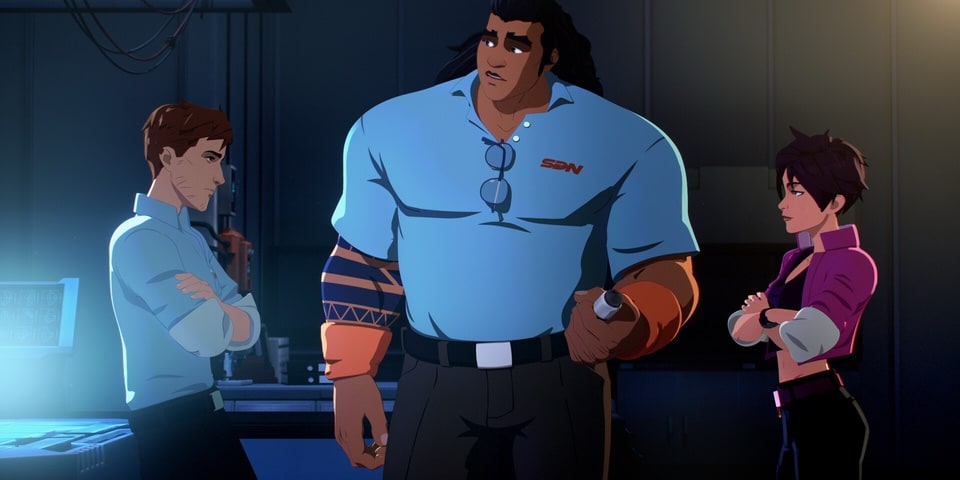
For those who haven’t heard of Dispatch, it’s basically a modestly interactive feature-length animation divided into eight episodes. Segmenting the story are a series of puzzle elements. The first sees retired superhero Robert Robertson the Third in his new job as a superhero dispatcher, though he’s tasked with sending a group of reformed supervillains to time sensitive emergencies. Looking at a map screen, you assess the crises before sending the best member of the Z-Team to deal with the problem. This is a pleasant enough diversion but is lightweight and far too easy, with the game signalling so blatantly which member of your hero squad to use that you really can’t fail.
The second puzzle element involves hacking into various computers, which is far more interesting. You guide your hacking bot through a veritable maze, dodging viruses and cracking codes as you go. With mechanics that meaningly develop from episode to episode, this is a challenging and satisfying mini game, with genuine thrills delivered by racing against time to rescue one of your teammates, hack into a safe, or access some vital CCTV footage.

The story of Dispatch is brilliantly told, it’s a delightful superhero yarn providing memorable characters, whip-smart dialogue, laugh out loud tomfoolery, and some surprisingly emotional moments too. Voice over performances are off-the-chart fantastic, with a veritable who’s who of actors delivering the most believable and absorbing dialogue I’ve ever experienced in a video game. Visually, Dispatch looks phenomenal too, with slick sumptuous visuals and smooth animation, ensuring the characters will live on in your memory long after the story has finished.
Less successful? Well, there’s the slightly pathetic QTE inputs during fight scenes, that are so half-hearted they feel like an afterthought. Then there are the dialogue choices themselves. Now, this genre has always required a hefty amount of smoke and mirrors for the player to believe that any of their choices really matter. That was true in The Walking Dead and it’s true in Dispatch. More often than not, whatever time-sensitive dialogue option you make, the story briefly deviates from its prescribed path before re-joining the overall narrative again. Nothing really changes, certainly nothing important. Dispatch suffers from the fact that most of the choices you make are so blatantly inconsequential that you can just leave the game to play itself and you’ll make it to the end of the episode unscathed. But every now and again, the game throws an absolute dozy of a moral choice at the player; and these are worth the price of admission alone. When Dispatch finally stops pulling its punches, it hits hard, resulting in the kind of uncomfortable ethical moments that will prompt hours of conversation between players, just what did you decide to do?
Overall, the Switch conversion is excellent, playing equally well docked or handheld. So, what’s the big problem? As you might have already gathered if you’d paid attention over the last couple of weeks, it’s all down to the bizarre censorship.

Dispatch is an adult game. It’s eighteen-rated and explores grown-up themes. It’s violent, sweary, and includes full-frontal nudity and sex scenes. Unfortunately, it’s the last of these two distinctly adult things that is getting the redacted documents treatment with some of the clumsiest censoring we’ve ever seen. You know how beautiful the visuals and animation of Dispatch are? We’ll get ready for them to be ruined by enormous black censorship rectangles being stuck on top of them!
A character raises a middle finger? Well, dear person over eighteen, you’re not permitted to see that – look at a big black censorship rectangle instead. Someone’s naked bum is revealed? I’m afraid, person over eighteen, despite you having a bum too, you can’t see that. Breasts? That’s not OK either. A flaccid penis? Simply unacceptable. That’s right, natural bits of a human body cannot be looked at, but gratuitous swearing and bloody violence are apparently not a problem.
The reason for the censorship is a little unclear, with AdHoc saying they worked with Nintendo to meet platform ‘content criteria’, Nintendo then saying AdHoc could have taken a different approach so long as games meet guidelines for ratings bodies, and AdHoc then not exactly explaining what happened or if there’s a real path forward. The speculation is that a single version of the game was submitted for all regions, meaning that they adhered to the CERO D rating in Japan and that this version was shipped everywhere. Other games, like Cyberpunk 2077, have multiple versions, but even with a single global approach, the method here is far too heavy-handed.
AdHoc Studio could have elected to edit the scenes in question, they could have chosen to pixelate or blur, but instead they elected to stick black rectangles everywhere, taking the player out of the moment entirely. One moment, I kid you not, the entire screen was covered in one enormous rectangle. The effect of this decision is calamitous; jokes are regularly ruined and it becomes difficult to tell what’s going on sometimes. Worse still, an incredibly affecting twist in the penultimate episode is entirely ruined by the big black censorship rectangle of doom. With Dispatch on Switch, AdHoc Studio had an open goal. Somehow, they’ve managed to perform an elaborate bicycle kick and hoofed the proverbial football into their own net.
While we hope there is some kind of remedy for this down the line, there’s no real indication that there will be.