
Crimson Desert does not make a good first impression. Imagine an episode of Game of Thrones, but you’ve taken a blow to the head and can’t remember much of anything. You’re hanging around with Jon, but you’ve got no idea about the Starks, no idea about the land they preside over, and, frankly, no idea about anything that’s going on. Imagine then, that the game version of this has the most convoluted, overly-complicated controls you’ve ever come across, and any tutorials use the vaguest words possible. It does get better, but this is the opening of Crimson Desert.
Pearl Abyss want you to immediately feel that Kliff, our central character, is a Good Guy. He’s upset about the death of Giles, rushing out to battle after the death of the Greymanes leader – not that you, the player, will know who or what these people are – and after a pretty cool, but unwinnable battle, you find yourself restored, and suddenly performing a bunch of random ‘good guy’ tasks around an equally random town. These include giving money to the poor and sweeping a dysfunctional couple’s chimney, when Kliff should surely be mourning the death of everyone he knows. There’s power to starting a story in media res, but it needs to be done responsibly. All of this happens at about 1000 miles an hour, and for the first couple of hours, you might well be wondering what you’ve let yourself in for.

These opening hours feel a lot like Pearl Abyss’ previous game, the MMO Black Desert Online. Short, oddly-paced tasks and quests hurry you back and forth, while you still search for the threads of overarching storytelling. Crimson Desert was originally meant to be an MMO sequel before the dev team pivoted to a single-player structure, and it seems like some of that original blueprint is still there, seeping into Crimson Desert’s early foundations.
Thankfully, it gets much, much better. The voice acting is continually excellent, and you start to build a picture of how this world operates and hangs together. The game doesn’t keep up its initial frantic, percussive pace, and instead, you start to settle into the push and pull of daily life in Hernand. This opening area is beset by all sorts of RPG woes, with bandits roaming the countryside, blacksmiths with broken hammers and the like, steadily teaching you an encyclopaedic array of different moves, abilities, and functions.

Learning is central to how Kliff interacts with the world of Crimson Desert, and it feels like the team has really hit upon a great way to contextualise new moves and information. You can learn new attacks in the middle of a fight, observing someone else kicking you in the face and then figuring out that you can pull off the same moves. You pick up recipe posters and have to read them, or check Wanted posters to learn what you can about a target. It makes growth, exploration and side quests feel more organic, and there’s a weight or depth of meaning here that I haven’t found elsewhere.
That said, a lot of the game feels like Assassin’s Creed, Breath of the Wild and The Witcher 3 have all been thrown into the casserole dish together. The expansive open world feels relatively grounded, but that’s tempered by the skyborne Abyss Gates – these sections particularly reminded me of Assassin’s Creed Valhalla’s Animus Anomalies – the otherworldly technology, and the way you interact with it. Your tether allows you to grasp and manipulate elements of the world, turning dials, connecting power supplies, largely matching Link’s Sheikah Slate runes.

The underpinning technology on show within Crimson Desert is remarkable, though not without snags during the review process. Playing on PC, initial load-in times have been slow, though they’ve steadily improved through the last two weeks and now they feel pretty snappy considering what is being loaded in. This is a full, vibrant, living world. Foliage is constantly on the move, leaves fluttering in the breeze, sheep and other livestock grazing in the fields, while the clouds drift lazily across the sky.
It looks fantastic, and the towns, cities and villages feel like interesting, lived-in places, with winding streets, eye-catching architecture, and swathes of NPCs milling about. The draw distances are frankly insane, and like the old Skyrim adage, you can look out across this world and choose where you’re going to visit. The difference is, that can be a lot further away here.

This is all based on the PC version. With High settings enabled, I’ve had a reliable 60fps experience throughout, and even with a bunch of the bells and whistles turned up, it’s still hit 30fps on my 3070, with 32Gb of RAM. There’s still a question mark hanging over the PS5 and Series X|S versions, as nobody has seen it running on them, and there’s always the worry that we could have another Cyberpunk 2077-like experience. Hopefully, that won’t be the case.
All of that visual fidelity, multiple characters, breakable scenery and the expansive movesets you’re given access to, can mean that Crimson Desert is equal parts fiddly and janky. It wants to do so much, but it has one of the most annoying controller setups in recent memory. As it stands, you can’t change it to your liking.
That’s doubled down with jank. You can kick out a bench before talking to a quest giver, and they’ll hover in place, butt resolutely not hitting the floor. You can muddle back and forth with your tether, trying to manipulate it in the way you want, but have it never quite react how you expect it to. Picking things up is as clanky and annoying as it is in various other games, but (and it’s a big but), you’ll still want to persevere, because you’ll want to see what’s going to happen next.

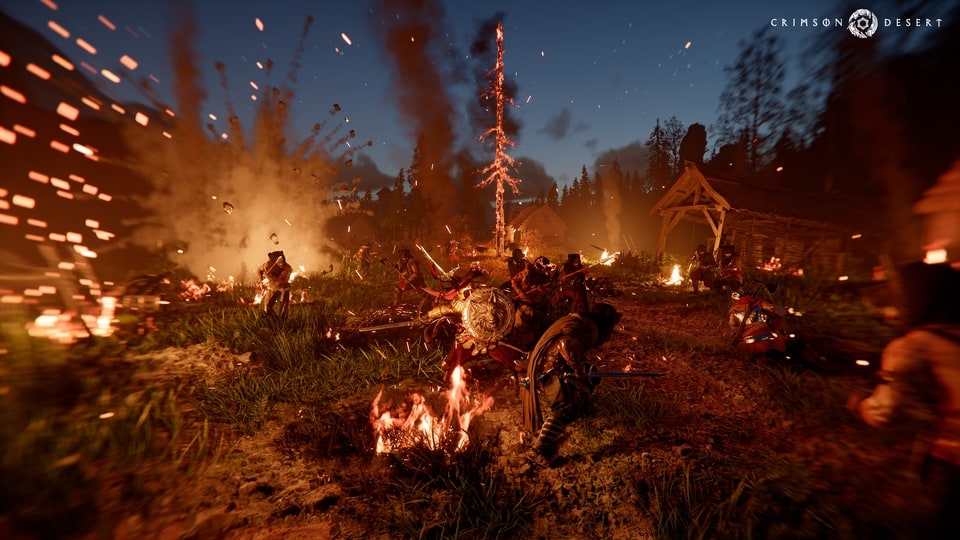
A big part of that is the combat. Combat in Crimson Desert is fast, brutal, and challenging. There’s often swathes of enemies, and you’ll often feel at a disadvantage, constantly on the edge of death, but you’re aided by the full range of options brought to you by an evolving, expanding batch of abilities and moves. It feels excellent and is a consistent highlight. Along the way, you will find areas where you need to grind, upgrading your equipment and your skills, but even then, heading out into the world brings plenty of points of interest, new targets and questlines, pulling you away from the central quest line, just as with the best open worlds.
We’re holding off on a score until we’ve seen the storyline through to the end, but Crimson Desert is certainly one of the most impressive open worlds we’ve ever seen in games. I really need to decide how I feel about the inherent jankiness, and while the storytelling is helped by the excellent voice acting, it’s still weaker than you’ll find in the best examples of the genre. So far, at least. With all that said, this is still an experience that’s well worth checking out one way or another, just to see the world that Pearl Abyss have built.