

Crabs are terrifying creatures, so it makes perfect sense for them to be the central focus of a Lovecraftian horror game. Crabmeat takes the skittering claws and beady eyes of the crustacean and forces you into direct contact in a dystopian world that feels exposed and alien. Billed as a point ‘n’ click survival horror, the entirely mouse-driven first-person game succeeds in making you feel uncomfortable and presenting a nightmare future in which being in debt is a life sentence.
You wake up on a crabbing boat alone and tasked with catching enough crabs to pay off your debt to the Australian feudostate. Venturing out into the harsh and icy seas of the Antarctic, you have a strict time limit in which to fulfil your quota, with a fatal punishment threatened if you don’t succeed. The threat is existential but also physical in the form of mutated denizens of the sea that regularly board the boat and must be fought off.
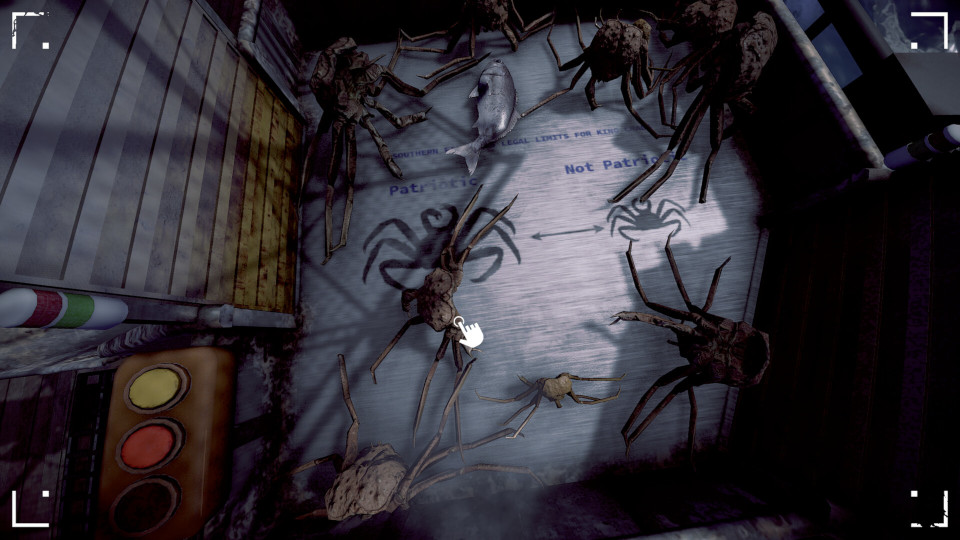
Graphically, Crabmeat has a crunchy PS2-style aesthetic that helps to cement the uncanny feeling and uneasiness. Everything is clearly and literally signposted with instructions for the various machines you’ll need to use around the environment. The design of the boat is almost like a mini Dark Souls level with locked doors and shortcuts to discover. The initial air of mystery is replaced by a deep familiarity with the layout and responsibilities of single-handedly piloting the boat and manning the equipment.
The beginning half hour or so of the game is mainly a process of learning how to navigate, bait the crabpots, hook them, and winch them back in. Once you have your catch, you have to manually sort through it to only keep the larger crabs, with everything else being released back into the ocean. There is a tactility to everything that feels almost like a VR game controlled entirely by mouse – a control system that is already proving controversial, going by Steam comments about the demo version. Many are annoyed that there is no WASD movement control, but the more I played, the more I appreciated the uniqueness of the controls and the ways in which they fit with the restrictive nature of your punishment on the boat.

Navigating the boat takes a little getting used to, as there is obviously a much larger turning circle than you’d get in more traditional vehicles. Once it clicks, however, you’ll be swinging around and getting in place to collect the crab pots as soon as they are filled. To do so, you have to harpoon them and then winch them in with the harpoon being on the opposite side of the boat to where you drop them off. This simple mechanic makes the repetitive process feel engaging, and there is a genuine sense of achievement when you perfectly nail getting into place first time.
As you make your way to crabbing spots, you’ll also find question mark icons on the map which contain secret stashes that add to the mystery and sometimes provide keys or notes that progress the meta-story. It’s entirely possible to just go through and focus on catching crabs, but that only scratches the surface of what the game has to offer. Bonus crabpots can also be picked up from these question marks, which enable you to be more efficient in your work.

As mentioned above, every so often, a larger crustacean will board your boat and attack either you or your machinery. You are armed with an axe and a shotgun to fend these foes off, whilst any damage they do must be repaired with a blowtorch. Managing the rhythm of navigation, catching crabs, defeating enemies, and maintaining the boat soon fits into a satisfying loop – one that sees your debt slowly decreasing along with the time limit.