
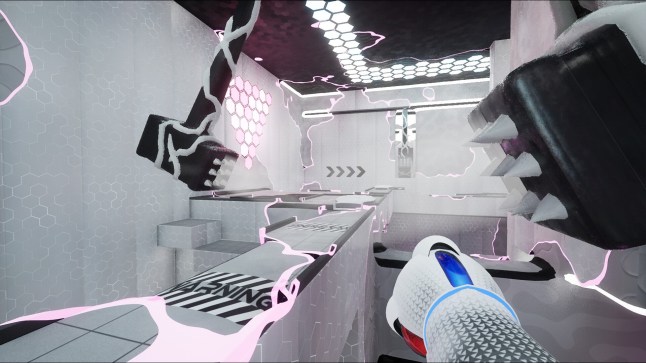


A German comedy puzzle game in the style of Portal is one of the most enjoyable indie titles of the month, and the next best thing to an official Valve sequel.
If someone asked you to name a first person puzzle game set in a secure, near-future testing facility, with a sci-fi gun for a main character, there’s an almost 100% chance you’d say Portal. Despite its sequel having been released 15 years ago, Valve’s magic touch provides an alluring combination of ingenuity, comedy, and exceptional production values, which make it a hard game to forget. It’s clearly front of mind for Pixel Maniacs, the German indie developer behind ChromaGun.
Now a decade old, the original ChromaGun – later re-released in VR – also had you completing brainteasing tests in a lightly futuristic prison-like laboratory, but instead of creating wormholes through the space-time continuum, your gun painted things red, yellow or blue. Once painted, they attracted objects of the same colour, which was the key to solving most of its puzzles. Unfortunately, owing to budgetary constraints and a considerably less accomplished script, it felt a bit too much like a Pound Shop Portal.
This sequel is probably closer to the game they were trying to make in the first place. The splendidly named ChromaGun 2: Dye Hard, even opens with a Bruce Willis reference in its first chapter, as you clamber about in the facility’s ventilation ducts. At the start of the game, your ChromaGun gets broken, leaving you with a limited version that only fires yellow paintballs. It’s impressive the range and variety of puzzles Pixel Maniacs manage to squeeze out of that single colour.
Soon enough though, you manage to activate the transuniversal matter displacement array, something the game amusingly describes as ‘a sort of… portal’, and off you go to parallel dimensions, where you hope to find a fully functional tri-colour ChromaGun to complete your testing. Rather than aping GLaDOS, your narrator and instructor is an avuncular chap called Richard, although it’s immediately made clear that your life in the test chambers remains wholly expendable.
In the dimension you travel to, he’s replaced by the English accented Mildred, who greets you like a cackling, cheerily homicidal Mary Poppins. Her lab complex is slightly more high tech, helping complete the sense of having been transported somewhere new. You soon manage to find a more advanced ChromaGun, which along with painting all three primary colours, can also remove layers of paint, returning objects to their factory state.
Expert, exclusive gaming analysis
Sign up to the GameCentral newsletter for a unique take on the week in gaming, alongside the latest reviews and more. Delivered to your inbox every Saturday morning.
In most cases you’ll be shooting paint at hovering, silent, spherical WorkerDroids, and at wall, floor and ceiling panels, which once again attract like-coloured bots. By painting multiple panels the same colour you can use their competing gravitational attraction to position droids accurately over floor and wall switches to activate doors and trigger useful events. Unlike its predecessor, you’ll also be spending quite a bit of your play time in the interstices of the testing facilities.
Popping open vents, you regularly find yourself in parts of the complex that are clearly supposed to be off limits to testers like you, the rough hewn stone walls contrasting with the otherwise sleek interiors, and stacks of archived equipment marking them as firmly behind the scenes. Naturally, they also contain the exact same puzzle ingredients as the main shop floor, giving ChromaGun 2 even more space to flex is undoubted creativity.
Along with painting objects in primary colours, you can shoot them again to mix secondary colours, creating green, orange and purple. You’ll also find impermeable glass walls, forcefields that only paint can pass through, and tubes that convey your blast of colour via looping glass conduits to its target, as well as the return of aggressive WorkerDroids that pursue you relentlessly until you stick them to a same-coloured panel.

Puzzles now often span multiple rooms and levels, getting you to work your way back and forth as you unpick exactly how you’re going to steer one of those bots to the switch (or switches) that activate the door to the next test. In one of the regular moments when you seem to have exhausted every possibility available, the answer is often to be found in furniture that doesn’t initially look interactive, or a side turning in a tunnel or corridor that you hadn’t previously spotted.
While difficulty ramps up noticeably through the first chapter, it stays more or less consistent during the rest of the game, rather than continuing to get more cryptic. You will find a greater reliance on kinetic puzzle design as you progress, though. There’s a note at the very beginning of the game informing you that reflexes and fast reactions will never be a factor in the game’s test chambers. Like the cake in Portal, this is a lie.
Along with moments where you’ll have to change a droid’s colour at just the right moment, there are sets of huge swinging hammers to avoid, and plenty of first person platforming, sometimes onto moving lifts. That’s not nearly as bad as it could have been, although inevitably there are occasional fiddly bits that just don’t feel as interesting as the more cerebral puzzles.
Compared with the original it’s a far more polished and entertaining experience. There’s a story, the tables being turned on your cybernetic tormentors at various points, as the dimensions you gain access to blend together in increasingly chaotic ways. And while it’s certainly nowhere near as perfectly pitched as Portal in its humour, it remains funny throughout, its voice actors doing a good job of bringing out the competing personalities of your antagonists.
Just like borrowing ideas from Nintendo, using Valve as your inspiration is always going to invite unflattering comparisons, and even though ChromaGun 2 is an adept and interesting game, you can feel the chasm between this and your mind’s eye view of a probably-never-going-to-happen Portal 3. It has neither the razor-sharp wit, nor the refined perfection of Valve’s execution. But then again, what does?
Don’t let that put you off though. ChromaGun 2’s well designed and frequently taxing puzzles are matched by an amusing and twisty plot, along with characters that more than do their jobs in making you feel part of their sadistic milieux. It’s also outstanding value for money, and depending on luck and mental acuity should provide 12 or 14 hours of gently head scratching entertainment.
ChromaGun 2: Dye Hard review summary
In Short: An accomplished and darkly witty first person puzzle game that’s predictably not as good as Portal, but does come surprisingly close at times.
Pros: Clever puzzle design, with plenty of eureka moments and an impressive amount of variety. Adroitly written GLaDOS style antagonists.
Cons: As good as it is, it can’t survive direct comparisons with Portal. The music can be a bit insistent in some areas and a couple of minor technical issues in the final two chapters.
Score: 7/10
Formats: PlayStation 5 (reviewed), Xbox Series X/S, Nintendo Switch 2, and PC
Price: £15.99
Publisher: PM Studios
Developer: Pixel Maniacs
Release Date: 12 February 2026
Age Rating: 7

Email gamecentral@metro.co.uk, leave a comment below, follow us on Twitter.
To submit Inbox letters and Reader’s Features more easily, without the need to send an email, just use our Submit Stuff page here.
For more stories like this, check our Gaming page.


This review of ChromaGun 2: Dye Hard sounds intriguing! It’s always exciting to see games that capture a unique blend of humor and puzzle-solving. The comparison to Portal 3 definitely raises expectations. Looking forward to seeing how it plays out!
I agree! The blend of humor and puzzles in ChromaGun 2: Dye Hard really does evoke that Portal vibe. Plus, the use of color mechanics adds a unique twist that could lead to some creative gameplay moments.
Absolutely! The way ChromaGun 2: Dye Hard incorporates colorful mechanics into its puzzles is really innovative. It’s interesting to see how humor can enhance the gameplay experience, making it both challenging and entertaining.
I totally agree! The vibrant mechanics not only enhance the gameplay but also create a unique atmosphere that feels both engaging and lighthearted. It’s interesting how the humor in the design adds a layer of fun to solving the puzzles, reminiscent of the cleverness found in games like Portal.
Absolutely! The vibrant mechanics really do add a fresh twist to puzzle-solving. Plus, the humor woven into the gameplay makes for an enjoyable experience that stands out even more. It’s great to see games that blend fun and challenge so seamlessly!
I completely agree! The blend of vibrant mechanics and humor really sets ChromaGun 2 apart. It’s interesting how the game’s design encourages players to think creatively, much like the iconic puzzles in Portal.