


Mountain-climbing simulators have been surprisingly common in recent years but how does this compare to co-op hit Peak and the acclaimed Jusant?
Last weekend saw Alex Honnold’s globally televised ascent of Taipei 101, one of the world’s tallest skyscrapers. Although it only took an hour and a half for him to get from street level to the top of its mast, if you’ve ever had a fear of heights it was relentlessly stressful to watch, the monumental physical and psychological effort it takes to do something like that suddenly entering mainstream consciousness. You only had to look at his wife, cruelly interviewed several times during the climb, to realise that stress was not limited to the climber.
It’s a spectacle that’s ideal preparation for playing Cairn, a game about the realities of solo mountaineering. Delayed from its original 2025 release date, it now arrives just as the world is in thrall to the dangers, thrills, and controversies of high altitude climbing. You play as Aava, an experienced and – you later discover – famous climber herself. She’s decided to make an attempt on Kami, a menacing fictional mountain that’s already claimed the lives of 159 fellow mountaineers before her arrival in its foothills.
Naturally, Aava’s partner and agent are both worried about her in their own different ways. The agent needs her to record her journey to keep press and sponsors happy, and make regular progress reports, something she flatly ignores, having accidentally destroyed her camera on the way in. Her partner offers updates from home, alternating between forced jollity and barely concealed anxiety that she’ll never see Aava again.
It helps frame a journey that’s as much about the characters’ state of mind as it is about progress up increasingly bare rock faces. Along with listening to the hopes and fears of those left below, during your climb you’ll find remnants of a population that lived high in the mountains, their abandoned villages, classrooms, and dwellings offering written notes, paintings, and maps pointing you towards hidden relics. Along with the noticeboards you sometimes find, they fill in the region’s lore and tell you about its wildlife, some of which you encounter as you ascend.
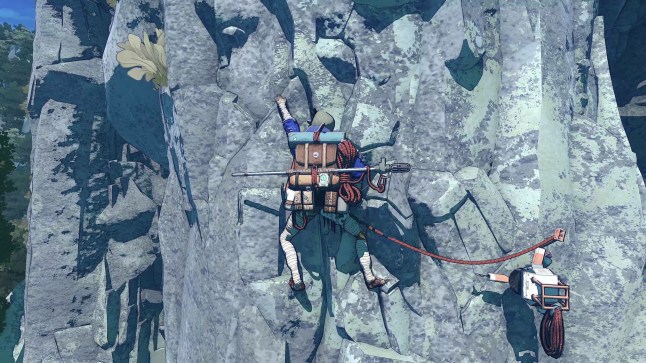
Of course, the real meat of Cairn is the climbing itself, which you undertake one limb at a time. While that might bring to mind the hilarious chaos of QWOP or Biped 2, this is an altogether more considered affair, even if Aava still frequently gets into positions that make her look as though she’s auditioning for Monty Python’s Ministry of Silly Walks. The idea is to hover each of her hands and feet over a crack, crevice or ledge, offering something to grip onto, before moving on to her next limb.
Expert, exclusive gaming analysis
Sign up to the GameCentral newsletter for a unique take on the week in gaming, alongside the latest reviews and more. Delivered to your inbox every Saturday morning.
It works to a point, but suffers from parallax error, where your angle of view means the game regularly positions your hand above or below the hold you were targeting, offering less to grip onto. If you were already precariously balanced that can result in a fall. It’s possible to cancel moves and reposition but, especially when you’re running out of stamina, it’s raining, and daylight is fading, that’s not always feasible.
You’re also at least partly riding on instinct, because by default there’s no HUD at all. It’s an inspired choice, leaving you to enjoy the scenery depicted in Cairn’s lovely hand-drawn visuals. That means your diminishing stamina as you sustain a difficult position, or only have two out of four appendages attached to solid anchor points, is conveyed without the use of power bars or anything else to get between you and the mountain.
Instead, you’ll hear Aava cry out, or her leg start to shake, and eventually the screen dims to indicate she’s about to lose her grip. That gives you a second or two to find more secure hand and footholds before she falls. Your other option is to use a piton. They screw themselves into the rock face, providing an anchor that prevents longer or more lethal drops.
You deploy pitons using a golf game style swinging cursor: get it perfectly in the zone and the piton’s fully secure, while hitting its slightly wider grey zone gives you a twisted piton that’s still effective but won’t arrest longer drops. Miss entirely and it breaks, something you can only fix when you stop to rest in your bivouac tent.

The tent also acts as a save point, as well as letting you cook, prepare tea, tape up your fingers if they’ve been injured, and sleep. That’s because Cairn is also a survival game at heart, Aava’s body temperature, hunger, and health all need to be closely managed during her climb. While everything’s available in your tent, on a rock wall you need to suspend yourself from a piton in order to grab stuff from your backpack, and even then you won’t be able to heat up tea or cook noodles.
Getting the balance of all those factors right is a job not just for players, but also for the developer. Everywhere you go on Kami, you find stuff – mountain springs to fill your canteen, old wrecked bothies, corpses of former climbers, and even the site of an old illegal rave. You also stumble across bear-proof boxes and broken vending machines that let you scavenge morsels of food.
The routes you take, of which there are many, mean you may or may not find all these potential hoards, and on our first playthrough we managed to starve to death about five hours into the climb, and since you can only return to your most recent checkpoint, that was that. Letting players box themselves into a corner is poor game design, and having to restart from scratch did not feel like a fun aside.
Still, when Cairn’s systems operate as intended, they create their own stories as you climb. The tension between metering out scarce supplies of food, water and pitons, the effects of daylight and weather, and your gradual progress, picking out promising lines across the sheer face of a cliff, inspire and resolve a succession of mini-dramas with each decision you make. Those are brought into further relief when you stop and collect emotional messages from home.
Emerging at the top of a demanding rock face, the glorious alpine vistas framed by clouds and a sunset, is a reward in itself, with no need for trophies or achievements, the dopamine arriving all on its own. As a representation of exactly what it is that inspires people to climb despite the dangers, hardships, and opprobrium from those left behind, even the exquisite Jusant doesn’t come close.
Cairn review summary
In Short: A flawed but brilliant mountaineering game that splices survival gameplay and a fascinating four-limb climbing system with exploration, risk-taking, and the emotional fallout from a climber’s loved ones.
Pros: Immersive representation of the physicality of rock climbing. Perfectly pitched down-to-earth voice acting and an evocative art style with only fleeting use of a HUD.
Cons: Survival aspects – specifically food availability – sometimes spoil the fun. Controls can feel imprecise and there’s occasional graphical glitches, with limbs flickering even when not under strain.
Score: 7/10
Formats: PlayStation 5 (reviewed) and PC
Price: $29.99
Publisher: The Game Bakers
Developer: The Game Bakers
Release Date: 29th January 2026
Age Rating: 16

Email gamecentral@metro.co.uk, leave a comment below, follow us on Twitter.
To submit Inbox letters and Reader’s Features more easily, without the need to send an email, just use our Submit Stuff page here.
For more stories like this, check our Gaming page.