
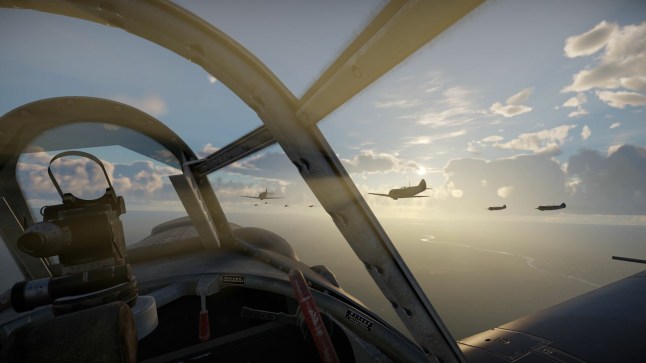


The makers of War Thunder release a new, more focused flight sim that has some of the best VR support on the PlayStation 5.
Depending on where exactly you were stationed, the life expectancy of a Second World War fighter pilot could be anything from a few months to four weeks, if you were unfortunate enough to be involved in the Battle of Britain. At some points in the First World War pilots survived an average of 11 days, which must have had them regarding even trench fighting infantry with a degree of envy.
For pampered 21st century gamers, that level of risk is practically unknown, which is part of the allure of simulating those conditions to gain at least a second-hand inkling of what those brave airmen were up against. Aces Of Thunder has been promising to do exactly that, and although it’s been billed as ‘coming soon’ for some time, leading frustrated players on Facebook to review bomb it long before a release date had been announced, it’s now finally available for all to experience.
Those who’ve played Gaijin’s free-to-play War Thunder will know something of what to expect. While Aces Of Thunder contains only a fraction of its long running sibling’s planes and multiplayer modes, it has a significant amount of single-player component. And while it’s fully playable on a flat screen, it also works with PlayStation VR2, whereas War Thunder only supports VR on PC.
If you’ve grown up on more modern simulators like Ace Combat, this could come as a shock. Instead of being an all-conquering hero whose presence on the battlefield is both pivotal and frequently tide turning, here you’re just another pilot. Your help chipping away at the enemy, and helping the war effort, is valued but no more so than that of fellow pilots – and initially considerably less.
That’s because just flying the planes in Aces Of Thunder is a challenge. Although most are fighters rather than bombers, and therefore reasonably nimble in the air, they’re also between 80 and 110-years-old and come with none of the fly-by-wire assistance you might be used to. Bank too steeply or fail to keep your throttle high enough as you climb, and you can easily stall or enter an unrecoverable tailspin.
Expert, exclusive gaming analysis
Sign up to the GameCentral newsletter for a unique take on the week in gaming, alongside the latest reviews and more. Delivered to your inbox every Saturday morning.
You’ll also have to live without a HUD. In VR it can even be tricky knowing when your aircraft’s taken damage. You’ll regularly hear bullets zipping past or pinging through its metallic skin, and occasionally catch one in the head, your pilot suddenly just dying. But there are other times when your stick feels even more sluggish than usual and when you bail out of your plane in a parachute, you discover the tail’s missing, or a large chunk of one wing.
The other factor of HUD-less air combat is differentiating friend from foe. Planes’ liveries are indiscernible until you’re right on top of them, and while there is a blue rectangular friendly indicator when you get close enough, you need to develop a sense of what friendly and enemy planes look like so that you can concentrate on only shooting down those who aren’t trying to help you.
It’s amazing air wars were even feasible with this little technology. Enemy ground forces are practically invisible amongst the bombed out ruins of a city, as you blast over them at 400kph, and you only realise how absolutely vast the sky is when you’re flying for minutes at a time towards a squadron of black dots who may or may not be a wing of enemy bombers you’re tasked with destroying.
With practise, and reminders to yourself not to make any reckless manoeuvres, things do eventually start to click, once you accept that you’re not some sort of air-Rambo. As you’re getting used to a plane, sometimes the best you can hope for is doing a bit of damage and not dying too often. Getting into position behind a bomber and blowing chunks off it with your machine guns or successfully strafing a column of enemy tanks and seeing at least one erupt into flames, is reason enough to celebrate when you’re learning the ropes.

It helps that Aces Of Thunder is really well implemented in VR, the detail of planes, cockpits, and the land below helping to draw you in. All dials work as they would in a real plane, showing altitude, speed, climb rate, and an artificial horizon, although only the stick, throttle, and flaps are actually interactive, the other levers and switches are purely cosmetic.
While using the virtual joystick might seem like the best way to fly, having to hold your hand out in front of you for entire missions is just too tiring, as is trying to make subtle changes to your plane’s attitude for aiming. It’s a better bet using the Sense Controllers’ analogue sticks, and better yet to use a Thrustmaster T-Flight HOTAS – the only throttle and joystick combination currently compatible with the PlayStation 5.
That proves to be easily the most refined way to fly, although it’s sadly not capable of navigating menus. For that you’ll need to keep both Sense controllers connected, which means throughout each flight you’ll have a pair of discarded leather gauntlet-clad disembodied hands somewhere in or near the cockpit. It looks a bit weird, and you’ll need to blunder about trying to grab them at the end of each mission, but it’s not catastrophic.
Worse is the absence of any training. There is a three page in-game virtual instruction manual, but it doesn’t explain something as simple as retracting your landing gear, let alone how and when to use flaps, or the mechanics of dropping bombs. You will eventually muddle your way through, but it’s a strange omission.
Hardcore sim heads may also be upset to find auto-trim switched on by default. That means you won’t need to continually pull back slightly on the stick to maintain level flight, which may be authentic but isn’t all that much fun. If you’re a no-nonsense stickler for exactitude, or just a glutton for punishment, you can turn off that tiny extra convenience, although it’s not something we rushed to do.
Multiplayer supports up to 16 planes at a time across a range of modes, many based around managing a limited number of respawns. That means if your job is defending a wing of bombers from incoming fighters it can be useful to have some team members hanging back in case of an early rout, making communication essential. VR’s bigger issue in multiplayer is attracting enough players for viable matchmaking, and it remains to be seen how this online community will fair.
There is something alluring about leaning into the privations of early wartime aviation, though. The noise, confusion, and myriad ways things can go wrong still lead to moments of triumph, which are all the sweeter for how hard they are to come by. For aficionados, there’s a decent cross section of Axis and Allied planes and scenarios, and its War Stories missions include the Battle of Britain, the smoking aftermath of Pearl Harbor, the Battle of Medway, the Normandy Landings, and a catalogue of famous engagements across multiple continents.
Those work like fully interactive historical role-plays. Events play out more of less as they did on the day, your input making a modest difference, while giving you the chance to fly over and through events you’d previously only read about or seen in films. You get to fly around them, taking in the landscapes and what’s happening, as well as engaging enemy planes, tanks, and shipping. It’s an immersive and impressive experience in VR, and one that’s often pleasingly stately.
Whether it’s enough to drag you away from War Thunder is a different matter. For PlayStation VR2-owning Biggles fans it’s an easy sell, but PC VR players have many other options.
Aces Of Thunder review summary
In Short: An historically authentic military flight sim that rewards the hard work put into mastering its combat, although there was no need for it to be quite this inaccessible to non-propellerheads.
Pros: Unusually crisp visuals in VR, with detailed planes and cockpits. Satisfying flight characteristics, that punish careless manoeuvres. A good range of different planes.
Cons: Perverse lack of detailed tutorials and questionable value when the far more extensive War Thunder remains free. The best control set-up means buying a separate peripheral.
Score: 7/10
Formats: PlayStation 5 (reviewed) and PC
Price: £24.99
Publisher: Gaijin Distribution
Developer: Gaijin Entertainment
Release Date: 3rd February 2026
Age Rating: 12

Email gamecentral@metro.co.uk, leave a comment below, follow us on Twitter.
To submit Inbox letters and Reader’s Features more easily, without the need to send an email, just use our Submit Stuff page here.
For more stories like this, check our Gaming page.