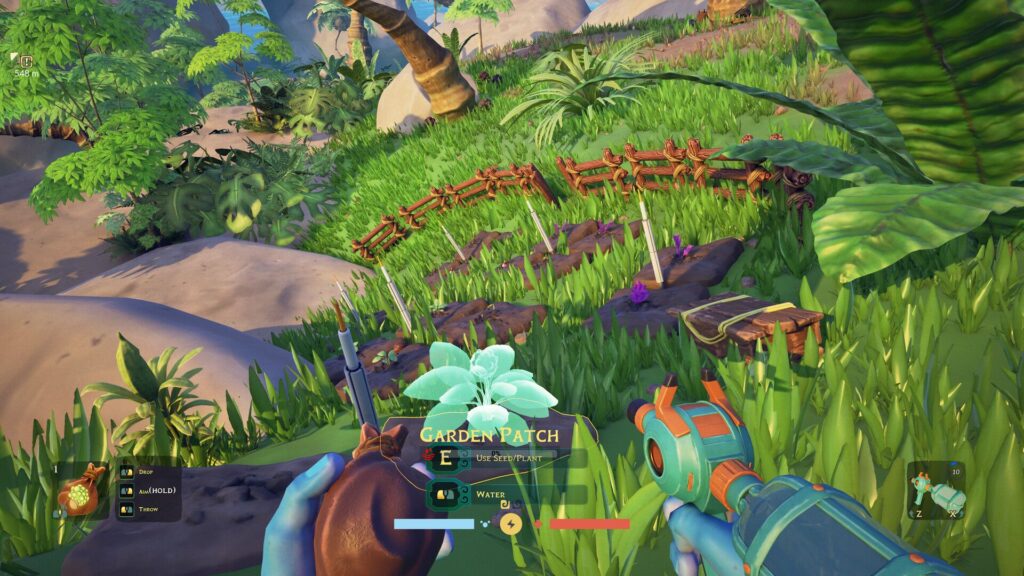

Survival crafting games come in all shapes and sizes these days, from heavily-simulationist approaches to the genre, to more laid back and chill experiences. Space Goblin Studio’s new game, Astrobotanica, sits on the more laid-back side of the survival-crafting spectrum, with a focus on exploration, science and building. When it was first unveiled, it looked promising, since the premise—exploring a prehistoric Earth as an alien—is an underrepresented one. However, now that it’s out in Early Access, Astrobotanica feels like it still needs more time in the oven.
Now, don’t get me wrong. Astrobotanica is an Early Access release, which means it will likely improve over time with new features, content, and quality-of-life upgrades. In its current state, it’s difficult to recommend even if you’re a fan of the genre.
The biggest issue with Astrobotanica is that its control scheme is incredibly unintuitive. While the menus are generally fine, allowing for drag-and-drop for inventory management, switching between consumables mid-exploration is a pain. You can switch between the various plants and tonics you’ve crafted with the mouse scroll, but outside the inventory screen, there’s no clear indication of which tonic you currently have selected. The inventory has its own headaches, since there are no sorting options, leaving you to manually drag and drop each item. Large stacks also can’t be split into smaller ones, and the only way to achieve this is by dropping the entire stack on the ground and picking it back up one by one.
Tools are similarly painful to use, since you can’t hotkey tools like the hammer or pickaxe, and are instead forced to cycle through them with the X and C keys. While the controls can be remapped, how the game handles what you’re holding in your left or right hand feels fundamentally flawed, and changing the buttons would simply put a band-aid solution over poor design choices. The controls feel slightly better on a controller, with the contents of your left hand delegated to the left and right D-pad buttons, while your right hand is handled by the up and down buttons.
“Tools are similarly painful to use, since you can’t hotkey tools like the hammer or pickaxe, and are instead forced to cycle through them with the X and C keys.”
Unfortunately, the tutorial also feels quite haphazardly thrown-together. While it does give you clear directions on what you can do and where you should go, it ends quite abruptly once you’ve built a work bench. It also doesn’t quite tell you how you can fill up your water gun—used for watering plants in your garden—or even how to unlock more crafting recipes. You simply get quick prompts telling you how you can scan plants or creatures, how you can craft tonics, and how you can help a neanderthal get over their illness by crafting antibiotics. After this, you’re pretty much on your own.
The gameplay loop revolves around exploration, gathering materials and herbs, scanning the local flora and fauna, base-building, and interacting with neanderthals. Along the way you have two key resources you need to manage—your CO2 levels, and your health. While health is easy to manage since avoiding damage is straightforward, CO2 steadily drains over time. There are two key ways to deal with this: climb into your crashed space pod to regenerate it quickly, or consume plants or tonics that raise your CO2 levels. The latter works just fine during exploration. The former, however, has the added effect of encouraging players to build their bases close to the crashed pod.
Thankfully, the exploration itself can be quite fun, and there are plenty of surprises to find along the way. The map is sizable, with winding pathways that make it easy to get lost. As you explore, you’re bound to find ruins and intricate buildings to explore. Some tend to offer simple ball-pushing puzzles that reward you by filling out your map, while others will be home to rare plants and animals that you can scan and catalog. Each region also has multiple sub-areas worth poking through.

“Unfortunately, the tutorial also feels quite haphazardly thrown-together.”
Scanning the local wildlife and plants is the primary method of progression in Astrobotanica. Doing so rewards you with science points that you can then spend to progress through the P.R.I.M.A.L. skill tree. The tree offers useful passives, from a compass that makes navigation easier, to increasing your inventory size, and even unlocking brand new recipes. Aside from scanning, you can also get science points by simply exploring the world, and helping out the local neanderthal population. The neanderthal system also needs quite a bit of work, since there isn’t much you can do with them yet aside from opening up trading for simple materials.
The base-building aspects of Astrobotanica don’t quite feel fully fleshed out either. While it’s simple enough to lay down some blueprints and build a base, even a simple wall requires a surprisingly large amount of materials. Speaking of materials, there aren’t many types in the game. You get wood, clay, and stone, each of which can then be processed into one or two different materials. Overall, there isn’t much incentive to engage deeply with base-building right now. All you really need is a crafting bench, maybe a couple of light sources and storage chests, and a garden where you can grow the plants of your choice.
There isn’t any combat here. While the world might pose a few dangers, they’re mostly limited to avoidable hazards, like plants that spew poison if you get too close, or a few particularly aggressive creatures that might keep headbutting you while you run past. So you wouldn’t really need a house to provide shelter from dangerous creatures either, despite what the soundscape might make you think.

“Thankfully, the exploration itself can be quite fun, and there are plenty of surprises to find along the way.”
A day/night cycle is typically used in many survival games to ramp up the threats in the darkness. Here, however, it feels like little more than aesthetic change. Things are harder to see without a flashlight or torch, and there are plenty of spooky sounds coming in from the forests around you, but once again, you’re never really in any danger aside from potentially getting lost. A house doesn’t help in this regard either, since there’s no real way that I could find to skip through the night. Short of wandering around collecting plants, there isn’t much meaningful to do at night—so I often found myself waiting it out until sunrise.
Speaking of local fauna, the game also claims to let you befriend them by finding the right kind of plant or fruit that they might like. However, I couldn’t get this feature to work despite my best efforts, and ultimately resorted to tossing fruit at dodos in the hope that something would finally click.
It’s quite easy to hit your first wall in Astrobotanica, owing to the lack of content. There aren’t too many biomes in the game yet, since I was largely only able to discover a beach and dense forests of different kinds. Upgrades also don’t feel meaningful yet outside of simplistic passive skills from the P.R.I.M.A.L. tree that I mentioned earlier.

“It’s quite easy to hit your first wall in Astrobotanica, owing to the lack of content.”
Visuals are one of the few aspects that Astrobotanica gets right. Its highly stylized take on a prehistoric Earth can be quite beautiful to stare at if you find the right vantage point, and just about every creature and plant you find is visually distinct without feeling out of place. Along with this, performance was also pretty decent, and I was able to play at a steady frame rate of 120 FPS on my PC—a Ryzen 7 7800X3D CPU, 32 GB of DDR5-6000 RAM and a Radeon RX 7800 XT GPU—aside from a few stutters when entering entirely new areas. In this regard, further updates will only bring more improvements.
In its current form, Astrobotanica feels more like a foundation than a fully realized game. There are plenty of interesting ideas here, like exploration and science serving as the main method of progression, and generally non-violent survival crafting gameplay. However, there just isn’t much to do outside of running around, solving some basic puzzles, and observing the ruins and landscapes. Even the neanderthals don’t really add much to the game despite there seemingly being a full-fledged reputation system, and a base-building game where building a base has no real point just sounds like a parody.
However, being an Early Access game, Astrobotanica will no doubt continue to improve over time. Aside from a few fundamental issues like the clunky UI/UX, the biggest problem plaguing the title is a general lack of content, and that’s the kind of issue post-launch support can address. In the meantime, however, if you’re looking for your next survival fix, I’d look elsewhere for now—unless you’re specifically interested in following its Early Access progress.
This game was reviewed on PC.