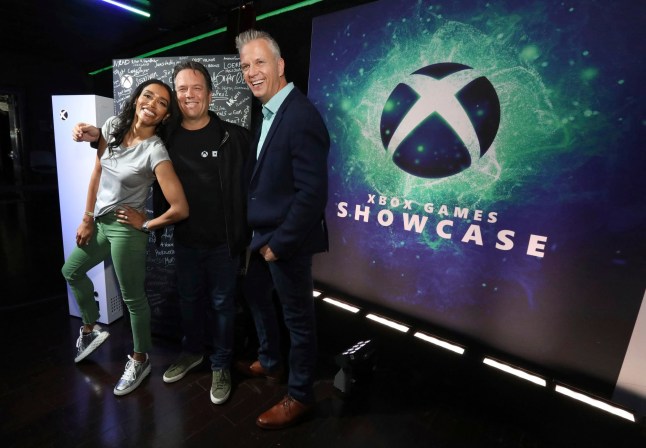


Phil Spencer has retired from Microsoft and Sarah Bond has resigned, as Xbox starts its biggest shake-up in 25 years – but the future seems more uncertain than ever.
The Xbox brand will be 25 years old this Christmas and for the entirety of that time Phil Spencer has been a major figure at Microsoft’s gaming division, influencing policy and then shaping it directly when he was put in charge in 2014, following the disastrous reveal of the Xbox One.
He’s credited with inventing the idea of Game Pass and for pushing for the acquisition of a swathe of developers and publishers, culminating in Bethesda and Activision Blizzard. We’ve interviewed him several times and consider his claims of being a passionate gamer to be genuine. But as has become obvious in recent years, his various plans and machinations have not worked out.
Xbox hardware sales have flatlined and while first party output has improved recently, in terms of both quantity and quality, the only major commerical success has been Forza Horizon 5 on PlayStation 5. Clearly change was needed but exactly what kind of change remains to be seen.
Who is in charge of Xbox now?
The news broke on Friday evening, but it’s now confirmed that Spencer will be replaced by Asha Sharma, who only joined Microsoft in 2024 but has made a named for herself as president of its CoreAI product.
Expert, exclusive gaming analysis
Sign up to the GameCentral newsletter for a unique take on the week in gaming, alongside the latest reviews and more. Delivered to your inbox every Saturday morning.
She has no experience with video games, but on the Microsoft website she insisted that, ‘We will not chase short-term efficiency or flood our ecosystem with soulless AI slop. Games are and always will be art, crafted by humans, and created with the most innovative technology provided by us.’
‘We have done this before, and I am here to help us do it again. I want to return to the renegade spirit that built Xbox in the first place. It will require us to relentlessly question everything, revisit processes, protect what works, and be brave enough to change what does not.’

The question of how much hands-on experiences those in charge of video game firms need is an open issue, as there’s little consistency within any company. Former Nintendo president Satoru Iwata, for example, started out as a programmer, but the next two incumbents were both finance executives.
Former PlayStation boss Jim Ryan had, like Spencer, worked at Sony since the brand’s inception, before leaving under a cloud, while the current boss worked at a consulting firm, before co-founding developer Guerrilla Games – but not as a developer.
Although there have been whispers that Spencer may retire in the next few years it was assumed that Xbox president Sarah Bond was being groomed to take over his role when he left. It seems likely she was assuming that too, as she announced on the same day that she is resigning from the company. Not only that but no one has been announced as replacing her, implying her role may be phased out.

Matt Booty, the other prominent exec for modern day Xbox, isn’t leaving but is instead being promoted to chief content officer. Previously, Booty has been criticised for problems with Microsoft’s first party output, that has led to many delays and the closure of several studios, as well as projects such as the Perfect Dark reboot.
Spencer is 58, so it’s unclear whether he’ll take another role in the industry, but he will make himself available to Microsoft, in an advisory role, until the end of the summer.
‘I’ve made the decision to retire and begin the next chapter of my life. It’s a milestone that’s given me a chance to reflect on the incredible journey I’ve been fortunate enough to share with so many of you,’ he wrote on X.
How will Microsoft turn things around for Xbox?
What happens from here on is a mystery – probably for the execs themselves as much as anyone else – but Sharma has stated that she’s sticking to ‘three commitments’, starting with the promise of ‘great games’. According to her, ‘We will take risks. We will enter new categories and markets where we can add real value, grounded in what players care about most.’
Second on her list is the ‘return of Xbox’, which she says will, ‘Celebrate our roots with a renewed commitment to Xbox starting with console which has shaped who we are.’
That seems to be intended as assurance that she will not abandon console hardware, but she immediately followed that up by saying: ‘Gaming now lives across devices, not within the limits of any single piece of hardware. As we expand across PC, mobile, and cloud, Xbox should feel seamless, instant, and worthy of the communities we serve.’

The third, and vaguest, of the commitments is the ‘future of play’, which will apparently involve Microsoft inventing ‘new business models and new ways to play by leaning into what we already have: iconic teams, characters, and worlds that people love. But we will not treat those worlds as static IP to milk and monetise. We will build a shared platform and tools that empower developers and players to create and share their own stories.’
All of that is fine in theory but what it all means is very much open to interpretation, which is no doubt exactly as intended.
It certainly seems fitting that Microsoft made the announcements late on Friday, at a time that was only convenient for America. One of the key problems with the brand – and one that it has been loath to admit over the years – is its lack of appeal outside the US.
The Xbox has never been popular in continental Europe or Japan, and it’s rarely ever tried to appeal to those markets directly. In recent years local offices have complained at decreasing marketing budgets, as the failure of the Xbox Series X/S became obvious.
One of the many questions now, is whether Microsoft is prepared to increase its investment in gaming, to the point where it can compete as a console manufacturer and not just a third party publisher.
Microsoft is an incredibly wealthy company but the only time that’s ever really been obvious, when it comes to Xbox, is in the purchase of Activision Blizzard and other companies. The former was such a huge outlay – amounting to $75.4 billion by the end – that it was directly responsible for policy changes such as going multiformat, and put an uncomfortable spotlight on gaming in terms of senior Microsoft execs.
While the exit of Spencer does seem overdue it’d be wrong to say that things can only get better with new people in charge. Things can always get worse and given how much of the industry Microsoft currently controls, everyone should hope that the new boss can turn things around and that the Xbox brand can flourish again. Not least so it can once again provide meaningful competition to PlayStation.

Email gamecentral@metro.co.uk, leave a comment below, follow us on Twitter.
To submit Inbox letters and Reader’s Features more easily, without the need to send an email, just use our Submit Stuff page here.
For more stories like this, check our Gaming page.