

Reviewed on:
PC
Platform:
PC
Publisher:
Edmund McMillen, Tyler Glaiel
Developer:
Edmund McMillen, Tyler Glaiel
Release:
2014
Mewgenics is difficult to assess; it executes some ideas incredibly well, while others are clumsy and grating. I adore its combat, which makes for excellent roguelike gameplay and has been well worth my extensive playtime. Simultaneously, the game’s humor and breeding mechanics have really brought my opinion down over time, as both elements have gotten old as my playthrough went on. Even so, the combat and breeding are two distinct parts of the game, and the former takes up so much playtime that it’s easy for me to push the latter to the side. Mewgenics makes me uncomfortable often enough that I can’t ignore it, but man, that combat is incredible.
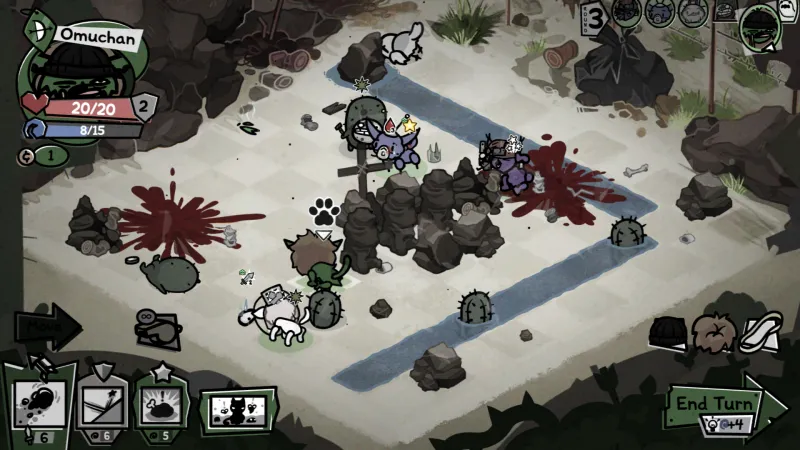
An early combat encounter in the desert biome
To complete a playthrough of Mewgenics is a gargantuan task, taking anywhere from 150 to 200 hours of gameplay. Therefore, in order for Mewgenics to do something successfully, it has to remain enjoyable or entertaining for that entire time. Its features need to have a long shelf life to remain fresh for hundreds of hours. In an inspiring feat of game design, its combat achieves this.
The battles in question have players control four cats of various classes in turn-based encounters across roguelike runs. Each cat starts with random new abilities, and it’s always fun to experiment with new builds and team compositions. There are so many items, moves, passive abilities, and field events that it’s impossible to predict how a run will go, and no matter how it varies, it’s almost always fun.
Even dozens of hours in, I was consistently surprised by new interactions between Mewgenics’ varied systems, whether it was in excitement when I had a potentially game-breakingly powerful Fighter cat, or in horror as I realized a negative trait on one cat meant it accidentally permanently killed another of my party members. I facepalmed when I tried to grow grass in a blizzard, only to create a tile of icy spikes. I felt genuine relief when it began to rain in the desert, and I could fill my water bottles. As good or bad as it goes, there’s always another run, and that next run is going to feel remarkably different. Even with my criticisms of the game, the thrilling and engaging combat makes up the vast majority of your playtime, for which I’m thankful.
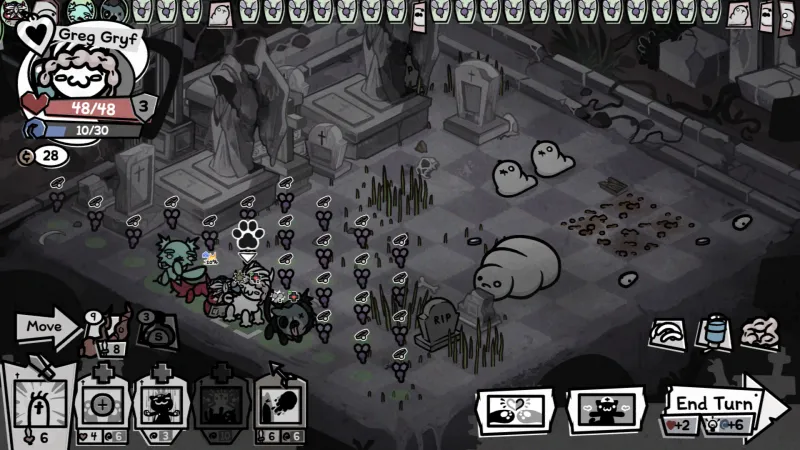
A fight in which I somehow spawned in with 22 flies as allies
The soundtrack is also stellar, with area-specific tracks that shift dynamically based on the situation. Each song also gets lyrics when you fight the area boss, which almost always improves it. I particularly enjoyed the frenetic jazz in The Crater, and shamelessly admit I journeyed there more times than necessary just to hear the music.
On the other hand, Mewgenics’ worst feature is its humor. NPCs are stale stereotypes with voice lines that had me rolling my eyes, and the game’s insistence on fecal humor is particularly exhausting. I was tired of poop jokes 10 hours in, but there were still countless more hours to go. I enjoy the game’s creativity and willingness to send players to bizarre locations (like the moon or the Ice Age), I like some of the meows (one has autotune), and I generally liked the pop culture references. But as the game went on for dozens of hours, the things I did enjoy faded into the background, while the things I didn’t enjoy continued to stand out as annoying and gross. One recurring fight begins with a man eating a child, and even though it’s quick and cartoony, it only gets more unpleasant over time.
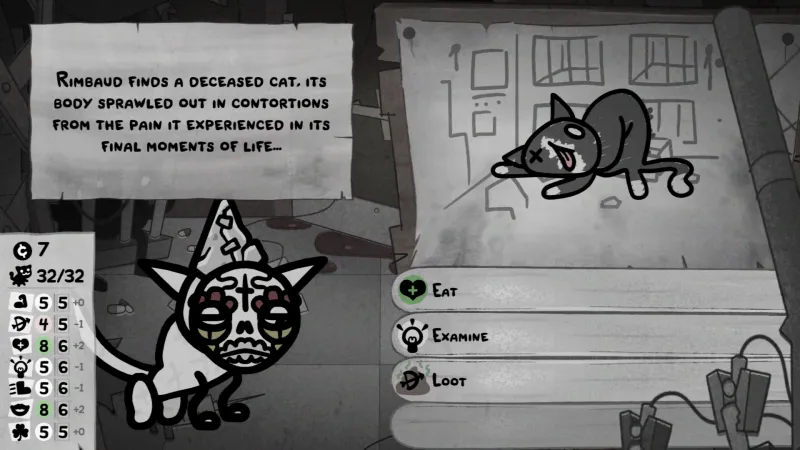
An unpleasant encounter, where my option most likely to succeed is to eat a dead cat
There’s also the subject of the game’s name. Between runs, you breed various cats to combine their stats and create genetically superior warriors for the next run. The house the cats gather in is inconveniently designed because all the cats cluster on the floor and run back and forth, making them difficult to click on. I would have appreciated a menu to organize them by stats or age, but instead I have to chase them around with, ironically, my mouse to find the ones I’m interested in. You can decorate the house with furniture, but it’s not a very interesting process – it’s best to just buy stuff with the best stats and cram it in each room to improve breeding results. Overall, it’s a clunky system that I tried not to spend too much time with.
Long-term progression happens by completing runs or donating cats to the game’s various NPCs. In either case, you rarely keep any cat in your house for very long. Cats die on runs or come home and die of old age. If they live, it’s best to donate them to an NPC to unlock more item storage, improve the shop’s offerings, or get some other long-term upgrade.
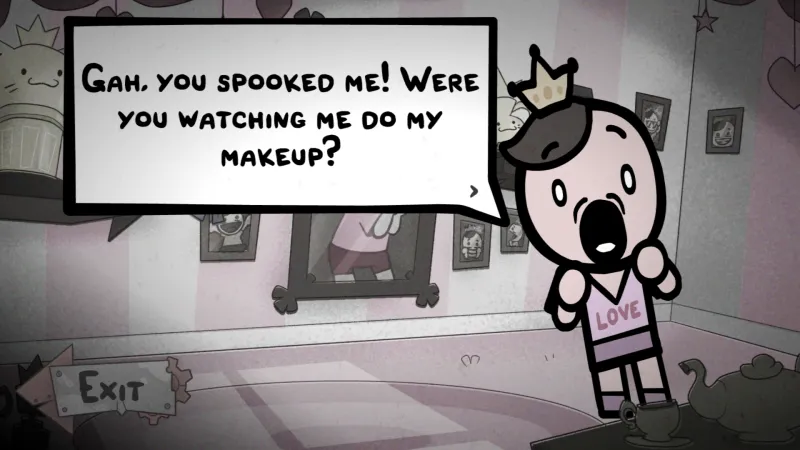
Tink, one of the game’s NPCs
Your pets are disposable, both because you can easily make more and because you’re incentivized to get rid of them. Since you churn through cats so quickly, you start putting much higher value on combat viability and vilifying defects and negative quirks, of which the game has many. “Mewgenics” is obviously a pun on the word “eugenics,” but I was still taken aback by how ruthless the system feels.
In a world defined by combat viability, you’re not just breeding to get good stats; you’re eliminating cats with disorders and bad stats. I have a room in my house exclusively filled with “star” cats, with each pet marked with a star to indicate they have the best stats. Meanwhile, circle cats have one or more negative stats, so they’re pushed into a different room. Other cats are donated or left unmarked in another separate room. Mechanically, it makes perfect sense, but I’d be lying if I said my segregated house didn’t make me uneasy.
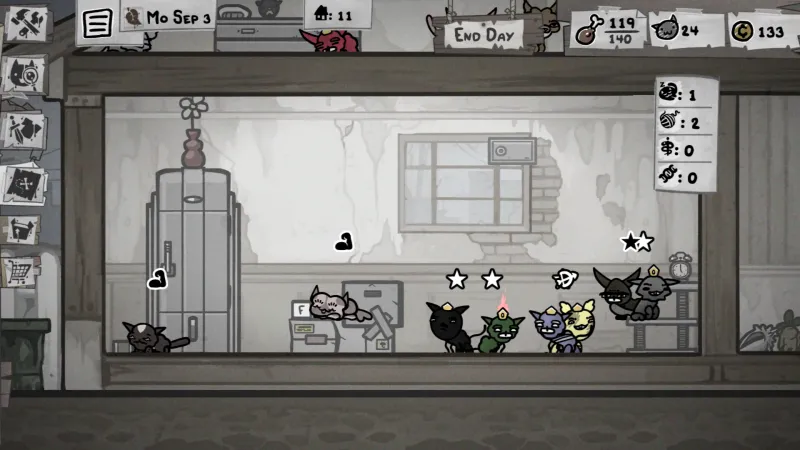
The “star” room in my in-game house
Like the excessive poop and cartoon gore, I think these breeding patterns are intended to be funny or shocking. It’s another joke; the setup is “what if you had a game where you raise cartoon cats,” and the punchline is “and then you segregate them based on genetic strength and breed them for combat.” On paper, it’s a shockingly dark reversal of what you expect from a game where you raise pets. I actually do think this is funny in isolation. It’s absurd! It catches you off guard. But like most jokes, it doesn’t stay funny for hours and hours and hours. After a while, it just becomes the status quo. After a while, you’re just earnestly doing cat eugenics, and that gets old and uncomfortable.
Because the breeding happens in between the game’s fantastic runs, it’s hard for me to come to a firm consensus on how I feel about Mewgenics. Its combat mechanics truly stand out, and in isolation, might make it one of my favorite games of the year. But even though those hours and hours of combat comprise almost all of my playtime, the odd, upsetting creative decisions stick with me. Despite Mewgenics’ best attempts to kill my appetite, dozens and dozens of hours in, I’m still hungry for another run.