
You probably know Milestone best for their long lineup of motorcycle racing games, from MotoGP through Ride and on to Motocross, but that’s not where the studio started. No, the studio’s big break came in 1995 with the arcade-style racing game Screamer, which went toe-to-toe with Ridge Racer as a PC alternative. Over a trio of games in the 90s, the series drifted towards more rally racing, before petering out at another studio, but now in 2026? Screamer’s back, and it’s a refreshing new take on the arcade street racer.
The immediate and most obvious shift from the 90s is that the graphics are so very different. Obviously, they are massively higher fidelity, there’s none of the early 3D polygon wibble, and the gameplay is built around more nuanced physics and handling models… but the art direction has shifted towards anime cutscenes, and there’s a drama-filled story to sink into alongside.
Michele Caletti Creative and Development Director discussed the game’s blend of visual styles: “We took inspiration from things like Akira, from Ghost in the Shell, from Bubblegum Crisis, from Cyber City Oedo, from Cowboy Bebop, and many more, but one of the things that we had to take a very strong decision was not to make the game cel shaded.
It would have been the easy choice – It’s an anime, so you make the game cel shaded – but if you do so, you have to oversimplify some details, you cannot go into fine details with cel shading. So the art direction was bold enough to try to blend the anime and the realistic or quite realistic rendition of the world. And then take some other moves like that there’s not onlythe city setting, there are many other settings that try to portray a different but familiar world.”

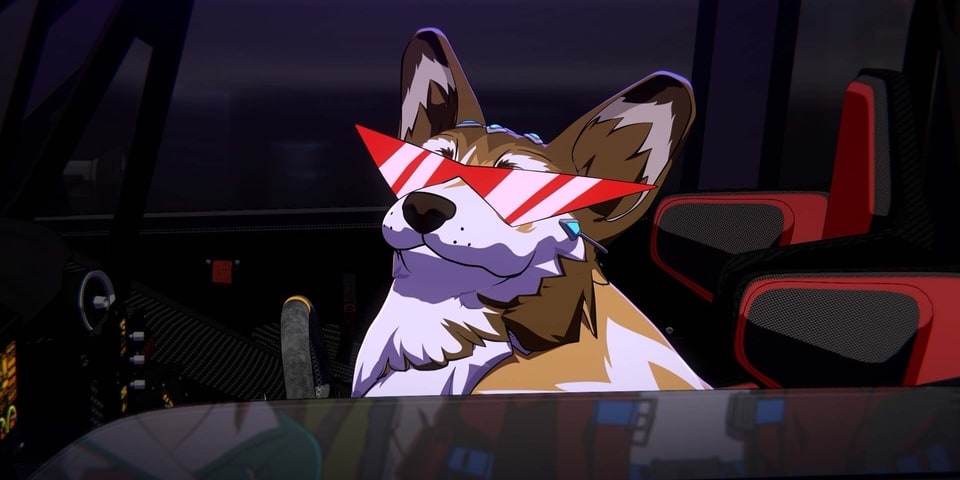
You know it’s anime sci-fi when you have a dog that can drive a car.
The Tournament is a long-running illegal street racing competition, but this latest edition is for a huge $1 billion prize, drawing in teams from all kinds of backgrounds. For the Banshee PMC, Hiroshi, Roisin and Frederick are looking for revenge on Anaconda Corp and their distinctly fascist-coded leader, Gabriel. The best way to get close is to enter the same tournament, with the possibility that Gabriel’s demise could be made to look like an accident… But it’s also a story that won’t take itself too seriously. I mean, there’s a dog that can drive a car, and whose owner has fitted it with the same universal translator that everyone else uses to communicate using their native tongues – “This is another choice that we made early,” Michele said, “because we wanted to have cultural melting pot of different characters, of different ethnicities and this was important to convey the fact that in this near future the culture is something like what we have today, but even more diverse, even more varied.”
They won’t be the only team that you race as, though, with five teams competing and the story hopping back and forth, putting you in control of various racers, cars and their specific abilities. Even in the opening few story chapters, there’s races where you just need to finish, where you’re driving as a team, where you’re regularly jumping via cutscenes between different cars.
“We wanted to go away from the pure racing focus and jargon and dialogue and always thinking, always about [winning].” Michele explained. “So you see the characters are not even dressed like drivers, because they are something else, then they are drivers. So their goal is to win, yes, but everyone has also another goal. So you will see that during the story, they’re focus shifts towards their inner goal. Then you’ll be playing in the role of all the characters of the game. So everyone has the goal to be first, yes, but from different perspectives.”
What’s particularly striking about the racing is how it reimagines the controls. The right and left trigger make you go and stop, of course, and the left stick is for turning, but drifting is on the right stick, you have a timing minigame for upshifts to give you boost charges, and those feed into a bull-rushing attack to destroy other competitor cars.

It’s quite a lot to get a handle on, and the way you can counter-steer while drifting felt a bit like rubbing my head and patting my tummy at the same time, so it makes sense that the story mode adds these concepts one at a time. When you wrap that around the mix of lavishly produced anime cutscenes and the character portrait dialogue scenes, though, that does lead to a pretty slow feeling rollout over the course of the opening hour or two. I was really waiting for it to give me all of the gadgets and toys to play with.
Michele admitted “The story takes you that slowly, yeah. It takes hours to get to all the mechanics in place, and the point is, you’re never thrown multiple things together to you.”
He continued, “We thought and we discussed a lot about how to lay out the default controls, how to favour the most intricate actions, because you might want to do strange stuff and we want to allow you to do so. I think we’ve reached the balance where it’s not overwhelming. Give yourself some time to get into the mechanics and it’s not about much about the fingers, but the strategy in order to understand and being in control of when to do things, not to overuse the systems.”

The macguffin that makes all of this possible is the ECHO, a device fitted to each and every car like a super sci-fi MGU-K from Formula 1. Fitted by Gage on behalf of the tournament’s enigmatic host Mr. A, it gradually accumulates Sync, both passively over time and when tapping the Active Shift to shift up a gear in time with the rev limiter – don’t worry, it’s still an arcade game and you won’t be asked to downshift at all. This builds up to grant you boost charges, which you can then deploy, and even strengthen by holding and releasing with another mini timing challenge.
As you Boost, this takes that energy and transfers it over to the second meter of the ECHO device, building up Entropy. This gives you charges to use defensively, to create a temporary shield for a few moments, or to unleash as a Strike, boosting forward again and destroying any car that you hit from behind. Save up the Entropy to fill out the meter, and you can enter into Overdrive, putting you in a much longer-lasting Strike boost that can blast multiple rivals into smithereens, and eventually leaves you vulnerable to destruction just from hitting a wall. You can technically outlast the Overdrive, but I would explode my car every time…
That’s where the ECHO’s final trick comes in, as destruction just respawns your car and body, and gets you racing again. There’s no moral quandary over whether or not this new car and person is the same as the one that died – Milestone seem to be leaving that philosophical debate to the Ship of Theseus and the Star Trek teleporter – and instead it’s just a canny way of keeping the action rampaging along.
“We didn’t want to have this pattern of side-striking the cars,” Michele said. “We tried different things like because the hot part is that it’s easy to strike on a straight, it’s harder to strike into a corner, so the more the intricate the trucks, the more it’s complicated to strike. But we experimented with many things like a semi-automatic strike that drives you toward your opponent, but it didn’t work. We tried something like a seeking missile, but it didn’t work. So we ended up with this where you’re still in control, so you if you hit, you feel like you’ve done it. If you miss, you understand what you have done wrong.”

It all blends into a rather unique take on the arcade racer. Combat is direct and to the point, with just the Strike as your only option for attack – no side-swiping and no missiles or energy abilities like in Wipeout or Blur – and there’s a technical depth to master with the drifting and boost timing, not to mention juggling energy.
In one race, I was able to break away in the lead, conserving my boosts in a way that meant I couldn’t be caught, but it felt much more likely to be caught in the middle of the pack and really have to scrap and fight. That ties in very well with the team race mode, with duos or trios battling for victory. This isn’t about the first across the line, and it’s not even just the combined finishing positions that determine the winning team, as every KO also awards points, so that the highest-placed racer might have finished eighth and outscore the winner that didn’t have a single KO to their name.
After adapting to its style of racing, Screamer really started to speak to me. I’m definitely curious to see how the game will blend together its anime narrative and single-player racing scenarios, but that combination of racing and combat? Well, it makes perfect sense for anyone who watched the F1 movie.