

Given the sheer range of activities that Nintendo’s moustachioed icon undertakes, it’s a surprise he bothered to complete his plumbing training at all. If he’s not battling Bowser’s army of Goombas or driving carelessly in his Kart, he’s competing in a dizzying amount of sporting endeavours. One of the most enduring of these sports is tennis, with Mario and his friends (and foes) making a racket since the earliest days of Nintendo consoles. Previous entries in the series have met with a mixed reception, from highlights such as the Gameboy Advance and N64 versions being offset by the disappointing Wii U one. With the most recent iteration being 8 years old, it’s certainly high time for a new ball smashing experience.
Making Mario Tennis Fever a Switch 2 exclusive is true to form for Nintendo, but it does feel a little odd in this cross-gen era of gaming, and especially when there’s still such a vast install base for the original console. This game has clearly been built from the ground up to take advantage of the more powerful machine, and the graphics and performance are the best examples of how polished this title is, but does it have much to offer over 2018’s Mario Tennis Aces? Well, the answer is not so clear cut, as the core gameplay remains relatively similar even if there are some new bells and whistles to dress up the basic action.
Upon first launch, Fever greets players with a suitably bright and colourful aesthetic, and one that really pops whether you’re playing handheld or on a TV. The presentation is exemplary, with the customarily intuitive menu and user interface, all aided by a clear mark of how many players each mode can cater for. Obviously, the real longevity of a sports game lies in the multiplayer but there is a decent amount of single player content here to help train you up and help you hone your skills.

The first main single player mode is Adventure – a familiar experience in Mario Tennis history. While not as fully featured as the GBA version (which is arguably the greatest game in the whole series) this story focused mode is a good way to really cement your knowledge and racket use before venturing into multiplayer. Following some unusually cheap feeling static image narration, the mode really begins with a glorious animated cutscene detailing the mysterious events that have seen Mario, Luigi, Peach, and even the tricksters Wario and Waluigi, transformed into baby versions of themselves. The following adventure sees Mario and his friends setting out to remedy this situation and to do so they must take on a series of tennis challenges from matches to puzzles.
Adventure mode starts off by putting you through the Tennis Academy before setting you off on the main adventure – you are now a baby, after all. Learning the basics of tennis involves a bunch of minigames, practice sessions and challenge matches, but this prologue to the main adventure gets old quite fast. What follows is much more enjoyable, wrapping up situations needing to douse a flaming airship with water balls to put the flames out. Whoever let Baby Wario and Baby Waluigi play with matches, should know better!

The other main single player mode on offer is the Trial Towers. These involve tackling ten different challenges that include all the various gimmicks and special powers in the game, from challenge courts to unique racket types and more. The first two towers are pretty simple, but I’ve not yet got past floor 6 of the third and have failed several times now. This degree of difficulty is actually welcome as the Adventure mode was also pretty much free of challenge. There are also mix-it-up modes that feature unique challenges such as scoring points by hitting balls through rings, or avoiding Piranha Plants on the court, and Super Mario Bros. Wonder-inspired court transformations.
Of course, the real meat of this title comes from the tennis gameplay itself. Both standard and motion controls are available, with the latter being fun, but not feeling as intuitive and responsive as Wii Tennis did back in the day. Other than an occasional fun knockabout with friend and family most of your time will probably be taken up with standard pad controls. These are set up to allow players to compete with the full range of control options from Pro Controllers to a single Joy-Con 2. The main concession to this openness is that lob and dropshots require a combination of button presses to carry off in the default layout, but it is easy to map both of these to trigger buttons on either handheld or controller modes.

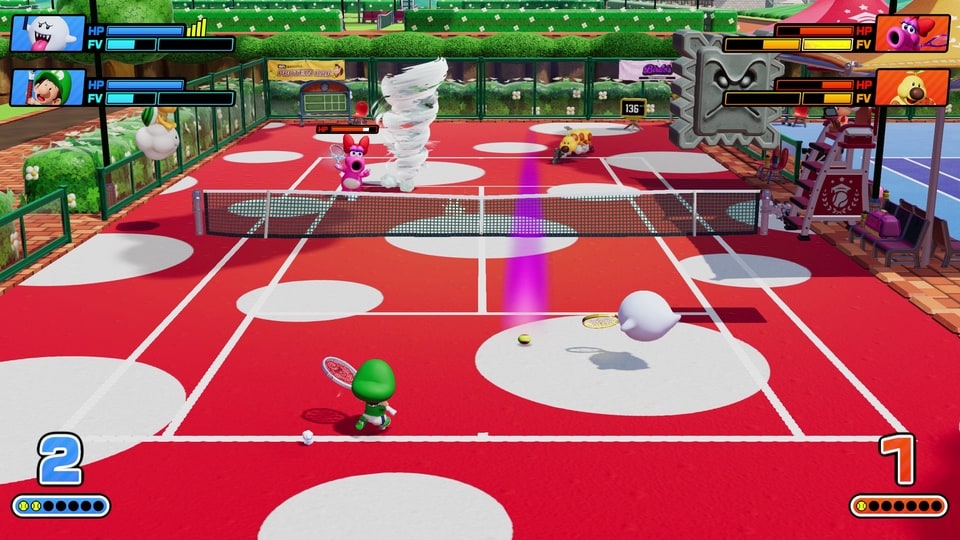
The main new innovations here are an assortment of unlockable racket types and their fever shots which give the game its name. Special abilities are no longer tied to particular characters, giving you more freedom to mix and match with different rackets. These are unlocked through progression or beating specific challenges and range from fire and ice effects to more novel ones like DK’s bunch of bananas racket or even one that summons a Thwomp. These are fun additions and provide an extra layer of randomness and strategy to the games, but can be a little too distracting and overpowered at times. Using these rackets requires you to build up your fever meter through rallies so that you can unleash a fever shot. These shots can be directly aimed and will activate your racket’s special ability for your benefit. However, should your shot be volleyed back the effect will also hit you, so there is some welcome risk and reward here.
Singles and doubles matches are available in local tournament and online modes, with the story seeming to encourage the latter. Having played doubles with my kids I found it enjoyable but a little too chaotic, especially once the titular fever shots were taken into account. Singles felt far more balanced for me but your mileage may vary. Doubles with CPU partners is predictably frustrating as they’ll sometimes completely miss the ball for no real reason and this can lead to lost matches that feel outside of your control.