
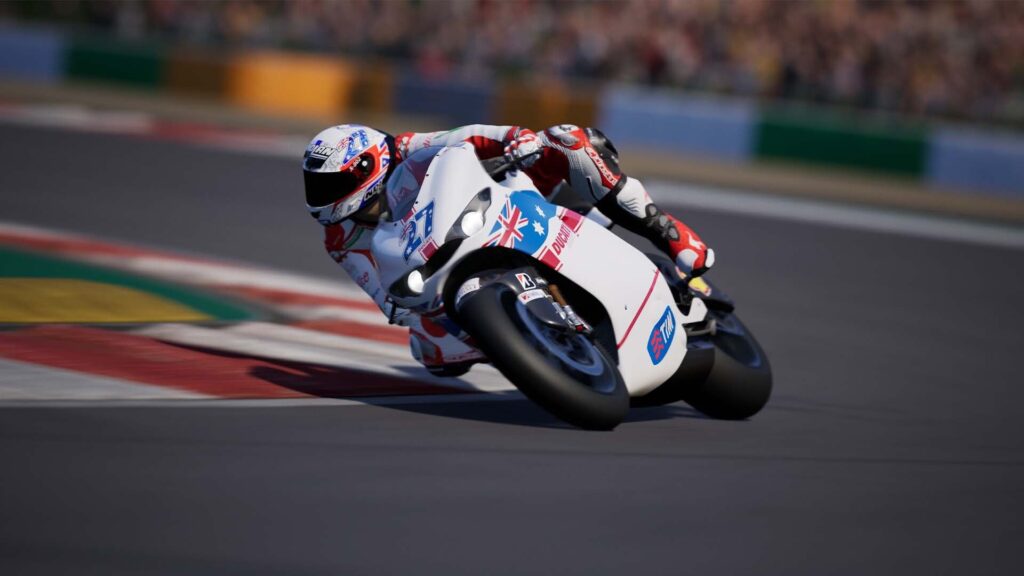

Few forms of racing demand the same precision, patience, and bravery as pushing a motorcycle to its limit, where every millimetre leaned and every flicker of throttle straddles the knife-edge between perfect control and instant catastrophe. RIDE 6 sets out to capture this gilded balance with the most expansive roster, deepest simulation systems, and most accessible onboarding Milestone has yet assembled. It’s a package clearly aimed at welcoming newcomers while still satisfying seasoned riders chasing mechanical authenticity.
After considerable time in the saddle, I can confirm RIDE 6’s ambition holds mostly true. The physics model delivers hard-earned thrills, while engaging progression keeps victories meaningful. And, despite potholes in presentation and a festival framework that never truly delivers, the game’s reverence for two-wheeled machinery is unmatched.
“With Pro style engaged, braking earlier than instinctual, measuring corner momentum, and applying throttle with deliberate restraint are essential skills.”
If you’re new, to convince you of the symbiotic relationship between biker and machine RIDE 6 arrives with two riding styles: the returning Pro and all-new, beginner-focused Arcade, the latter less an opening salvo and more a push with stabilisers. While the split suggests a clear divide between accessibility and full simulation, the distinction feels only subtle in the opening laps.
Yet, where Arcade style smoothens the harsher edges of bike control, it also limits mechanical interaction, removing meaningful setup options and on-board electronics management in favour of immediacy. The result is approachable racing that rarely feels expressive. Together with RIDE 6’s Bridgestone Riding School – a series of on-track tutorials also novel to the series – the transition to Pro feels an eventual formality, given onboarding’s focus.
Purposeful accessibility options – including colour filters, one-handed control schemes, tinnitus sliders, and game speed adjustments, the latter I reduced by 15 points during my own onboarding – further widen the door for newcomers without compromising the act of riding.
With Pro style engaged, braking earlier than instinctual, measuring corner momentum, and applying throttle with deliberate restraint are essential skills. See, bikes don’t rotate like cars; RIDE 6’s physics suggest they hinge on a delicate cliff edge between speed and balance, where slowing too much dramatically sharpens lean angles, yet carrying too much speed risks understeering to your next accident. Learning to exist confidently on this boundary is where RIDE 6’s onboarding process leads you. And when it clicks, each clean lap feels earned.
Likewise, mastering mechanical setup subtly deepens your relationship with your machine. Adjustments to gear ratios, suspension stiffness, and braking stability won’t produce dramatic changes in isolation, but their cumulative effect can decide tightly contested races. Shortening high gears to extend top speed works wonders on Daytona’s long, banked curves, for instance, but it does introduce rear-end instability which must be countered with suspension damping and geometry adjustments. Even then, success depends on your skill as a rider more than pure configuration. It’s a philosophy that recognises both machinery and your ability to extract every ounce of performance.
“Bridgestone’s aforesaid Riding School is the process leading you to competence, with bitesize lessons covering the fundamentals before demystifying the more technical aspects like electronic rider aids, wet weather management, chicane handling, and beyond.”
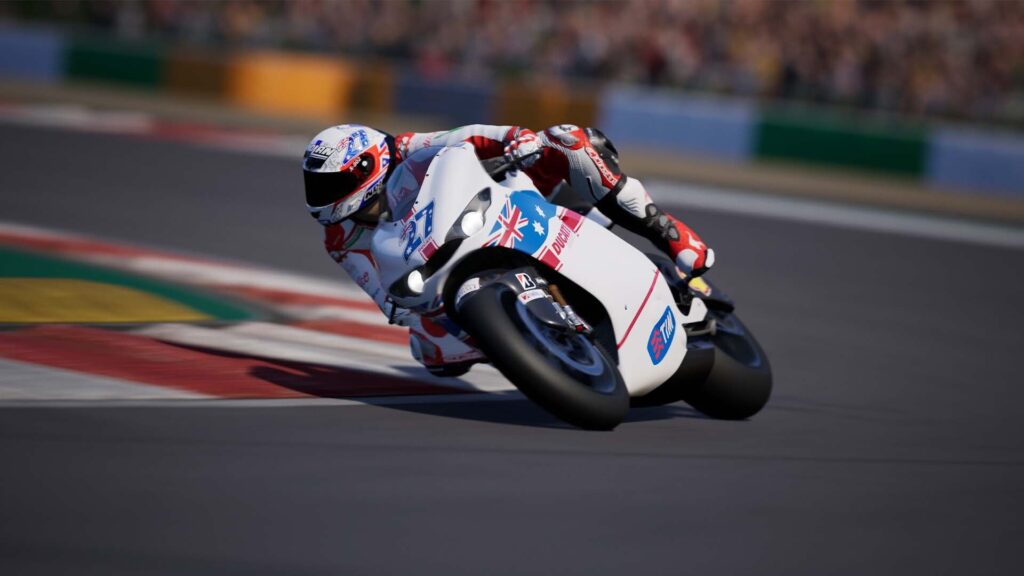
With Pro as your de facto riding style, authenticity comes with a steeper difficulty curve, but the trade-off is an experience that consistently rewards patience and mechanical understanding. When everything aligns – brake marks hit perfectly, apexes kissed, throttle feathered with control, your bike weaving smoothly through a fast sequence of corners – it’s like threading a needle at two-hundred kilometres an hour. It’s a sense of flow few racing games can match, and where RIDE 6’s bike physics are best realised.
Bridgestone’s aforesaid Riding School is the process leading you to competence, with bitesize lessons covering the fundamentals before demystifying the more technical aspects like electronic rider aids, wet weather management, chicane handling, and beyond. Just as importantly, these drills highlight the strength of the simulation’s tactile feedback, where controller vibration and trigger resistance via the PS5’s DualSense communicates grip, pressure, and surface response with remarkable clarity, elevating riding beyond raw mechanics.
However, the school’s staccato rhythm isn’t flawless. Certain exercises feel overly prescriptive, forcing rigid racing lines even when missing bollards still yields gold-tier times. Furthermore, the Riding School’s rigidity almost undermines motorcycling’s inherent freedom, where bike racing often presents multiple racing lines and opportunities for switch-backs. It’s a minor niggle, but constantly reloading lessons that you’d otherwise fly through in race conditions lead me to abandoning the school once I’d grasped the basics, opting instead to hone my development in wheel-to-wheel skirmishes.
And tapping into biking’s freedom, and communal culture perhaps, RIDE 6 now builds its career progression around a festival. It’s a framework familiar to anyone who’s played Forza Horizon, albeit, sadly, without the freeroaming fantasy. RIDE Fest guides you through a vast selection of events centred on different motorbike categories and riding disciplines. New contests arrive quickly, with the Fame Points needed to unlock more events accumulating at a satisfying pace. With a steady stream of races, superpole laps, one-on-one duals, endurance tests, and off-road challenges, there’s always a sense of momentum and growth, bolstered further by an ever-growing garage of spectacularly rendered, and reasonably priced, vehicles – given as prizes, or bought new, used, even rented by spending earned credits.
RIDE Fest’s most distinguishing feature, however, is its lineup of ten elite riders whom you’ll challenge in their own personalised events. For bike enthusiasts, there are genuine legends in two-time MotoGP champion Casey Stoner or Isle of Man TT lap record holder Peter Hickman, but even if you’re unfamiliar the game communicates the gravitas each icon holds in their respective formula via introductory cutscenes. With certain contests reframed as boss-style encounters, you’ll feel like you’re in genuine competition for your own place in motorcycling history. Milestone’s intent is to plant your role as the player into RIDE 6’s identity as firmly as the machines you’re racing, but it also reflects the studio’s affection for two-wheel culture clearly.
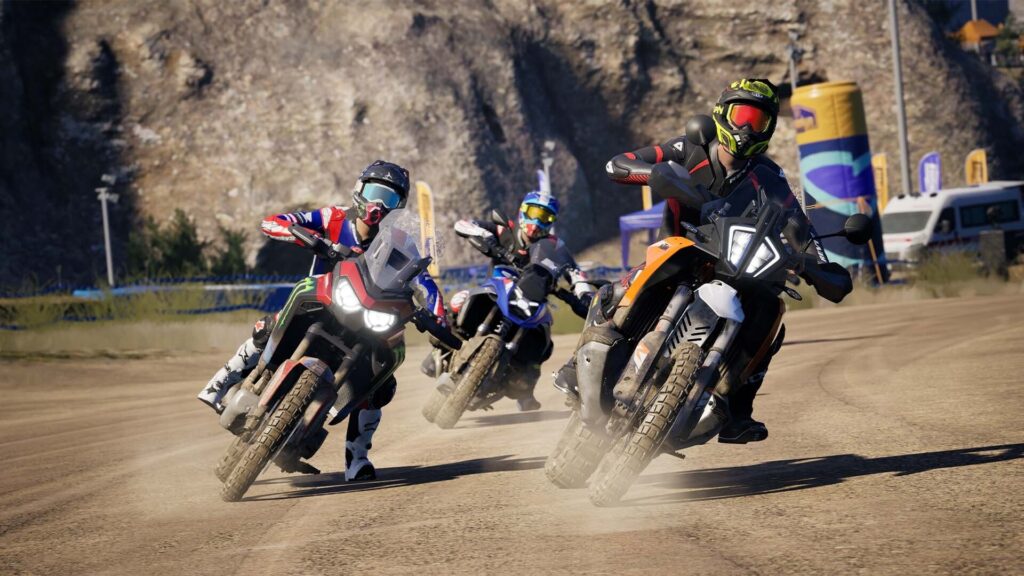
“The all-new off-road racing lacks convincing physical feedback, with minimal dirt spray and surface interaction. Ambient audio – particularly crowd noise – sounds poorly mixed and implemented, with audible cheers at sections where no spectators are present and jarring silence when its white noise loops back on itself.”
The only place the festival concept weakens is in atmosphere. Despite visual flair, hot air balloons, the presentation rarely feels authentic. Its “live paddock” menu is more a cosmetic set dressing than a true motorcycling celebration. Still, as a structural package, the festival-themed career signals progression clearly, and puts a spotlight on the excellent new categories like Bagger racing and Maxi Enduro cross-country biking.
Now, whether speeding on tarmac or sliding over dirt, RIDE 6 delivers consistently tense races, even if your opponent’s racing etiquette lacks the mastery of your superbike’s engineering. Adaptive difficulty and adjustable AI aggression provide useful control over the challenge, but on-track awareness can be middling. Rivals will occasionally turn into you or collide from behind, seemingly unaware of your presence. These occasions don’t derail the experience, and they are counteracted somewhat by AI racers making unprovoked mistakes – you know, like a real human – but they chip away immersion which the bike’s physics work hard to establish.
RIDE 6’s visual presentation is spearheaded by Unreal Engine 5, its tech pushing realism with improved lighting and weather effects that add welcome depth across the entire game. Framerate performance on base PS5 is silk-smooth, displaying vibrant 4K at a consistent 60 FPS. Leading the visuals though are the bikes themselves, each modelled in striking detail. If there’s a true motorcycling celebration threading through RIDE 6, it’s this. In what are arguably the most ferociously designed, downright scary contraptions, these machines sure are stunning.
The game’s presentation is less consistent elsewhere. The all-new off-road racing lacks convincing physical feedback, with minimal dirt spray and surface interaction. Ambient audio – particularly crowd noise – sounds poorly mixed and implemented, with audible cheers at sections where no spectators are present and jarring silence when its white noise loops back on itself. Sound levels can be tailored to taste in the settings menu via sliders and presets, yet the lack of audio optimisation settings for headphones is glaring.
“When expertly carving through Suzuka’s famous Esses, or weaving down Laguna Seca’s iconic Corkscrew, RIDE 6 finds rhythm on a razor’s edge quite unlike any other racer. “
Gracefully, engine notes across all biking categories are generally convincing – from throaty, guttural Baggers, to spitting Motards and screeching Superbikes. Even Scooters sound terribly nasal, much like real life. It’s just a shame the broader sound design hasn’t received the same level of polish as the engines, as the result is a visually immersive racer with sensory elements that struggle to keep up.
Yet, for all its uneven presentation and a festival which fails to ignite, RIDE 6 ultimately succeeds where it matters the most: the act of riding itself. The game’s physics and sheer sense of speed capture the freewheeling spectacle that defines motorbike racing. Seriously, take a ride through Ulster GP’s narrow country lanes. It’s as white-knuckle terrifying as the real thing.
Accessibility improvements and structured onboarding make two-wheel mastery more approachable than ever, while there is enough varied, meaningful content here to entertain both casual and enthusiast bikers. RIDE 6 may fall short of fully realising the cultural celebration it gestures towards, but as an expression of motorcycling competition this is the series at its most complete. When expertly carving through Suzuka’s famous Esses, or weaving down Laguna Seca’s iconic Corkscrew, RIDE 6 finds rhythm on a razor’s edge quite unlike any other racer.
This game was reviewed on the PlayStation 5.